
Ntas Breves
Added to library: September 2, 2025
Summary
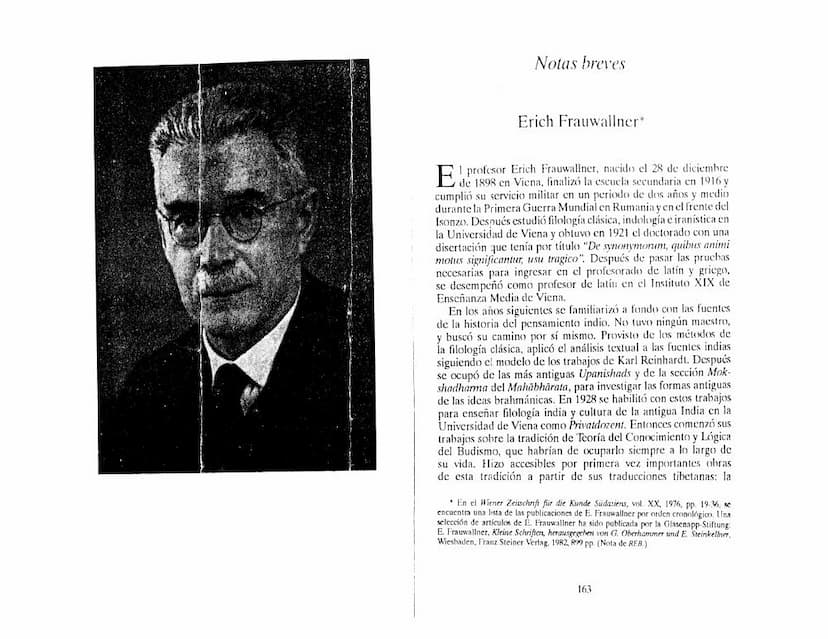
This document, "Notas Breves" by Ernst Steinkellner, is a biographical sketch and tribute to the renowned Indologist and Buddhist scholar, Erich Frauwallner.
The text highlights Frauwallner's academic journey, starting with his secondary education and military service during World War I. He then pursued studies in classical philology, Indology, and Iranistics at the University of Vienna, earning his doctorate in 1921 with a dissertation on the use of words signifying emotions in tragedy. He also qualified to teach Latin and Greek and worked as a Latin teacher.
Frauwallner's significant contribution lies in his deep engagement with the sources of Indian thought. He approached these texts with the rigorous methods of classical philology, particularly influenced by the work of Karl Reinhardt. His early research focused on the oldest Upanishads and the Mokshadharma section of the Mahabharata, aiming to understand early forms of Brahmanical ideas. This led to his habilitation in 1928, allowing him to teach Indian philology and ancient Indian culture at the University of Vienna.
A pivotal area of Frauwallner's lifelong research was the tradition of Buddhist epistemology and logic. He made significant contributions by making important works from this tradition accessible for the first time through his translations from Tibetan.
The text emphasizes Frauwallner's methodology, which was characterized by:
- Deep philological expertise and accurate interpretation of sources: He possessed a profound understanding of the nuances of language and a meticulous approach to textual analysis.
- Critical-historical methods: He applied the well-developed critical-historical methods of classical philology to Indian texts.
- Strict adherence to source-based conclusions: His interpretations were exclusively derived from the primary sources, with a constant, rigorous control of the process from source examination to drawing general conclusions.
- A keen sense for historical plausibility: He developed an excellent intuition for what was historically likely and could clearly and confidently identify the evolution of philosophical problems within their specific historical and temporal contexts.
Frauwallner's work significantly advanced Indian and Buddhist studies in Austria. The text concludes by noting the international group of disciples he mentored in his later years, ensuring the continuation of his scientific influence.
The piece also mentions a chronological list of E. Frauwallner's publications in the Wiener Zeitschrift für die Kunde Sudasiens, vol. XX, 1976, and a selection of his articles published by the Glasenapp-Stiftung.
In essence, "Notas Breves" is an homage to Erich Frauwallner, celebrating his rigorous scholarship, his pioneering work in making Buddhist epistemological and logical traditions accessible, and his lasting impact on the field of Indology.