
Notes On Prajnaparamita Texts
Added to library: September 2, 2025
Summary
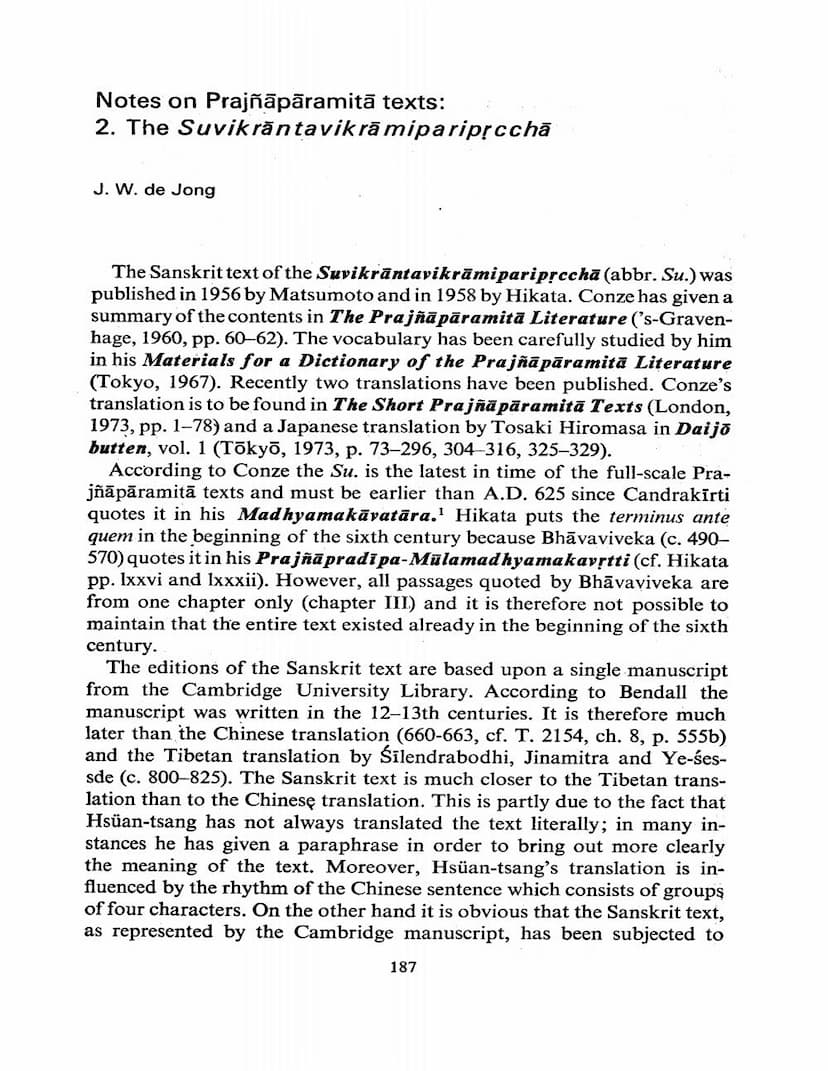
Here's a comprehensive summary of J.W. de Jong's "Notes on Prajñāpāramitā Texts: 2. The Suvikrāntavikramiparipṛcchā":
This article by J.W. de Jong focuses on a critical examination of the Sanskrit text of the Suvikrāntavikramiparipṛcchā (Su.), a Mahayana Buddhist text belonging to the Prajñāpāramitā literature. De Jong's primary aim is to analyze the existing Sanskrit text and compare it with its Chinese and Tibetan translations to identify potential textual corruptions and suggest emendations.
Key Points:
-
Textual Basis and Editions: The Sanskrit text of the Suvikrāntavikramiparipṛcchā is primarily based on a single manuscript from the Cambridge University Library, dating from the 12th-13th centuries. De Jong notes that this manuscript is significantly later than the Chinese translation (660-663 CE) and the Tibetan translation (c. 800-825 CE).
-
Dating the Text: De Jong discusses the dating of the Suvikrāntavikramiparipṛcchā. Conze suggests it is the latest of the "full-scale" Prajñāpāramitā texts and predates 625 CE, citing Candrakirti's quotation. Hikata places the terminus ante quem in the early 6th century, referencing Bhāvaviveka. However, de Jong points out that Bhāvaviveka only quotes from chapter III, making it impossible to definitively conclude the entire text existed that early.
-
Comparison with Translations: De Jong highlights significant divergences between the Sanskrit text, and its Chinese and Tibetan translations. He notes that the Sanskrit text, as represented by the Cambridge manuscript, has likely undergone changes and corruptions. The Tibetan translation, while closer to the Sanskrit in some respects, appears to have been made with less care than translations of other Prajñāpāramitā texts. The Chinese translation, particularly Hsüan-tsang's version, is sometimes more literal and can offer better insights into the original meaning, even though it can be influenced by Chinese sentence structure and paraphrasing.
-
Challenges in Textual Reconstruction: The author emphasizes that the discrepancies between the recensions are so great in places that arriving at the original meaning of the text is challenging. He argues that simple emendations of the Sanskrit text are often insufficient. He provides an example from chapter 4 where the Chinese translation seems to preserve the original text better than the Sanskrit manuscript, suggesting a corruption in the Sanskrit ('mahāsamsāra' potentially from 'mahāsambhāra').
-
Detailed Analysis of Passages: The bulk of de Jong's article is dedicated to a meticulous line-by-line analysis of specific passages from the Suvikrāntavikramiparipṛcchā. He compares the readings in the Sanskrit text with those found in the Peking and Lhasa editions of the Tibetan Kanjur and the Taisho edition of the Chinese Tripitaka. For each passage, he:
- Identifies potential errors or corruptions in the Sanskrit manuscript.
- Proposes emendations based on the evidence from the Tibetan and Chinese translations.
- Discusses the interpretations of scholars like Conze and Tosaki.
- Offers his own insights into the most plausible readings and their contextual meaning.
-
Examples of Emendations and Observations:
- Page 5.6: Discusses the translation of "anapatrapānām" and the variations in Tibetan and Chinese.
- Page 5.19-22: Suggests omitting "bodhisattvānām mahāsatvānām" in one line, as they are present in another.
- Page 7.10: Analyzes the word "pāramitaisā" and argues for "pāramitā."
- Page 8.1-3: Examines the passage concerning "jñānagocara" and "ajñānagocara," suggesting a logical interpretation of knowledge and non-knowledge.
- Page 12.1: Suggests "avirodho nirodhaḥ" instead of "anirodho nirodhaḥ" based on Tibetan and Chinese.
- Page 12.15-16: Notes discrepancies in translating "jñānavigama."
- Page 13.22-23: Debates the reading of "dharmâdharmasvabhāvena" versus "dharmasvabhāvena."
- Page 16.17: Identifies "viparyantāḥ" as an error for "viparyastāḥ."
- Page 17.8-9: Proposes correcting "sarvasamjñāḥ" based on Tibetan and Chinese evidence.
- Page 19.7-8: Compares the rendering of "bodhi," "citta," and their absence.
- Page 20.1-3: Notes significant differences in the translation of "cittaprakṛti" and "bodhiprakṛti."
- Page 22.20: Suggests "samdhāyanti" instead of "samdhayanti."
- Page 25.1: Argues for "ratnānām nāmāpi."
- Page 42.3-19: Proposes emendations for "svabhāvanirdeśaḥ," "māyāsvabhāvanirdeśasya," and "maricinirdeśasvabhāvo."
- Page 96.12-13: Critiques Conze's translation of "ālambanavaśikatām," arguing for its correct meaning as "depending on an ālambana."
- Page 98.20-22: Suggests "kalpanāvikalpanāsamucchedaḥ" as the original reading for "vikalpanāsamucchedaḥ" and "kalpasamucchedaḥ."
- Page 101.20: Proposes "vedanāttamanā" is a corruption of "'nattamanā."
- Page 114.10-11: Corrects "avalokitamūrdhatāyāḥ" to "anavalokitamūrdhatāyāḥ."
- Page 120.7-9: Offers a revised reading involving "meghā" and "utsāha."
- Page 123.17-18: Discusses the readings of "asanga" and "sanga."
- Page 126.9-10: Suggests a corruption from "marat" to "marah" and "papiyaso" to "papiyamso."
-
Conclusion: De Jong concludes by reiterating the necessity of consulting the Chinese and Tibetan translations for a better understanding of the original text of the Suvikrāntavikramiparipṛcchā. He also suggests that a complete translation of Hsüan-tsang's version would be valuable for scholars. The article serves as a crucial scholarly contribution to the philological study of this important Prajñāpāramitā text.