
Notes On Manuscript Transmission Of Vaisesika Sutra And Its Earliest Commentaries
Added to library: September 2, 2025
Summary
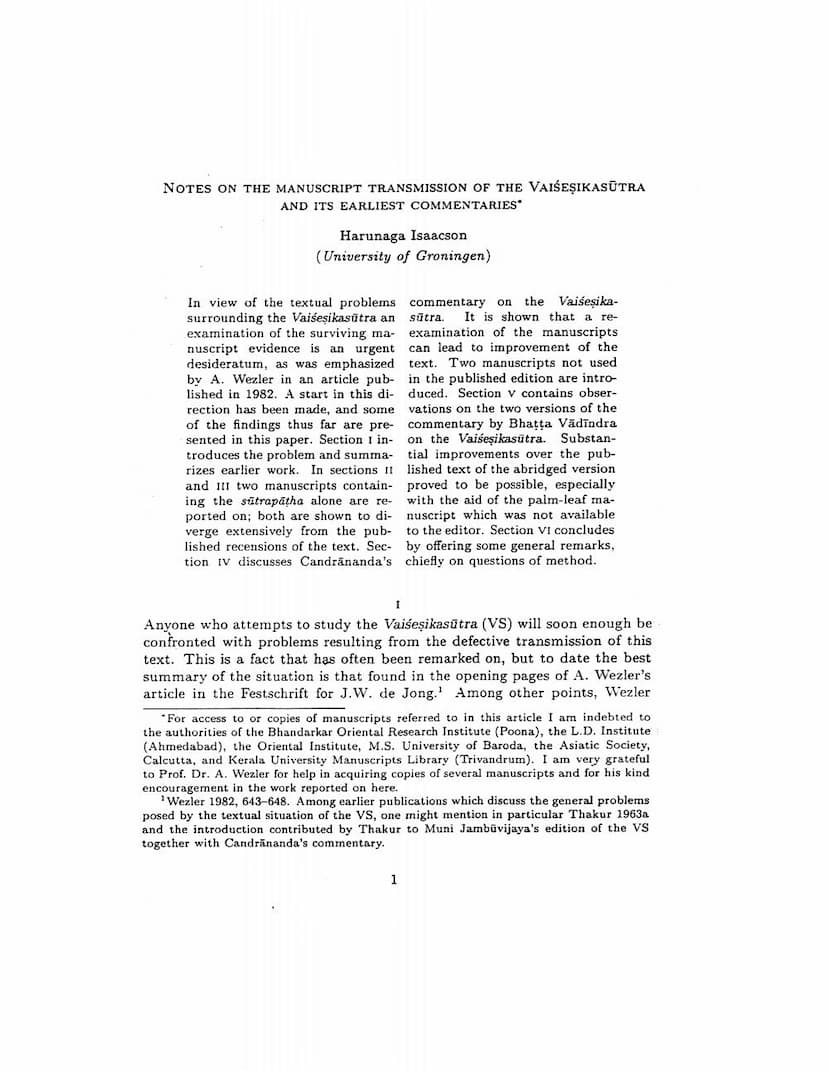
Here's a comprehensive summary of Harunaga Isaacson's "Notes On Manuscript Transmission Of Vaisesika Sutra And Its Earliest Commentaries," based on the provided text:
Overall Argument:
The paper argues for the urgent necessity of re-examining the manuscript evidence for the Vaiseṣikasūtra (VS) and its early commentaries. The author, Harunaga Isaacson, contends that existing editions are based on insufficient manuscript data and that a deeper philological analysis of available manuscripts can significantly improve our understanding of the VS text. He presents preliminary findings from his own examination of manuscripts, highlighting divergences from established recensions and suggesting potential textual improvements.
Key Issues and Problems Identified:
- Defective Manuscript Transmission: The VS, like many ancient Indian texts, suffers from a problematic manuscript tradition. This has led to textual inconsistencies and challenges in establishing a definitive critical edition.
- Inadequacy of Previous Scholarship: While scholars like A. Wezler have emphasized the need for more thorough manuscript examination, this "indispensable examination" has not been fully carried out. Existing work, particularly by Anantalal Thakur, is criticized for lacking detailed information about the manuscripts used and their readings.
- Prevalence of the "Maithila Version": Many available manuscripts tend to follow the text as presented in Śankara Miśra's commentary (the "Maithila version"). The paper seeks to identify and analyze manuscripts that represent different or potentially older recensions.
- Importance of Sutra-Only Manuscripts: Wezler's earlier work highlighted the potential value of manuscripts containing only the sūtrapāṭha (the sutras themselves, without commentary), as they might represent independent transmission streams or texts extracted from better commentaries. Isaacson's research focuses on identifying such manuscripts.
Findings and Contributions:
Isaacson's paper presents findings from his examination of several key manuscripts, categorized as follows:
1. Manuscripts Containing the Sutrapaṭha Alone:
- The Problem: The paper acknowledges previous work by Gopinath Kaviraj and Anantalal Thakur but notes their limitations in providing comprehensive details. Kaviraj's early report on a manuscript from a private collection is mentioned, but its current whereabouts are unknown, limiting its usefulness. Thakur's extensive collation is acknowledged but criticized for a lack of specific data.
- Manuscript A (L.D. Institute, Ahmedabad):
- This is a Sammelhandschrift (miscellaneous collection manuscript) containing the VS without commentary.
- It is written in Jaina Devanāgarī script, possibly from the 17th or early 18th century.
- Significance: Manuscript A exhibits significant differences from known recensions, particularly the "Maithila version" followed by Śankara Miśra. It shows notable variations in sūtra divisions and readings. Isaacson believes A represents a hitherto unknown recension and is superior to Śankara Miśra's version, showing more affinity to Candrānanda's text but with distinct differences.
- Manuscript T (Kerala University Manuscripts Library, Trivandrum):
- This is a palm-leaf manuscript, also containing the VS without commentary, preceded by the Nyāyasūtras.
- Written in Malayalam script, possibly no older than the 19th century.
- Significance: Manuscript T is described as "eccentric" and shows even more radical divergences from other recensions than manuscript A. It contains unique readings and even extra sūtras not found in other known sources. While more prone to scribal errors than A, its readings are considered significant and potentially representative of an old recension.
2. Manuscripts of Commentaries:
The paper focuses on improving the textual basis of the two oldest commentaries:
- Candrānanda's Commentary:
- Jambūvijaya's 1961 edition of Candrānanda's commentary is lauded as a significant achievement.
- However, Isaacson has found that re-examining the manuscripts used by Jambūvijaya (a Śāradā manuscript from Baroda and a Jaina Devanāgarī manuscript from the L.D. Institute) reveals numerous cases of misreadings and omissions in the published edition.
- Key Findings: Isaacson highlights specific instances where his collation suggests corrections are needed, particularly concerning the reading kaṣāya instead of katha in the commentary on the first sūtra, which he argues significantly improves the sense. He also notes unreported variants and misreadings in the critical apparatus, suggesting a lack of scrupulousness in the editing process.
- New Manuscript Evidence: Isaacson identifies two previously unnoticed manuscripts of Candrānanda's commentary in the Bhandarkar Oriental Research Institute (Poona) – one in Śāradā script and another in Jaina Devanāgarī. While the latter is likely a copy of the L.D. Institute manuscript, the Śāradā manuscript appears to be a new, independent witness, suggesting a closer relationship to the Baroda Śāradā manuscript but not an ancestor.
- Bhaṭṭa Vādīndra's Commentary:
- The paper discusses two versions: the long version (BhV) and an abridged version (V), both edited by Anantalal Thakur.
- Critique of Thakur's Editions: Isaacson finds Thakur's edition of V (1957) to be based on a defective transcript of a single Malayalam palm-leaf manuscript and lacking in critical apparatus. His edition of BhV (1985) is also criticized for its lack of information on manuscript basis and variant readings, suggesting it might be a minimally corrected transcript.
- New Manuscript Evidence for V: The original Malayalam palm-leaf manuscript of V, acquired by the Kerala University Manuscripts Library, is identified as crucial. Isaacson's examination of this manuscript (No. 21600C) reveals numerous corrections are possible due to misreadings and omissions in Thakur's transcript. He highlights specific examples of textual omissions and misreadings, suggesting that the original manuscript often offers readings closer to BhV.
- Relationship between BhV and V: Isaacson largely agrees with Thakur's assessment that V is an abridged version of BhV, emphasizing that V omits lengthy discussions while retaining core interpretations. He suggests that the abridgement might not have been done by Vādīndra himself.
- Challenges: The manuscript of V is described as damaged and corrupt in places, making definitive textual reconstruction challenging. Bhaṭṭa Vādīndra's complex style also adds to the difficulty.
Methodological Remarks:
Isaacson concludes with general remarks on methodology in studying classical Indian philosophy:
- Textual Criticism is Essential: Given that original authorial manuscripts are rarely available, textual criticism is a crucial discipline for reconstructing the history of texts and their original forms.
- Beyond the Original Text: The goal of textual criticism should not solely be the recovery of the "original" text but also the reconstruction of its transmission history, understanding the evolution and cultural context.
- Respect for Manuscripts: He urges scholars to recognize the fragility of manuscript evidence and not grant printed editions more authority than they deserve. The survival and editing of texts are subject to chance.
- Humility: Scholars should approach their reconstructions with humility, acknowledging the vast historical distance and the numerous scribal interventions between the original authors and our current understanding.
In essence, Isaacson's paper serves as a call to action for a more rigorous and evidence-based approach to studying the Vaiseṣikasūtra and its commentaries. He demonstrates through concrete examples the significant textual improvements that can be achieved by engaging directly with manuscript sources, thereby contributing to a more accurate and nuanced understanding of this foundational philosophical text.