
Notes On Bodhisattvabhumi
Added to library: September 2, 2025
Summary
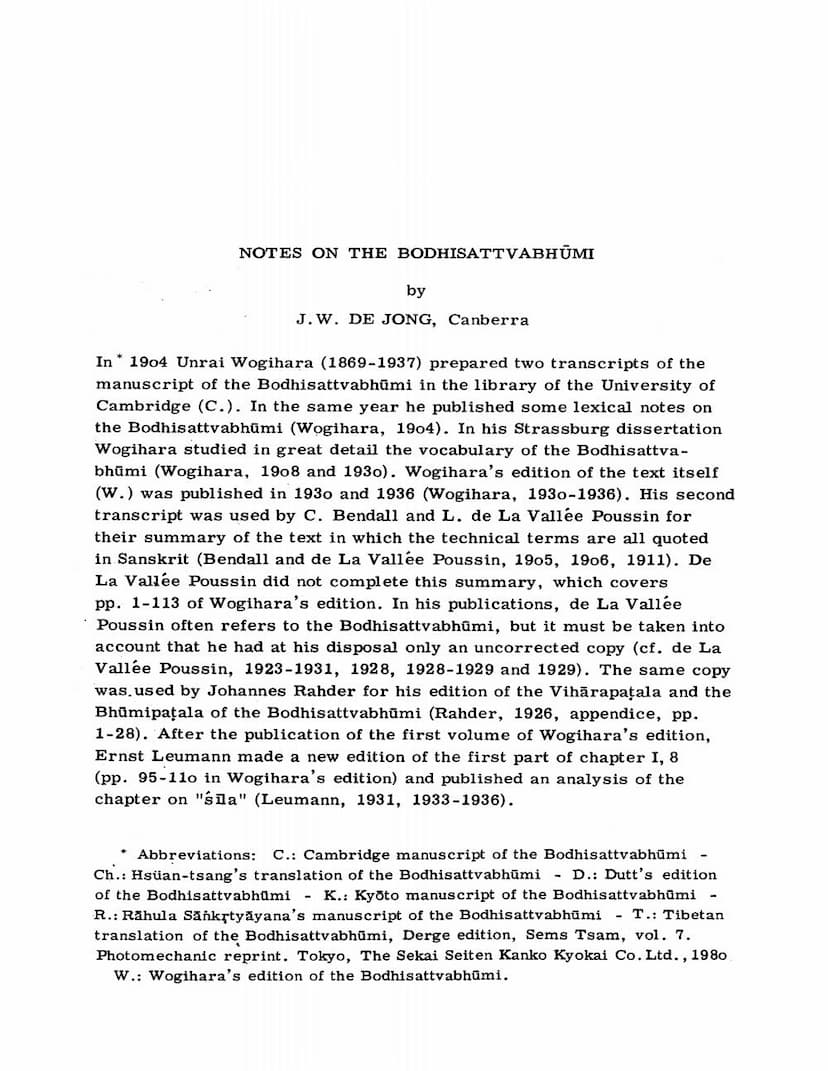
This document, "Notes on Bodhisattvabhūmi" by J.W. de Jong, is a scholarly exploration of the Bodhisattvabhūmi, a significant Mahayana Buddhist text. The author focuses on the critical study and analysis of different editions and translations of this text, as well as the interpretation of its complex vocabulary.
Here's a breakdown of the key points covered in the provided pages:
1. Scholarly Foundation and Textual History:
- Early Scholarship: The text highlights the pioneering work of Unrai Wogihara, who prepared transcripts of the Cambridge manuscript and published significant lexical studies and the first critical edition of the Bodhisattvabhūmi in 1930-1936.
- Subsequent Editions and Translations: De Jong details the contributions of other scholars:
- C. Bendall and L. de La Vallée Poussin: They used Wogihara's second transcript for a summary, focusing on Sanskrit technical terms, though their work remained incomplete. De La Vallée Poussin's later references were based on an uncorrected copy.
- Johannes Rahder: Edited specific chapters (Viharapaṭala and Bhumipaṭala).
- Ernst Leumann: Produced a new edition of a portion of Chapter I and analyzed the "sila" chapter.
- Franklin Edgerton: His "Buddhist Hybrid Sanskrit Dictionary" (BHSD) greatly contributed to the understanding of the Bodhisattvabhūmi's vocabulary.
- H. Ui: Published an index that included a translation of selected passages and an index of Sanskrit words with Chinese and Japanese translations, heavily relying on Hsüan-tsang's translation.
- Nalinaksha Dutt: Published a new edition based on a Tibetan manuscript, which often offered superior readings but was established with less care than Wogihara's edition. De Jong points out specific instances where Dutt's edition has errors or less accurate readings compared to Wogihara's or the Tibetan translation.
- Manuscripts and Translations: The text frequently refers to various manuscripts (Cambridge, Kyoto, Rahula Sānkṛtyāyana's) and translations (Hsüan-tsang's Chinese translation, the Tibetan translation). The differences and merits of these sources are discussed.
2. Linguistic and Lexical Analysis:
- Focus on Terminology: A significant portion of the notes is dedicated to clarifying the meaning of specific Sanskrit terms found in the Bodhisattvabhūmi.
- Key Terms Discussed:
- "avaropita": De Jong analyzes its meaning, contrasting Edgerton's interpretation ("to be cut off by the Buddha") with the Tibetan translation ("depending on") and the literal meaning ("planted in the Buddha"). He suggests it refers to good or bad dharmas and meritorious deeds being directed towards the Buddha, Dharma, and Samgha.
- "samjñāpti": De Jong examines its dual meanings: "information/statement" and "appeasement/mollification." He delves into passages where it signifies apologizing, asking for forbearance, or receiving an apology, referencing commentaries and translations to clarify its usage.
- "pragraha": This term is explored in detail, with de Jong linking it to "vipassanā" (insight) and "viriya" (energy). He discusses its role in Buddhist practice, particularly in rousing the mind after "samatha" (tranquillity) to engage in insight. He also analyzes its definition in the Śrāvakabhūmi and its relation to "cittasamharṣaṇāsamdarśanāsamādāpanā" (gladdening, instructing, inciting the mind).
- "viceṣṭate": The text investigates its meaning as "to despise" or "to insult," supported by commentaries and contrasted with other translations.
3. Importance of the Bodhisattvabhūmi:
- Alternative Titles: The text mentions that the Bodhisattvabhūmi is also known as Bodhisattvapiṭakamātṛkā and Mahāyānasamgraha ("Compendium of the Mahāyāna"), underscoring its comprehensive nature within Mahayana Buddhism.
- Scholarly Significance: The author emphasizes the ongoing importance of studying this text due to its rich philosophical and practical content for bodhisattvas.
In essence, de Jong's "Notes on Bodhisattvabhūmi" serves as a scholarly guide to the critical study of this foundational Mahayana text. It meticulously examines the history of its scholarly engagement, highlights the challenges of textual reconstruction and interpretation, and provides in-depth analyses of key terms, contributing to a deeper understanding of its doctrines and practices.