
Note On Zero And Numerical Place Value System In Ancient India
Added to library: September 2, 2025
Summary
Here's a comprehensive summary of Johannes Bronkhorst's "A Note on Zero and the Numerical Place-Value System in Ancient India":
Main Argument: Johannes Bronkhorst critically examines the claim that the decimal place-value system with zero existed in India before the beginning of the Christian era, arguing that the evidence presented for such an early development is weak and often based on questionable dating of ancient texts. He concludes that the evidence strongly suggests the system was known during the early centuries of the Common Era.
Critique of Early Evidence:
-
S.R. Sarma's Claims: Bronkhorst addresses the claims made by S.R. Sarma in the Kalātattvakośa, which suggests the decimal place-value system with zero developed in India much before the Christian era. Sarma's primary evidence is based on:
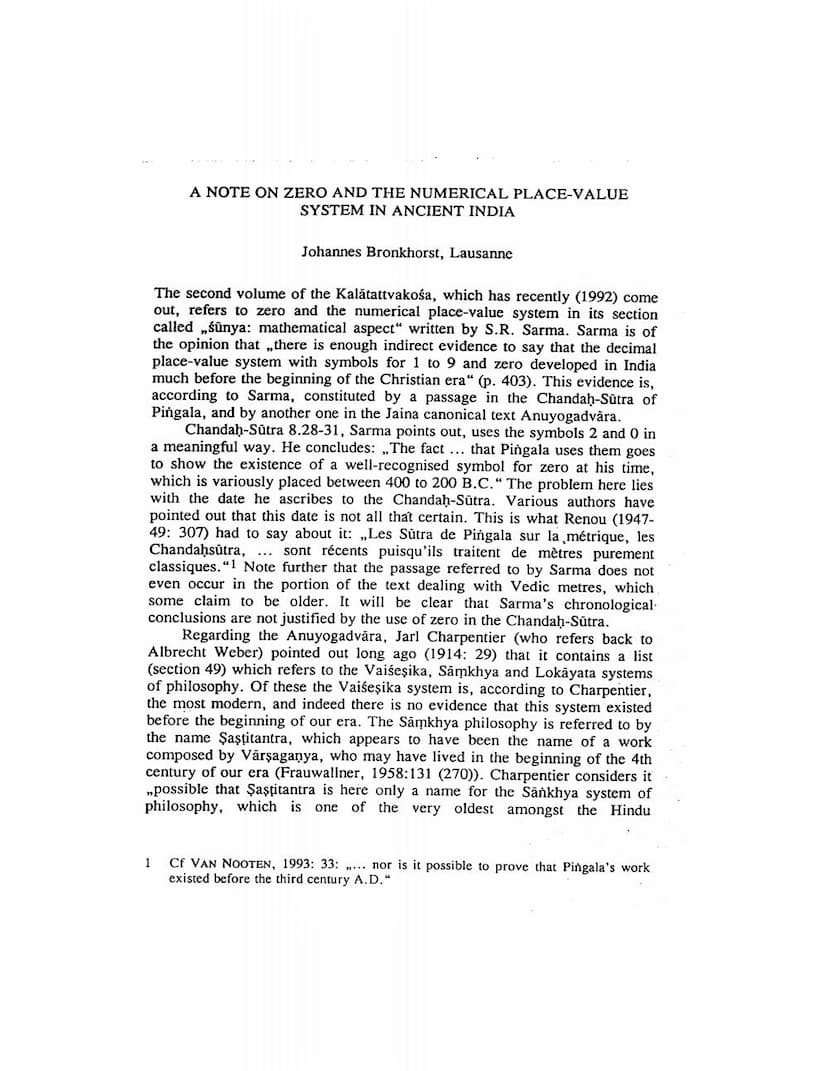
- Pingala's Chandah-Sutra: Sarma interprets a passage (8.28-31) as using the symbols '2' and '0' meaningfully. However, Bronkhorst refutes this by highlighting that the dating of the Chandah-Sutra itself is highly uncertain. He notes that scholars like Renou consider the work to be "recent" as it deals with classical metres, and the relevant passage isn't even from the potentially older section on Vedic metres. Therefore, the use of '0' in Pingala's work does not justify conclusions about its existence before the Christian era.
- Jaina Canonical Text Anuyogadvāra: Sarma also cites this text. Bronkhorst, drawing on Jarl Charpentier's earlier work, points out that the Anuyogadvāra refers to philosophical systems like Vaiśeṣika and Sāṅkhya.
- Vaiśeṣika: Bronkhorst states there's no evidence for Vaiśeṣika existing before the Christian era, suggesting the Anuyogadvāra passage is thus not from a very early period.
- Sāṅkhya (Şaştitantra): Bronkhorst challenges the idea that the mention of "Şaştitantra" (a name associated with Sāṅkhya) implies an ancient origin for Sāṅkhya. He questions the antiquity of the Sāṅkhya system itself and points out that "Şaştitantra" is not used to refer to Sāṅkhya in early texts, as the concept of sixty principles only entered the system later. He also notes that Kautilya's Arthaśāstra, which mentions Sāṅkhya, is a composite work completed long after the Mauryan period.
- Patanjali(ya): The Anuyogadvāra also mentions "Patanjali(ya)". Bronkhorst, citing his own earlier research, argues that this term refers to both the Yoga Sūtra and the Bhāṣya together, and that these are considered late works. This further pushes the dating of the Anuyogadvāra passage to a later period.
- M.D. Pandit's "Zero in Panini": Bronkhorst briefly mentions Pandit's work, which suggests a resemblance between mathematical zero and techniques used by Pāṇini (believed to have lived in the 4th century BCE). However, Bronkhorst notes that Pandit himself avoids concluding that this implies the existence of mathematical zero before Pāṇini, acknowledging the possibility of borrowing from Pāṇini.
-
Naneghat Inscriptions: Bronkhorst mentions that Van Nooten points to the Naneghat inscriptions (c. 1st century BCE) but admits they don't contain a "pure place-value system."
Evidence for a Later Development (Early Centuries CE):
- Vasubandhu's Abhidharmakośa Bhāṣya: Bronkhorst focuses on a passage (5.26) cited by Ruegg, which describes a "marker or counter" (vartikā) that has positional value (unit, hundred, thousand). This passage is attributed to Bhadanta Vasumitra, whom Ruegg suggests might be a contemporary of Kaniṣka or Nāgārjuna.
- Confirmation from Earlier Buddhist Texts: Crucially, Bronkhorst notes that this same or a similar passage appears in Chinese translations of the Mahāvibhāsā and in the Vibhāṣā. Given that the Mahāvibhāsā may have been composed during Kaniṣka's reign (early centuries CE), and the Vibhāṣā might be slightly older, this provides strong evidence that the decimal place-value system was known in India during the early centuries of our era.
- Other Texts: Bronkhorst lists several other texts that Sarma refers to as evidence for later periods, including the Āryabhaṭīya, Puliśasiddhānta, Pañcasiddhāntikā, Bṛhatkṣetrasamāsa, Siddhasena Gani's commentary on the Tattvārtha Sūtra, the Yoga Bhāṣya, and Śankara's commentary on the Brahma Sūtra. While these texts attest to the use of the system, their significance for early origins is what Bronkhorst is questioning.
Conclusion:
Bronkhorst concludes that the available evidence for the existence of zero and the numerical place-value system in India before the beginning of the Christian era is very weak and not well-justified by the textual dating. Instead, the evidence strongly supports the understanding that this mathematical innovation was known and utilized in India during the early centuries of our era, as demonstrated by its presence in Buddhist scholastic literature from that period.