
Note On Mahabhasya II 366 26 Gunasamdravo Dravyam
Added to library: September 2, 2025
Summary
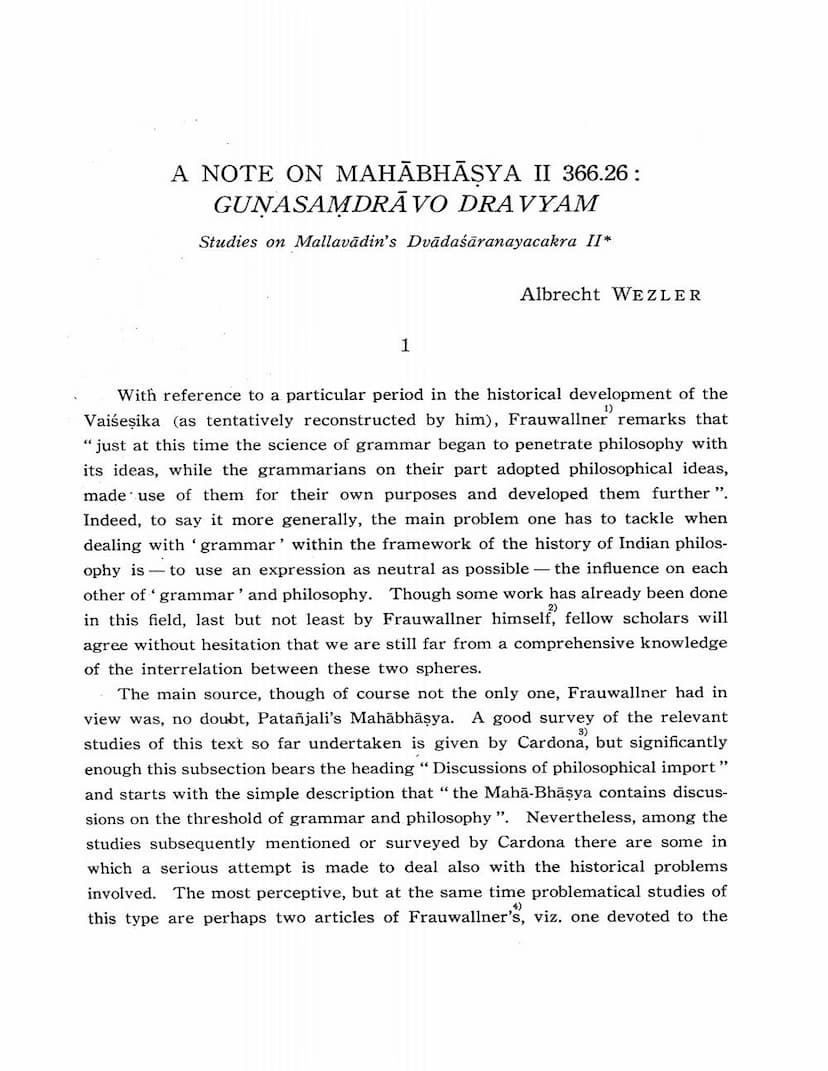
This academic note, "A Note on Mahābhāṣya II 366.26: Gunasamdravo Dravyam" by Albrecht Wezler, explores the intricate relationship between grammar and philosophy in ancient India, focusing on a specific definition of "dravya" (substance) found in Patañjali's Mahābhāṣya. The author highlights the challenges in understanding Patañjali's philosophical references due to his often unacknowledged sources.
Wezler's central argument is that the definition of dravya as gunasamdrāvo dravyam (substance is the melting together of qualities) in the Mahābhāṣya, and the related concept of gunasamudāyo dravyam (substance is an aggregate of qualities), are not original to Patañjali but rather originate from the Sāmkhya philosophical system.
The paper achieves this by:
- Analyzing Mallavādin's Dvādaśāranayacakra (NC) and Simhasūri's Nyāyāgamānusāriņi (NAA): Wezler examines two passages from these texts where the authors explicitly link Patañjali's definition of dravya to Sāmkhya. The first passage (NC 268.4-13) criticizes a Sāmkhya theory of evolution using the Mahābhāṣya definition, implying that this definition itself is Sāmkhyan. The second passage (NC 298.7 ff.) discusses the nature of the Sāmkhya guṇas (qualities) and how they constitute dravya, again referencing the Mahābhāṣya definition.
- Comparing with other Mahābhāṣya passages: Wezler analyzes other discussions within the Mahābhāṣya, particularly concerning the concept of "gender" (linga) in relation to Pāṇini's rule 4.1.3. Here, the commentator Kaiyaṭa explains a point by referencing the Sāmkhya concept that any object is merely an aggregate of qualities. Nāgeśa, another commentator, criticizes Kaiyaṭa for this, asserting that the Sāmkhya-Yoga notion of substance is closer to the grammarians' view. This reinforces the idea that Patañjali's discussions often engage with and draw upon Sāmkhya concepts.
- Examining Patañjali's "attempts to define substance": Wezler discusses two "attempts" to define dravya in the Mahābhāṣya on Pāṇini 5.1.119. The first defines substance as an "unchanging state" (tattva that does not perish amidst changing qualities), and the second, the gunasamdrāvo dravyam definition, is presented as corroborating this. Wezler argues that both these definitions have roots in Sāmkhya's understanding of pariṇāma (transformation) and the nature of guṇas.
- Highlighting the Sāmkhya concept of dravya: The paper details the Sāmkhya view that dravya is an aggregate (samudāya or samdrāva) of guṇas, where the guṇas themselves are not mere abstract qualities but are material in nature. This stands in contrast to the Vaiśeṣika understanding of dravya as something that "inheres" qualities. The Sāmkhya concept emphasizes the persistence of the aggregate (samudāya) despite changes in the constituent guṇas.
In essence, Wezler's study demonstrates that the grammatical discourse in Patañjali's Mahābhāṣya was not isolated but deeply intertwined with philosophical debates, particularly with the Sāmkhya school. The definition of dravya as gunasamdrāvo dravyam serves as a key example of how grammatical texts incorporated and utilized philosophical terminology and concepts, in this case, reflecting a distinctly Sāmkhyan understanding of substance.