
Note On Class Of Ascetics Called Unmajjaka
Added to library: September 2, 2025
Summary
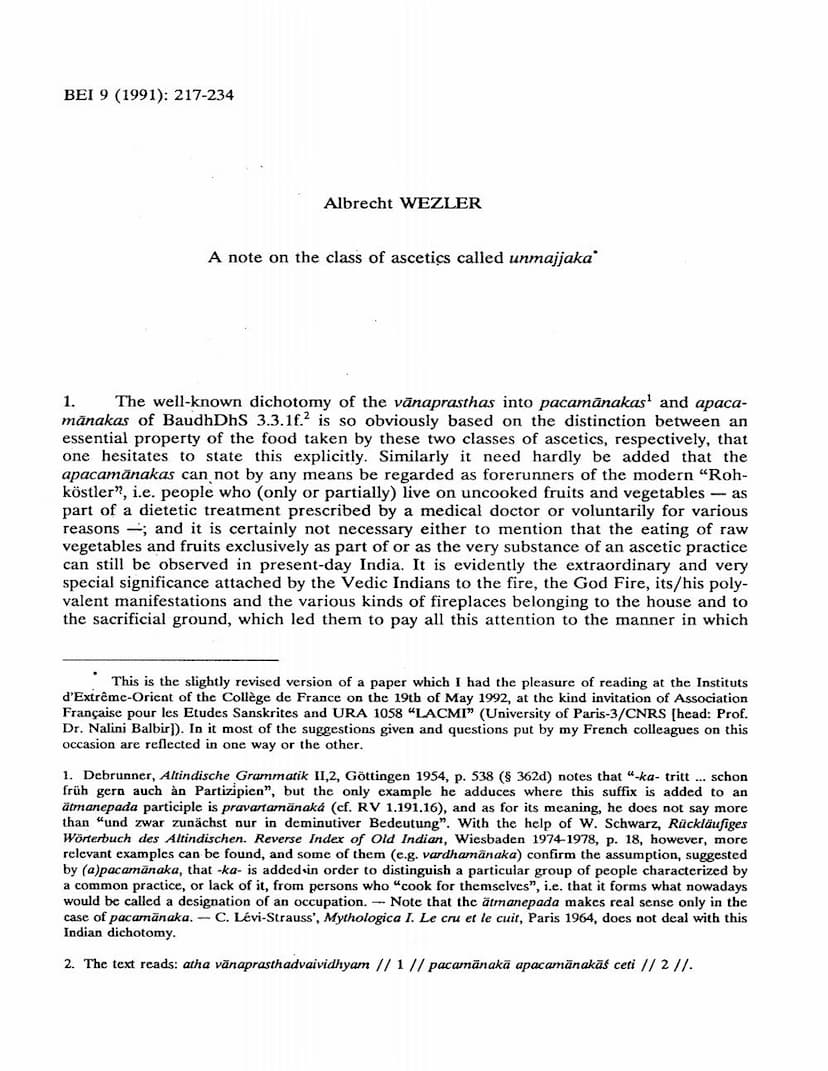
Here's a comprehensive summary of the provided Jain text, "Note On Class Of Ascetics Called Unmajjaka" by Albrecht Wezler, focusing on the key arguments and findings:
The article by Albrecht Wezler investigates the class of ascetics known as Unmajjaka, primarily drawing upon the Baudhāyana Dharmaśāstra (BaudhDhS). The author aims to clarify the specific practices and characteristics of these ascetics, differentiating them from other ascetic groups.
1. Context: The Ascetic Dichotomy in BaudhDhS
- The study begins by referencing the distinction in BaudhDhS between pacamānakas (those who cook their food) and apacamānakas (those who do not cook). This distinction is rooted in the nature of the food consumed.
- The apacamānakas are further subdivided into various groups. While some are defined by their diet (e.g., those who eat only fruits or vegetables), the Unmajjaka stand out as their definition is not directly related to food consumption.
2. The Meaning of "Unmajjaka"
- The term "Unmajjaka" is etymologically derived from ud-majj, meaning "to emerge (from water)." This suggests a connection to water-related practices.
- The author notes that the BaudhDhS itself does not provide a semantic explanation for "Unmajjaka," implying it was considered self-explanatory. However, subsequent research, particularly drawing from the Rāmāyaṇa and its commentators, offers crucial insights.
3. Clarification from Commentaries and Other Texts
- Rāmāyaṇa Commentaries: The verse quoted by Apte's dictionary, describing an Unmajjaka as one who stands in water up to their throat and practices austerities, is pivotal. Commentators consistently interpret this as ascetics who remain stationary in water reaching their throat, with only their head and perhaps neck above the surface, for extended periods. This isn't about emerging from water but rather about remaining submerged to a significant degree.
- Udavāsa: The author strongly links the Unmajjaka practice to udavāsa, a term found in later Sanskrit texts, meaning "residing in water." This practice involves remaining in water, often described as a form of tapas (austere penance).
- Mahābhārata and Other Texts: The Mahābhārata provides numerous examples of udavāsa, describing ascetics like Ambā, Mahādeva, and Goddess Mrtyu engaging in similar water-based austerities. These descriptions often emphasize immobility and endurance. For instance, Mahādeva is described as magna ambhasi (immersed in water), but with his head above the surface, akin to the Unmajjaka. Jājali's practice of jalavāsa and jalamadhye is also noted.
- Manusmṛti: The verse in Manusmṛti (6.23) mentioning ārdravāsās tu hemante (wet clothes in winter) is discussed. While a variant reading apsuvāsas (staying in water) is attested by some commentators, the author questions whether ārdravāsās might be a later emendation. However, wearing wet clothes itself was considered a form of tapas.
4. Key Characteristics of the Unmajjaka/Udavāsa Practice
- Stationary in Water: The core practice is standing in water, typically up to the throat, without significant movement.
- Immobility: Immobility is a crucial element of this tapas.
- Seasonal Association: Winter (hemanta) is often cited as a particularly suitable season for this practice, likely due to the harshness it imposes.
- Potential for Extended Periods: While some passages suggest year-round practice, the seasonal focus implies an intensification of austerities during colder months.
- Intimate Connection with Water: The practice suggests an extremely intimate relationship with the aquatic environment, almost becoming part of it.
5. Prohibitions and Diet
- BaudhDhS 3.3.10: This sutra prohibits the use of iron and stone implements for Unmajjaka.
- Interpretation of Prohibition: The author argues that this prohibition is not about floating implements but rather about the material of their tools. He suggests that only wooden implements derived from vegetation (trees) are allowed, reflecting the ascetic's deep connection to water-dependent life forms. This implies that their food collection and preparation (though not cooking) would utilize materials directly sourced from the aquatic or natural environment.
- Dietary Questions: The exact diet of Unmajjaka remains somewhat ambiguous. While the prohibition on iron and stone might relate to food preparation, the text doesn't definitively state what they eat, though annam salile prarūḍham (food grown in water) is mentioned as part of ascetic diet generally.
6. The Nature of Tapas
- The author concludes by reflecting on the concept of tapas itself. He notes the apparent contradiction between tapas as accumulating "fiery energy" and the practice of immersing oneself in water.
- This leads to the broader conclusion that the conception of tapas was not solely about literal "heating up." It encompassed a wider range of austerities, including water immersion, and the idea of accumulated tapas substance might not have always been conceived as fiery. The practice of Unmajjaka highlights the evolving and complex nature of ascetic disciplines in ancient India.
In essence, the article establishes that Unmajjaka are ascetics who perform tapas through the practice of udavāsa, characterized by standing immobile in water, often for extended periods and particularly during winter. Their ascetic discipline is further defined by a prohibition on iron and stone implements, suggesting a preference for materials intimately connected to the natural, aquatic environment. The study also touches upon the broader conceptualization of tapas and how seemingly contradictory practices could coexist within its framework.