
Note On Birth Of Hero In Ancient India
Added to library: September 2, 2025
Summary
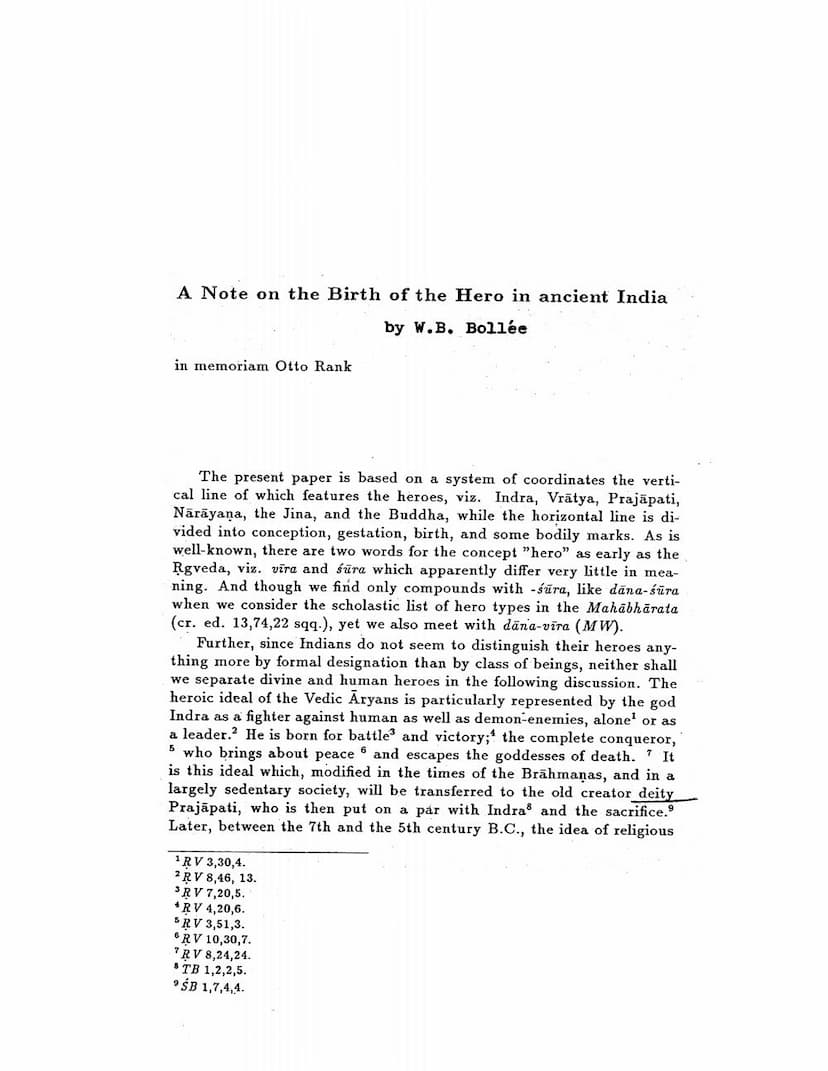
Here's a comprehensive summary of W.B. Bollée's "A Note on the Birth of the Hero in Ancient India," focusing on its analysis of heroic birth narratives, particularly in Jainism and Buddhism, and its comparison with Vedic traditions:
The paper, "A Note on the Birth of the Hero in Ancient India" by W.B. Bollée, explores the commonalities and distinctions in the conception, gestation, and birth of heroic figures across various ancient Indian religious traditions, with a particular emphasis on Jainism and Buddhism. Bollée sets up a "system of coordinates" where the vertical axis represents a progression of heroes like Indra, Vratya, Prajapati, Narayana, the Jina, and the Buddha, while the horizontal axis tracks the stages from conception to bodily marks.
Early Vedic Heroic Ideal:
- The concept of "hero" (vīra, śūra) is present from the Rigveda, primarily embodied by Indra. Indra is depicted as a warrior, born for battle and victory, a complete conqueror who brings peace.
- This ideal is later transferred to Prajapati, the creator deity, who is placed on par with Indra and the sacrifice, especially in the Brahmanic period.
Emergence of the Religious Hero:
- Around the 7th to 5th century BCE, the idea of a religious single-handed fighter emerges, particularly among non-Vedic Aryans in Magadha. These figures, possibly associated with the long-haired muni, overcome worldly attachment.
- Jains and Buddhists confer titles like Mahāvīra (Great Hero) or Vira upon these figures.
- A traditional definition of a vīra in the Vedic context includes being traditionally educated, entitled to priest and warrior status, admitted into the society of Āhitāgnis, allowed to drink Soma, married, and having a son.
The "Mahāvīra" Vessel and its Symbolism:
- The paper delves into the Mahāvīra vessel, a significant element of the Pravargya ritual.
- The Pravargya ritual, involving heated cow's milk, underwent changes, becoming associated with a potentially non-Vedic rite involving an earthen vessel called Mahāvīra.
- This ritual was often conducted in the aranya (forest) and screened from Sudras and women. The vessel itself, described as consisting of three clay balls stacked, is interpreted anthropomorphically by some scholars (like Van Buitenen) as representing a sitting man, and is explicitly defined as male in the Shatapatha Brahmana.
- The Mahāvīra vessel is linked to the invigoration of the sun or, as argued by others (like Lüders), the milkstream of the sky (rain) before the monsoon. It is also equated with the life-giving sun and time.
Vratyas and their Influence:
- The Vratyas, a group of people who predated Vedic Brahmins in Magadha, are identified as having a significant influence on Jainism and Buddhism. They represent an older Aryan wave and contributed elements like the title arhant and the designation gana.
- The Vratyas, with their possibly shamanistic customs, are seen as carrying pre-Vedic traditions and provided a reaction to the esoteric Vedic sacrificial speculations. Their survival is traced in figures like Lord Khandoba's Vāghyās in Maharashtra.
Conception and Gestation of Heroes:
- Exceptional beings, according to the paper, do not come into existence normally. Unusual methods of conception are discussed, such as a god or ascetic touching a woman's navel.
- In Buddhist legends, the Bodhisatta (Buddha-to-be) drops from heaven into his mother's womb. Similarly, Vardhamana Mahāvīra is also said to have descended from heaven.
- The paper notes that Mahāvīra, unlike the Buddha in some accounts, retains awareness of his descent and transfer in the womb.
- The concept of intra-uterine communication between mother and child, present in Vedic texts (Indra's mother), is highlighted as an early example, predating Western prenatal psychology.
- Mahāvīra's birth involves a unique event: he stays in the womb of a Brahmin lady, Devananda, for the first 82 days, and is then miraculously transferred by Hariñegamesī (a goat-headed god) to the womb of Queen Trishala, a Kshatriya. This transfer is justified by the idea that Jinas are not reborn into lower or Brahmin families. This mythologeme is linked to a similar Vaishnavite myth concerning Krishna's birth.
- The paper also examines the Bodhisatta's conception, where Queen Maya dreams of a six-tusked elephant entering her right side, signifying conception without direct involvement of her husband. This dream motif is seen as a variation of the ascetic touching the navel.
- Indra's mother is described as carrying him for an unusually long period, possibly to protect him from his father, or perhaps because she knows he will kill her.
- Lateral birth is discussed, with Indra's lateral birth potentially linked to his cosmic actions. Later, the Bodhisatta Gotama is depicted as being born laterally.
- The importance of lineage purity for both Mahāvīra and the Buddha is emphasized, with their parents belonging to Kshatriya families.
The Role of Hariñegamesī and other Divine Interventions:
- The goat-headed god Hariñegamesī (also known as Naigameșa or Nemesa) plays a crucial role in the transfer of Mahāvīra's fetus. This deity has a complex background, associated with Agni, Skanda, and Rudra-Siva, embodying both positive (bringer of children) and negative (child-seizing demon) attributes.
- The Jain adaptation of the Vaishnavite mythologeme of embryo transfer is discussed, with Hariñegamesī being identified as a fusion of Hari (Vishnu) and Negamesi.
Bodily Marks and Heroic Attributes:
- The paper touches upon the 32 bodily marks (lakṣaṇas) of a mahāpuruṣa (Great Man), which are a product of Brahmanic speculation adopted by Jains and Buddhists. These marks are seen as originating from Narayana and Indra, and possibly pre-Vedic concepts.
- The order of describing these marks (feet first) reflects how gods and great men are viewed from below.
- The paper briefly discusses the symbolic significance of hair in relation to renunciation and vital power, linking the ritual haircutting or hair-pulling of monks to the sacrifice of the self. The depiction of Jinas and Buddhas with hair, despite their ritual tonsure, is explained as symbolizing stored vital power.
- The concept of urdhva-reta(s) (sexually abstinent) is linked to the accumulation of semen, represented by the uṣṇīṣa (protuberance on the head), a feature shared by both Jinas and Buddhas.
The Name "Mahāvīra" and its Meanings:
- The name "Mahāvīra," while most prominently associated with the Jain Tirthankara, is also noted to be a title applied to Hanuman in later Hindu traditions, stemming from his extraordinary strength and devotion.
Concluding Remarks:
- Bollée concludes by noting that both the Jina and the Buddha, despite their human birth, were deified early. This deification is attributed to their celestial origin, miraculous births, and the divine interest in their passing.
- The paper highlights that the traditions surrounding the birth of heroes, particularly Mahāvīra and the Buddha, reveal a rich tapestry of religious and cultural influences, demonstrating the adaptation and evolution of myths and symbols across different Indian traditions.
In essence, Bollée's work provides a detailed comparative analysis of heroic birth narratives, demonstrating how figures like Indra, the Vratyas, Mahāvīra, and the Buddha share common mythological frameworks while also exhibiting unique characteristics shaped by their respective religious contexts. The paper underscores the interconnectedness of Vedic, Vratya, Jain, and Buddhist traditions in shaping these foundational narratives.