
Note In Patanjali And The Buddhists
Added to library: September 2, 2025
Summary
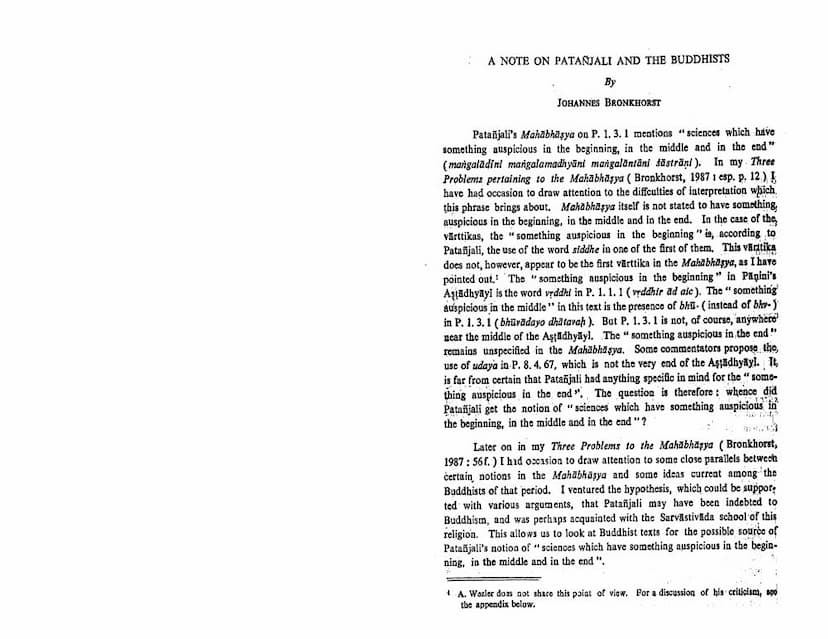
Here's a comprehensive summary of Johannes Bronkhorst's "A Note on Patañjali and the Buddhists," focusing on the main arguments and evidence presented:
Central Thesis: Johannes Bronkhorst proposes that Patañjali, the author of the Mahābhāṣya (a commentary on Pāṇini's grammar), may have been influenced by early Buddhist thought, particularly the Sarvāstivāda school. He supports this hypothesis by highlighting parallels between specific notions in the Mahābhāṣya and Buddhist texts.
Key Arguments and Evidence:
-
"Auspicious in the Beginning, Middle, and End":
- Patañjali's Mahābhāṣya: Patañjali mentions "sciences which have something auspicious in the beginning, in the middle and in the end" (mangalādīni, mangalādhyāni, mangalāntāni śāstrāṇi).
- Interpretation Issues: Bronkhorst notes difficulties in identifying specific "auspicious" elements within Patañjali's own work (the Mahābhāṣya) or even within Pāṇini's Aṣṭādhyāyī that clearly fit this tripartite structure. The identified examples in Pāṇini (like 'vṛddhi' at the beginning or 'bhū' in the middle) are not necessarily in the literal middle or end of the text.
- Buddhist Parallel: Bronkhorst points to a strikingly similar concept in Buddhist texts, where the Dharma (teachings of the Buddha) is described as "auspicious in the beginning, in the middle, and in the end" (Pali: adikalyāṇa, majjhekalyāṇa, pariyosanakalyāṇa; Sanskrit: aadau kalyāṇa, madhye kalyāṇa, paryavasāne kalyāṇa). This phrase is frequently found in Pali Vinaya and Sutta Piṭakas and in Sanskrit texts, many of which are attributed to the Sarvāstivādins.
- Hypothesis: This suggests that Patañjali might have adapted the Buddhist concept of the Dharma's auspiciousness to describe the ideal characteristics of grammatical sciences. This adds weight to the broader argument of Buddhist influence on Patañjali.
-
The Story of Sakatyāyana and Unperceived Carts:
- Patañjali's Mahābhāṣya: Patañjali recounts an anecdote about Śākātyāyana, a grammarian, who, while sitting by the roadside, failed to perceive a group of carts passing by, implying a lack of attention to the present. (Mbh II p. 120, l. 20-21).
- Buddhist Parallel: A similar episode appears in Buddhist literature, specifically the Mahāparinirvāṇa-sūtra and its parallels. In this account, Āraḍa Kālāma, a non-Buddhist teacher, describes a similar experience where he did not hear the sound of five hundred carts passing by, even though he was conscious and awake.
- Possible Connection: Bronkhorst suggests Patañjali might have been acquainted with the Sarvāstivāda Mahāparinirvāṇa-sūtra, which could explain both the Śākātyāyana story and the "auspicious" notion.
- Caveats and Counterarguments:
- Āraḍa Kālāma's Non-Buddhist Identity: Āraḍa Kālāma is presented as a non-Buddhist teacher in Buddhist texts, meaning such stories might have circulated in non-Buddhist circles, making direct borrowing from Buddhism less certain.
- Śākātyāyana's Name: The name Śākātyāyana ("descendant of Śakata") is related to the word for "cart" (śakata). This linguistic connection might have led to the story of carts being attributed to him, possibly independent of any Buddhist source. Patañjali might have even fabricated the story to fit the name.
-
Material Objects as Collections of Qualities:
- Patañjali's Mahābhāṣya: The Mahābhāṣya contains phrases like guṇasamudāvo dravyam (" a substance is a collection of qualities") and guṇasamudāyo dravyam ("a substance is an aggregation of qualities"). Bronkhorst notes these don't seem to express Patañjali's own opinion.
- Buddhist Parallel: The notion that material objects are collections of qualities (or dharmas in Buddhist terminology) was a concept present in Sarvāstivāda Buddhism.
- Argument: Since there's no clear evidence of Patañjali being acquainted with Sāṁkhya philosophy, where similar ideas might exist, this concept points towards a potential influence from the Sarvāstivādins.
Overall Conclusion: Bronkhorst concludes that while the discussed parallels cannot definitively prove Patañjali's direct knowledge of specific Buddhist texts, they strongly support the view that Patañjali underwent Buddhist influence, possibly indirectly. When combined with arguments presented in his earlier work ("Three Problems pertaining to the Mahābhāṣya"), the evidence makes Buddhist influence on Patañjali a "probable proposition."
Appendix Discussion: The appendix addresses a criticism from Professor Albrecht Wetzler regarding Bronkhorst's analysis of Franz Kielhorn's methodology in editing the Mahābhāṣya. Bronkhorst defends his position, arguing that Wetzler misinterprets his critique of Kielhorn. Bronkhorst emphasizes that theories are distinct from facts and that Kielhorn, in some instances, altered or added to manuscript readings based on his theoretical framework. He also subtly refutes Wetzler's implied criticism of his own work by highlighting that Wetzler's own arguments involve "theory" and "assumption," not just presentation of facts. He reiterates his disagreement with Wetzler concerning the application of Kielhorn's criterion for identifying vārttikas.
In essence, Bronkhorst's note argues for a reassessment of the intellectual influences on classical Indian scholarship, suggesting that the seemingly distinct intellectual traditions of early Buddhism and Patañjali's grammatical work might have had a more interconnected past than previously assumed.