
Nishkam Karmyog
Added to library: September 2, 2025
Summary
Here's a comprehensive summary of the provided Jain text, "Nishkam Karmyog" by Mahatma Gandhi, drawing from the content of the PDF pages:
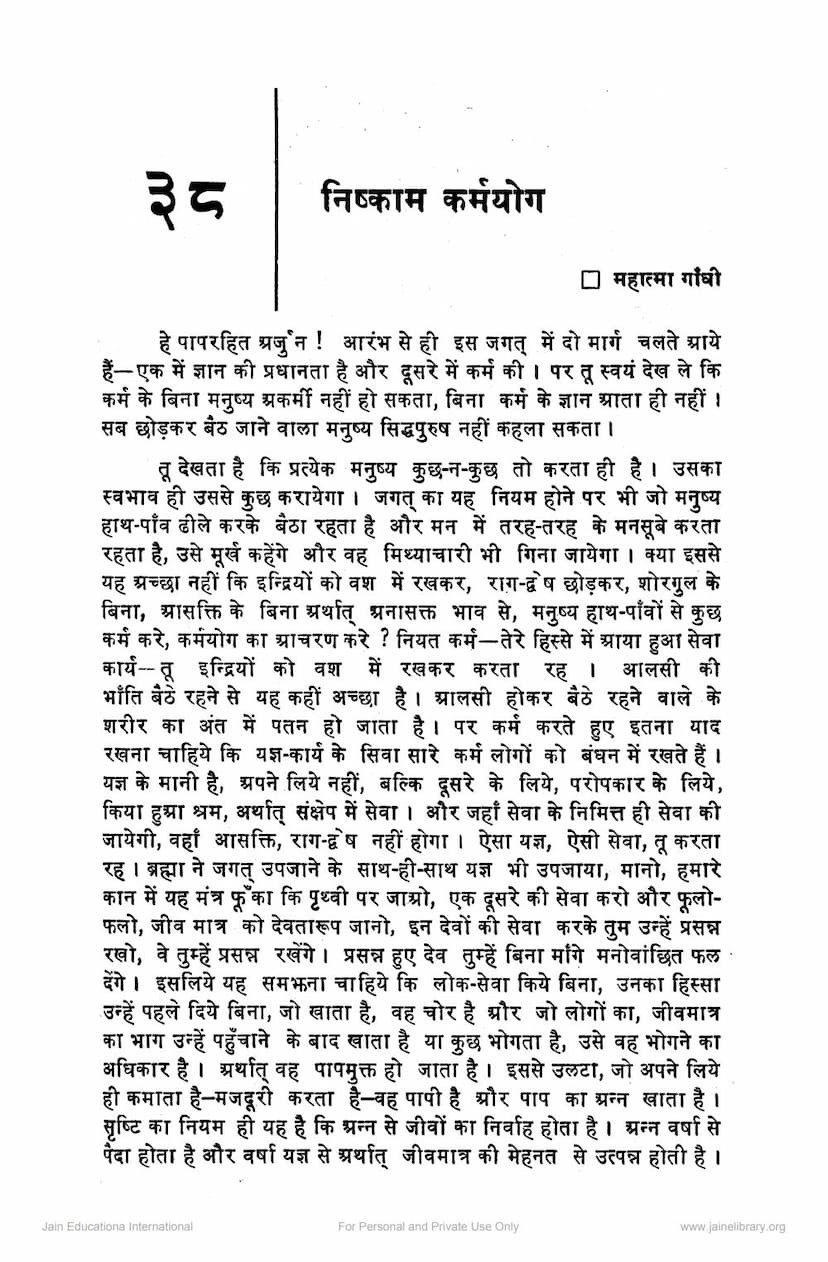
This text, attributed to Mahatma Gandhi and presented as an interpretation of Jain principles related to Karma (action), emphasizes the concept of Nishkam Karma Yoga – selfless action performed without attachment to the results.
The core message is that action is inevitable and inherent to life. The text argues that even knowledge cannot be attained without action. A person who renounces all action and sits idly cannot be considered accomplished. Every individual, by their nature, will perform some action. To remain inactive while harboring desires and intentions is foolish and deceitful.
The ideal approach, therefore, is to engage in action with controlled senses, detachment from desires and aversions (raag-dvesh), and without any attachment (anaashakti). This is the practice of Karma Yoga. The text specifically highlights performing one's prescribed duty (niyat karma), which is a service for the welfare of others, with this detached mindset.
A central concept introduced is Yajna, which is defined as labor undertaken not for oneself but for the benefit of others – altruistic service. When service is performed for its own sake, detachment, aversion, and attachment naturally cease. This Yajna, this selfless service, is to be continuously performed.
The text draws a parallel with the creation of the universe, where Brahma is said to have created Yajna along with the world. This is interpreted as a divine instruction to serve one another and prosper by recognizing all living beings as divine. By serving these divine beings (others), one pleases them, and they, in turn, bestow desired boons. Consequently, anyone who consumes without first fulfilling their duty of service and sharing with others is a thief. Conversely, one who eats after ensuring others receive their share is free from sin. Earning solely for oneself is deemed sinful.
The natural order of existence is that food sustains life, food is produced by rain, and rain is generated by Yajna (collective effort and service). Where there are living beings, there is rain; where there are no living beings, there is no rain. All living beings are laborers. If this holds true for even the simplest creatures, it applies even more so to humans.
The text asserts that action (karma) was created by Brahma, who originated from the immutable Brahma (Akshar Brahma). Therefore, the Supreme Being resides in all Yajna and service. Those who do not follow this principle are considered sinners and live in vain.
Even individuals experiencing inner peace and contentment cannot abandon their duties. Thus, one should continue to perform their duties without attachment or aversion. Performing actions with detachment leads to the realization of the divine. Examples like King Janak, who achieved spiritual realization through his actions for the welfare of the world, are cited to illustrate this point. The principle of emulation is also mentioned, where ordinary people follow the conduct of exemplary individuals.
The text highlights Gandhi's own example of working tirelessly without attachment for the welfare of the world and how this inspires others. He emphasizes that if wise individuals become inactive, others will follow suit, leading to moral decay. Therefore, a wise person must act with detachment to prevent others from becoming corrupted and to gradually teach them detachment.
Actions performed out of one's natural disposition and inherent qualities are also discussed. It is foolish to believe oneself to be the sole doer of these natural actions, such as breathing or blinking. Such actions, performed without ego or a sense of possession, are considered a golden path. Surrendering all actions and their results to the divine, and performing them with detachment, eliminates ego and selfishness, rendering all actions pure and free from the bondage of karma.
The text also addresses the struggle against desire (kaam) and anger (krodh), identified as the primary enemies of humanity. These are described as a formidable force that can cloud knowledge, akin to dirt on a mirror or smoke obscuring a flame. Desire is portrayed as a fierce fire that overpowers the senses, mind, and intellect.
The solution lies in conquering the senses first, then the mind, which will then bring the intellect under control. The underlying strength of the soul is often underestimated, leading to a feeling of helplessness against the senses, mind, and intellect. Recognizing the soul's power makes overcoming these obstacles easier.
Finally, the text advises to remain steadfast in one's own duty (swadharma), even if other paths appear more appealing. Death while adhering to one's swadharma is considered liberation. When Arjuna asks what compels humans towards sin, the response is that desire and anger are the culprits, acting like brothers who provoke action. The text concludes by emphasizing that controlling the senses, mind, and intellect through the power of the soul renders the armies of desire and anger powerless.