
New Sanskrit Fragments Of Pramanavinischayah First Chapter
Added to library: September 2, 2025
Summary
Here's a comprehensive summary of the provided text, "New Sanskrit Fragments Of Pramanavinischayah First Chapter" by Ernst Steinkellner, focusing on the key points and contributions of the article:
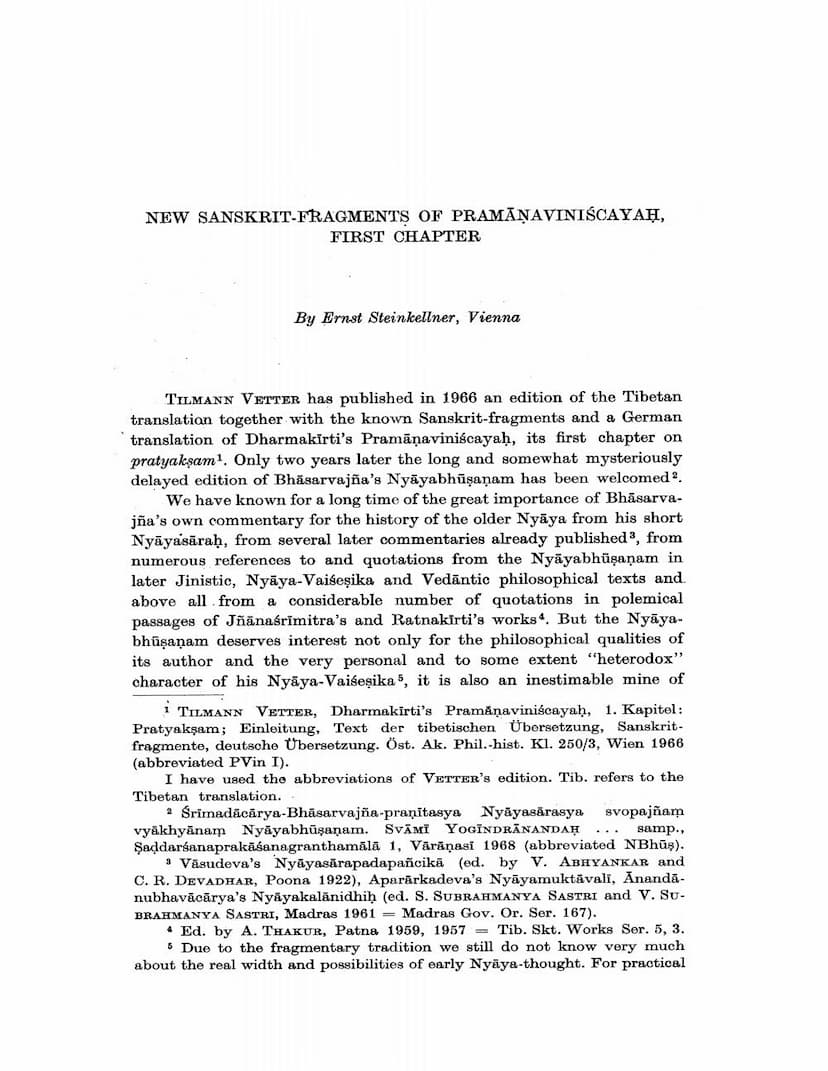
The article by Ernst Steinkellner presents a collection of newly discovered Sanskrit fragments of the first chapter (Pratyakşam) of Dharmakīrti's Pramāņaviniscayaḥ (PVin). These fragments are primarily derived from the Nyāyabhūṣaṇam, a commentary by Bhāsarvajña.
Key Contributions and Findings:
- Importance of Bhāsarvajña's Nyāyabhūṣaṇam: Steinkellner emphasizes the immense value of the Nyāyabhūṣaṇam, not only for understanding Bhāsarvajña's own "heterodox" Nyāya-Vaiśeṣika views but also as a crucial source for the history of early Nyāya and rival philosophical schools. It serves as a significant repository of quotations from a wide array of texts, many of which are no longer extant.
- Bhāsarvajña's Polemical Targets: The article highlights that Bhāsarvajña's main Buddhist targets are the theories of Dharmakīrti and Prajñākaragupta. Bhāsarvajña demonstrates a deep familiarity with both, often quoting extensively from Dharmakīrti's works.
- New Evidence for the Pramāņaviniscayaḥ: A significant finding is that many verses previously attributed to Dharmakīrti's Pramāņavārttikam are, in fact, quoted from the Pramāņaviniscayaḥ. Bhāsarvajña's extensive use of the PVin, quoting both its verses and prose passages, significantly contributes to improving the textual tradition of this important Buddhist philosophical work.
- Focus on the First Chapter: Steinkellner limits his collection to fragments from the first chapter of the PVin to supplement Tilmann Vetter's 1966 edition of the Tibetan translation and known Sanskrit fragments.
- Methodology: The fragments are presented in their sequence within the PVin. Instances where Bhāsarvajña intervenes with his own wording, deviating from the Tibetan translation, are noted, with his tendency for literal quotation but also occasional minor changes or free transformations being observed. Omissions are marked by dots.
- Specific Examples of Fragments and their Significance: The article provides several detailed examples of these newly identified fragments, comparing Bhāsarvajña's rendering with the Tibetan translation and offering critical notes on textual variations and interpretations. These examples illustrate the specific points of philosophical contention and textual recovery:
- Definition of Perception (Pratyakşam): Fragments discuss the distinction between direct (pratyakşam) and inferential (anumānam) knowledge, the nature of valid cognition, and the role of conceptualization (kalpanā).
- The Distinction Between Sensory and Mental Perception: The text delves into the debate about whether mental perception (mānasam pratyakşam) is dependent on sensory perception and the characteristics of immediate self-awareness (svasamvedanam).
- The Nature of Yogic Perception: Fragments address the perception of yogis, achieved through mental cultivation and reasoning, and its validity.
- Illusions and Errors: The article examines Bhāsarvajña's arguments regarding errors like seeing double moons or snakes, discussing whether they originate from the senses or the mind.
- The Role of the Object in Knowledge: Bhāsarvajña's critique of the idea that knowledge is solely determined by the object's nature is presented, emphasizing the role of the knower's own nature and the process of qualification.
- The Problem of Composite Objects (Avayavi): A substantial portion discusses the philosophical debate surrounding composite objects and their perception, with Bhāsarvajña drawing on Dharmakīrti's arguments against their existence. This section highlights textual discrepancies and Steinkellner's efforts to reconstruct the original arguments using the Nyāyavārttika Tātparyatīkā (NVTT).
- The Concept of "Co-occurrence of Perception" (Sahopalambhaniyamatā): The fragments explore the argument that if two things are perceived together, they are not ultimately different, a point Bhāsarvajña uses against the independent existence of qualities like color.
- The Independence of Knowledge from the Object's Visibility: The article concludes by presenting fragments that argue that knowledge is not dependent on the mere existence of an object but on the apprehension of that object, questioning the validity of unperceived objects.
Overall Impact:
Steinkellner's article significantly advances the scholarship on Dharmakīrti's Pramāņaviniscayaḥ by unearthing and presenting crucial Sanskrit fragments from a highly influential commentary. It not only enriches the textual tradition of the PVin but also sheds new light on the philosophical debates of the period and the complex relationship between different Indian philosophical schools. The meticulous cross-referencing with Tibetan translations and other commentaries demonstrates a deep engagement with the primary sources.