
New History Of Tantric Lieterature In India
Added to library: September 2, 2025
Loading image...
Summary
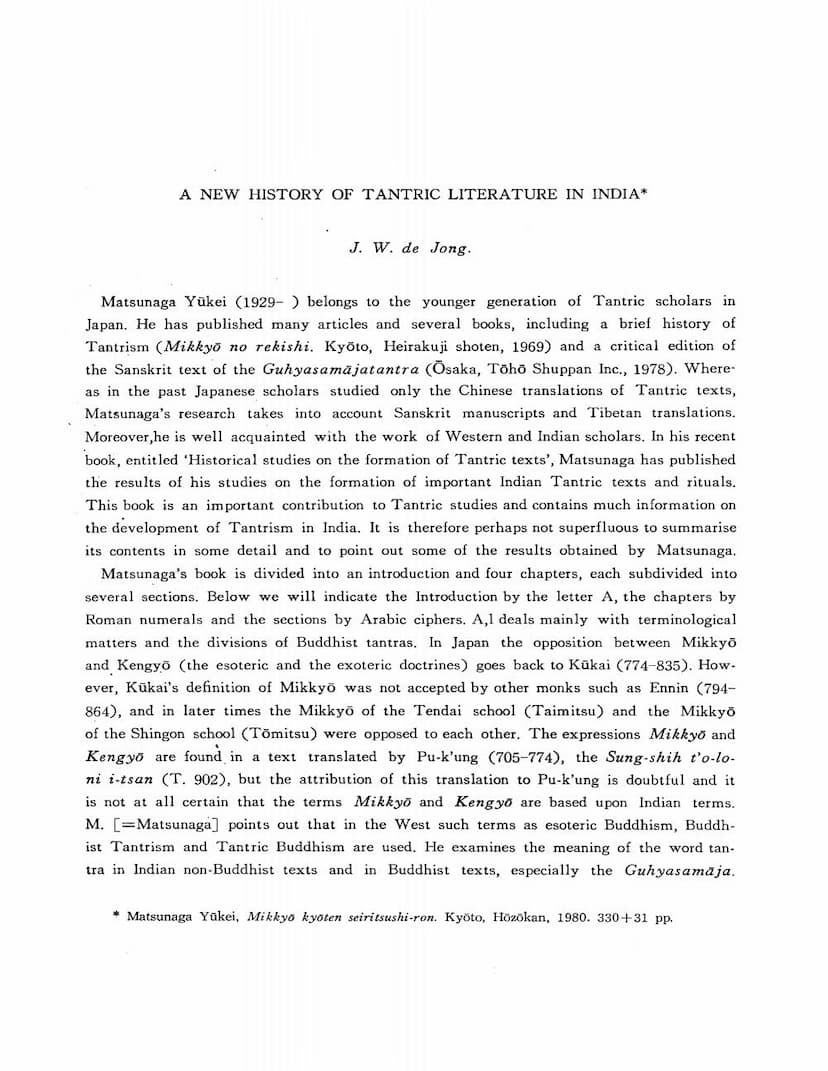
This document is a review by J.W. de Jong of Yukei Matsunaga's book, "Historical studies on the formation of Tantric texts." The review highlights Matsunaga's significant contribution to the field of Tantric studies, particularly his meticulous approach of incorporating Sanskrit manuscripts, Tibetan translations, and the work of Western and Indian scholars, moving beyond the older Japanese tradition of relying solely on Chinese translations.
Here's a breakdown of the key points covered in the review:
Introduction and Terminology:
- Matsunaga's work focuses on the formation of Tantric texts and rituals in India.
- The review discusses the Japanese terms "Mikkyo" (esoteric Buddhism) and "Kengyo" (exoteric Buddhism), tracing their origins and the debate surrounding their definition, particularly in relation to Kūkai and later Japanese schools.
- The author clarifies that "Mikkyo" in the Japanese context can be understood as encompassing all secret doctrines, rituals, spells, and symbols derived from Tantrism within Buddhism, with bodhi (enlightenment) as its ultimate goal.
- The review notes the Japanese terms "junmitsu" (pure Tantrism) and "zomitsu" (mixed Tantrism) and their later, value-laden usage.
- Matsunaga proposes a three-period division of Buddhist Tantrism: early, middle (7th century), and later (from 8th century onward).
- The review addresses the various designations for Tantrism found in Tibetan and Indian sources, such as "Mantrayāna" and "Mantranaya," clarifying that Tantrism is a subdivision of Mahāyāna, not a third yāna distinct from Hinayāna and Mahāyāna.
Tantric Texts and Their Transmission:
- Most Chinese translations of Tantric texts date from the T'ang dynasty, while Tibetan translations began in the late 8th century and were significantly expanded in the 11th century and later.
- Tibetan translations are often considered more accurate than Chinese ones and preserve many texts not found elsewhere.
- The review discusses various historical classifications of Tantric texts, such as the four-fold division (kriyā, caryā, yoga, anuttarayoga) attributed to Bu-ston and earlier classifications by Buddhaguhya.
Ancient Indian Culture and Tantrism:
- Buddhism, including Tantrism, absorbed elements from ancient Indian culture, such as spells and rituals for worldly goals.
- Early Tantric texts prioritized worldly benefits, while later texts shifted focus to the attainment of Buddhahood.
- Abstract Mahāyāna concepts like śūnyatā (emptiness) and prabhāsvara (luminous purity) were integrated into Tantric rituals.
- Hindu deities were incorporated into Buddhist pantheons, evident in mandalas like the Garbhamandala and Vajradhātumandala.
- Tantrism's acceptance of elements opposed to ordinary ethics is examined, linking it to the pursuit of union with the Absolute and the preservation of ancient religious practices. The opposition to conventional ethics is particularly strong in anuttarayoga tantras.
- The review highlights the symbolic meaning of sexual acts in Tantrism, drawing parallels to "primitive peoples'" views and the transformation of ancient magical practices within Mahāyāna Buddhism.
- The concept of transcending vices like passion by means of passion is discussed.
The Role of Dharani and Ritual:
- The term dhāraṇī is explored, tracing its etymology and its dual meaning of "holding" (related to mental concentration) and "spell."
- Dhāraṇī assimilated the meanings of vidyā (science and magic) and came to represent the wisdom and doctrine of the Buddha, capable of warding off evil.
- The review details the evolution of dhāraṇī from memorization of texts to potent magic spells.
- The development of Tantric rituals, including the adoration of statues, the simabandha (kekkai) and homa (goma) rituals, and the abhiṣeka (kanjō), is traced through Chinese translations.
- The emergence and development of the Vajradhātu and Garbha mandalas, including their respective five-Buddha groupings, are meticulously examined, with a focus on their historical evolution and differing iconographic traditions.
Formation of Key Tantric Texts:
- The book delves into the formation of significant middle-period Tantras like the Dainichikyō (Mahāvairocana Sūtra), Kongōchōkyō (Sarvatathāgatatattvasamgraha), and Rishukyō (Adhyardhaśatikā Prajñāpāramitā).
- Key characteristics of middle-period tantras are identified: the goal of Buddhahood, the systematic arrangement of mudrā, dhāraṇī, and samādhi as the "three secrets," the incorporation of Mahāyāna ideas ("ritualization of Mahāyāna ideas"), the formation of mandalas, and the shift of the preacher from Śākyamuni to Mahāvairocana.
- The influence of Madhyamaka and Tathāgatagarbha systems on the Dainichikyō is noted, particularly in the conceptualization of bodhicitta.
- The review analyzes the problematic "randatsu" (inversions) found in Chinese translations, attributing them to conflicting traditions rather than intentional obfuscation.
- The dating of the Dainichikyō is discussed, considering archaeological evidence and the circumstances of its transmission to China.
- The complex textual history of the Tattvasamgraha (Kongōchōkyō), including its various Chinese and Tibetan translations and the evolution of its recensions, is presented.
- The formation and development of the Rishukyō are explored, examining differing scholarly theories about its relationship to earlier Prajñāpāramitā texts and the emergence of its larger and smaller recensions.
- The book provides a detailed analysis of the Guhyasamajatantra, its classification within anuttarayoga tantras, and the evolution of its different traditions and mandalas. The text's structure, with the Mūlatantra and Uttaratantra, and its historical context are investigated.
- The relationship between the Tattvasamgraha, Māyājalatantra, and Guhyasamaja is examined, highlighting the Māyājalatantra's transitional role.
- The dating of the Guhyasamaja is discussed, refuting earlier erroneous identifications and pinpointing its composition to around 1000 AD.
- The doctrinal and ritualistic developments within the Uttaratantra are analyzed, including the introduction of new abhiṣekas and the further elaboration of the four upāyas.
- The study of the Ākhyānatantras and the 'Phags-lugs school is presented, focusing on the seven alamkāras as a system developed to legitimize the school's interpretations and to demonstrate the orthodox Buddhist character of Tantric teachings.
- The complex relationship between the Vajramalatantra and the Pañcakrama is explored, showing how later texts were sometimes fabricated to support existing practices.
- The Vajrajñānasamuccayatantra and its relationship to the Pañcakrama and Pradipoddyotana are examined, suggesting a probable order of composition.
- The Mañjuśrīmūlakalpa is analyzed in terms of its multilingual versions and its diverse content, including the dating of its various chapters and their transmission.
Overall Significance of Matsunaga's Work:
- De Jong praises Matsunaga's meticulous approach, emphasizing the necessity of consulting Sanskrit, Chinese, and Tibetan sources for a comprehensive understanding of Tantric history.
- The book is seen as a crucial contribution to Tantric studies, shedding light on the complex historical development of Tantric rituals and texts.
- The reviewer expresses hope that Matsunaga's work will stimulate further research on the vast amount of Tantric literature, much of which remains unedited or unexplored.
- The review concludes by acknowledging the significant progress made in Tantric studies since the work of Louis de La Vallée Poussin and expresses gratitude for Matsunaga's important contribution towards achieving a complete picture of Tantrism.