
Nagarjuna Logic
Added to library: September 2, 2025
Summary
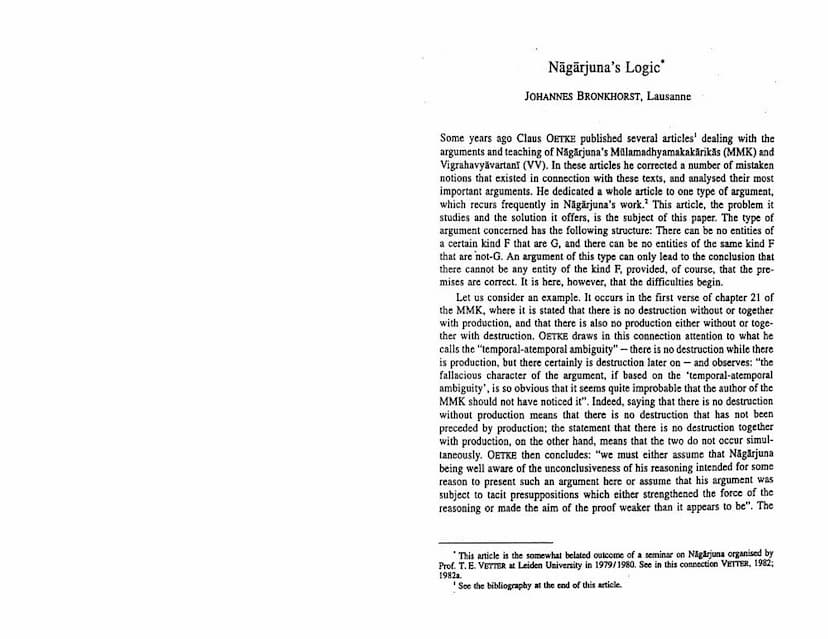
Here's a comprehensive summary of Johannes Bronkhorst's "Nāgārjuna's Logic," focusing on the core arguments presented in the provided text:
Core Problem: The article addresses a recurring pattern in Nāgārjuna's philosophical arguments, particularly in his Mūlamadhyamakakārikās (MMK) and Vigrahavyāvartani (VV). These arguments often seem logically flawed or based on questionable presuppositions when analyzed with standard Western logic. The author, Johannes Bronkhorst, aims to explain these arguments by proposing an alternative framework.
OETKE's Hypothesis (and its limitations): Bronkhorst begins by discussing the work of Claus Oetke, who proposed a solution to these apparent logical flaws. Oetke identified a common argument structure where Nāgārjuna demonstrates that if a certain type of entity (F) existed, it would have to possess contradictory properties (G and not-G). This structure, if sound, leads to the conclusion that the entity (F) cannot exist.
Oetke's key proposal is a general theorem, which Bronkhorst calls "OETKE's theorem": "For all x and for all y: If x is the condition of y / If x is the condition of the existence of y, then y must be something that exists during the existence of x (or: that does not exist exclusively later than x)."
Bronkhorst acknowledges that Oetke's theorem can successfully explain many of Nāgārjuna's arguments, such as those concerning time (past, present, future) and production/destruction. For example, if past, present, and future are conditions for each other, Oetke's theorem implies they must exist simultaneously. Similarly, it helps explain the argument against production and destruction coexisting.
However, Bronkhorst identifies a significant problem with Oetke's theorem: its own seemingly obvious fallacious character. He questions why Nāgārjuna would rely on such a counter-intuitive principle without strong reasons. He also points out that Oetke himself concedes that the MMK author might have applied principles to instances that contradict their general validity. This suggests Oetke's theorem might be explaining the how of Nāgārjuna's reasoning but not the why or its underlying justification in a way that feels philosophically sound.
Bronkhorst's Alternative: The Correspondence Principle
Bronkhorst proposes a different explanation rooted in a fundamental belief of Buddhism at Nāgārjuna's time: the interconnectedness and ultimate unreality of the phenomenal world, heavily influenced by language. He posits that Nāgārjuna inherited and extended this idea, focusing on the way language shapes our understanding of reality.
Bronkhorst's proposed principle, which he calls the "correspondence principle," can be summarized as: "the words of a sentence must correspond, one by one, to the things that constitute the situation described by that sentence."
How the Correspondence Principle Explains Nāgārjuna's Arguments:
- Language and Reality are Intertwined: Nāgārjuna believed that the phenomenal world is determined by language. Therefore, analyzing sentences and the relationships between their words was a valid way to understand and critique the phenomenal world.
- Linguistic Structure Dictates Ontological Requirements: If a sentence uses multiple words referring to a concept (e.g., "going"), the correspondence principle implies that there must be corresponding distinct instances of that concept in the described situation.
- Examples:
- Time (MMK 19.1-2): The statement "present and future depend on the past" implies, through the correspondence principle, that present and future must exist in the past. This leads to the contradiction that Nāgārjuna highlights.
- Production and Destruction (MMK 21): Statements like "destruction depends on production" or "destruction occurs along with production" necessitate, by the correspondence principle, that production and destruction coexist in the described situation. Nāgārjuna then points out this contradicts experience, as they don't occur simultaneously.
- Cause and Effect (MMK 1.6): The statement "a is the cause of b" or "the effect depends on the cause" implies, via the correspondence principle, that the cause and its effect must be present together in the described situation. This conflicts with the empirical observation that the effect doesn't exist while its cause is active.
- Characteristics of Conditioned Things (MMK 7.2): If multiple characteristics (like origination, etc.) are interdependent and true statements describe this interdependence, the correspondence principle implies they must exist together in the phenomenal world. Nāgārjuna then notes this is not what experience shows.
- Going (MMK 2.5, 2.22-23): Sentences like "the road is being gone" or "the goer goes" contain multiple references to "going." The correspondence principle demands corresponding instances of "going." In MMK 2.5, this leads to the problematic idea of two goings for one road. In MMK 2.22-23, it leads to a discussion of whether the goer goes the "manifesting going" or another one, highlighting the linguistic underpinnings of the argument.
- Production (MMK 7.17): The sentence "The jar is being produced" implies, by the correspondence principle, that a jar exists in the situation described. Nāgārjuna then questions what is being produced if there's no existing jar to begin with.
Comparison and Advantages of the Correspondence Principle:
- Wider Scope: Bronkhorst argues that the correspondence principle covers all cases explained by Oetke's theorem but also extends to situations where Oetke's theorem seems inapplicable, particularly those rooted in the relationship between language and reality.
- Philosophical Plausibility: The correspondence principle aligns with a well-established Buddhist belief of Nāgārjuna's era, making it a more plausible tacit presupposition for him than Oetke's theorem. It explains why Nāgārjuna might have made these arguments without resorting to an apparently flawed abstract theorem.
- Direct Explanation: In many cases, the correspondence principle offers a more direct and evident explanation of Nāgārjuna's logical moves.
Weaknesses and Caveats of the Correspondence Principle:
- Imprecision: The formulation of the correspondence principle is "approximate." Bronkhorst acknowledges that it raises questions about how Nāgārjuna viewed the correspondence for all word types (adverbs, indeclinables, etc.) and whether he envisioned a specific ontological structure dictated by language.
- Lack of Explicit Evidence: Nāgārjuna's texts may not contain explicit statements that allow for definitive conclusions on these finer points of his linguistic philosophy.
- Ultimately Unconcerned with Phenomenal Reality: Bronkhorst reminds us that for Nāgārjuna, the phenomenal world itself is ultimately unreal. Therefore, the precise ontological implications of the correspondence principle might not have been Nāgārjuna's primary concern; the goal was to demonstrate the ultimate unreality through these linguistic-ontological paradoxes.
Conclusion:
Bronkhorst concludes that while Oetke's theorem provides a functional explanation for many of Nāgārjuna's arguments, it suffers from its own implausibility. The correspondence principle, however, offers a more philosophically grounded and comprehensive explanation, connecting Nāgārjuna's logic directly to the prevalent Buddhist philosophical ideas of his time concerning the role of language in constructing our understanding of an ultimately unreal phenomenal world. He suggests that Oetke's theorem may even be a specific instance or a part of this broader correspondence principle.