
Miszellen Zur Erkenntnistheoretisch Logischen Schule Des Buddhismus
Added to library: September 2, 2025
Summary
Here's a comprehensive summary of the provided text, focusing on the Jain perspective as requested, though the text itself primarily discusses Buddhist philosophy:
The provided text, "Miszellen Zur Erkenntnistheoretisch Logischen Schule Des Buddhismus" by Ernst Steinkellner, delves into the intricate logical and epistemological frameworks within Buddhist philosophy. While the title and content are focused on Buddhism, the context of the Jain Education International catalog link suggests its relevance for individuals studying comparative philosophy or the history of Indian thought, which often includes Jainism.
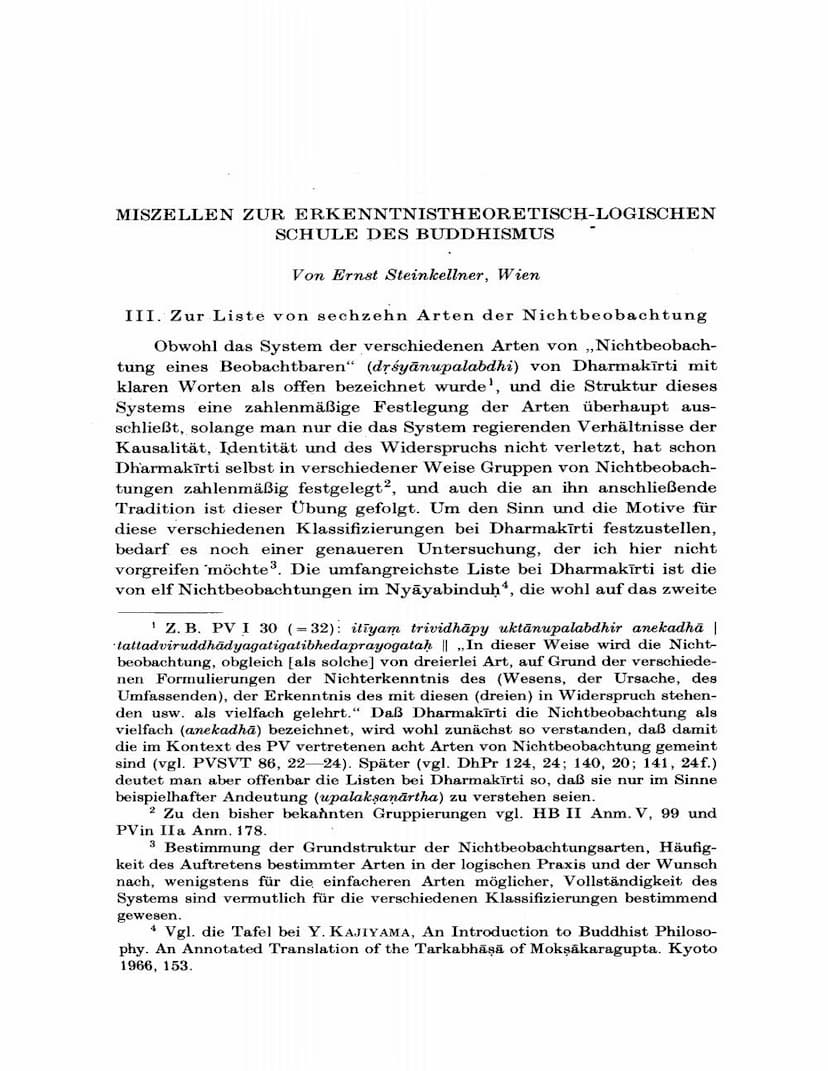
The article specifically addresses the concept of "Nichtbeobachtung eines Beobachtbaren" (drśyānupalabdhi), which translates to "non-perception of a perceivable." This is a key topic in Buddhist epistemology, particularly in the works of Dharmakīrti.
Here's a breakdown of the main points covered in the excerpt:
-
Dharmakīrti's System of Non-Perception: The author highlights that Dharmakīrti, a prominent Buddhist logician, presented a system of various types of non-perception. Although Dharmakīrti himself stated that this system was open-ended and not numerically fixed, as long as the fundamental principles of causality, identity, and contradiction were not violated, he did categorize and enumerate different types of non-perception.
-
Numerical Classifications: The text notes that Dharmakīrti himself created various numerical classifications of non-perception. The most extensive list attributed to him is one of eleven types of non-perception found in his Nyāyabinduḥ, which likely stems from the second and third chapters of his Pramāņaviniscayah.
-
Later Traditions and Expansion: The tradition following Dharmakīrti continued this practice of numerical classification. The article points to a later system that presents a list of sixteen types of non-perception, which is found in late handbooks like the Tarkabhāṣā and Tarkasopānam.
-
Tracing the Origins of the Sixteen-Type List: The author, referencing the work of Y. Kajiyama, discusses the effort to trace the origins of this sixteen-type list.
- Durvekamiśra, in his Dharmottarapradīpaḥ, presents a list of fourteen types. He also mentions "certain others" (kecit) who proposed two additional types, bringing the total to sixteen.
- Jñānaśrīmitra's mention of vyāpakaviruddhakāryopalabdhi suggests he was aware of more types than Dharmakīrti. Kajiyama posits that Jñānaśrīmitra's group of logicians was among the first to propose the classification of sixteen types.
-
Earlier Antecedents of the Sixteen-Type List: However, the text argues that the sixteen-type list is largely older than Jñānaśrīmitra.
- Śāntarakṣita's Contribution: Śāntarakṣita, in his commentary on the Vādanyāyaḥ, expands upon Dharmakīrti's eleven types by adding four more types with corresponding examples. These are:
- kāraṇaviruddhavyāptopalabdhi
- kāryaviruddhavyāptopalabdhi
- vyāpakaviruddhakāryopalabdhi
- kāryaviruddhakāryopalabdhi
- The first two of these are likely the ones Durvekamiśra attributes to "certain others," possibly referring to Śāntarakṣita himself. This brings the total for Śāntarakṣita to fifteen types.
- The missing type to complete the sixteen is vyāpakaviruddhavyāptopalabdhi.
- The text notes that Śāntarakṣita's expanded list is also consciously kept open-ended, as indicated by the use of "-ādi" (meaning "and so on") in his enumeration. However, he doesn't seem to have finalized the system in the way Ratnakīrti did. The author suggests that Śāntarakṣita might have intended his additions to be easily remembered by providing summarizing verses.
- Śāntarakṣita's Contribution: Śāntarakṣita, in his commentary on the Vādanyāyaḥ, expands upon Dharmakīrti's eleven types by adding four more types with corresponding examples. These are:
Relevance to Jainism (Indirect):
While the direct subject is Buddhist logic, the significance for Jainism lies in the broader context of understanding the development of philosophical and logical systems in ancient India. Jainism, like Buddhism, has a rich tradition of epistemology and logic (pramāņa and nayavāda). Studying the sophisticated logical frameworks of Buddhism can offer:
- Comparative Insights: Understanding Buddhist categories of knowledge and non-knowledge can provide points of comparison with Jain theories of perception (pratyaksha), inference (anumāna), and scripture (āgama).
- Historical Development: It helps contextualize the intellectual landscape in which Jain philosophy also evolved. The challenges and debates addressed by Buddhist logicians often mirrored those faced by Jain thinkers, contributing to the overall intellectual heritage of India.
- Methodological Similarities: Both traditions engaged in rigorous analysis of concepts, often through classification and categorization. Examining the methods used by Buddhist logicians, such as the systematic enumeration of types of non-perception, can illuminate the analytical tools employed in Indian philosophy more generally, including Jainism.
In essence, this excerpt from Steinkellner's work provides a detailed historical and analytical account of the evolution of the concept of "non-perception" within Buddhist logic, tracing its development from Dharmakīrti through later scholars, and highlighting the emergence of a sixteen-type classification. For those interested in Jainism, it offers valuable comparative material for understanding the broader philosophical currents of ancient India.