
Miszellen Zur Erkenntnistheoretisch Logischen Schule Des Buddhismus
Added to library: September 2, 2025
Summary
Here's a comprehensive summary of the provided Jain text, "Miszellen Zur Erkenntnistheoretisch Logischen Schule Des Buddhismus" by Ernst Steinkellner, focusing on the aspects relevant to understanding Dharmakirti's school of Buddhist philosophy:
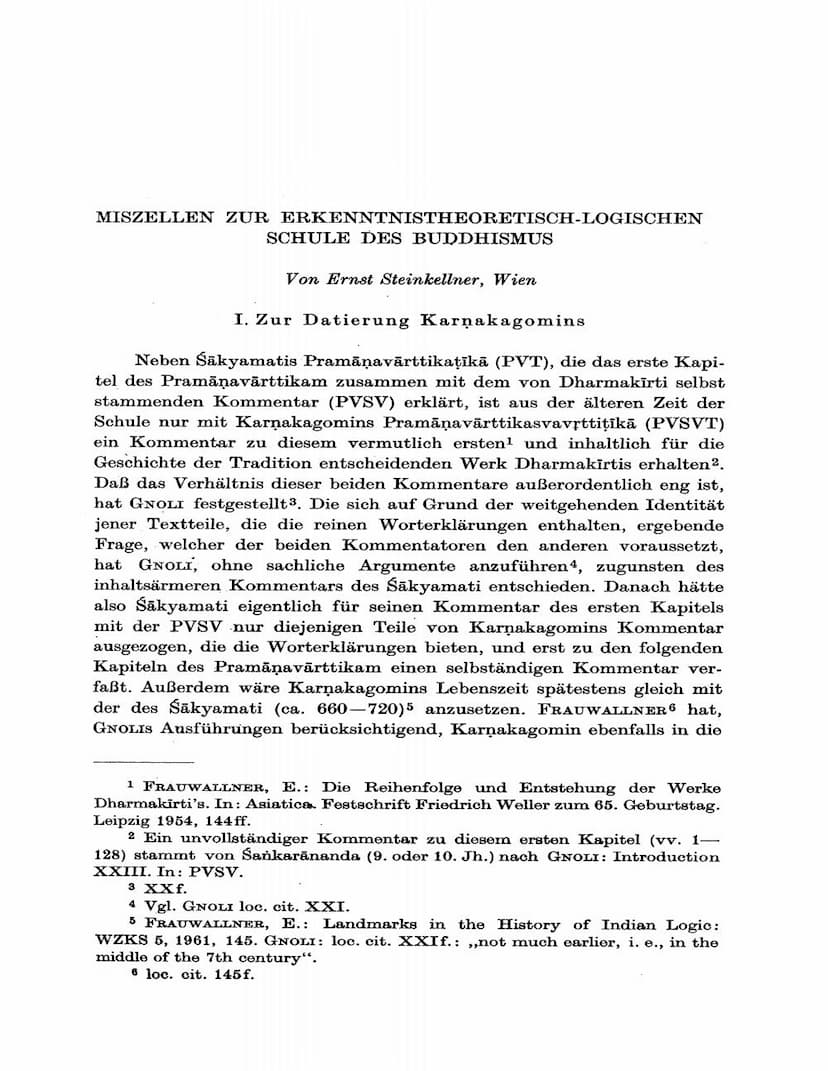
The article by Ernst Steinkellner, "Miszellen Zur Erkenntnistheoretisch Logischen Schule Des Buddhismus" (Miscellanea on the Epistemological-Logical School of Buddhism), delves into the dating and textual relationships of early commentators on Dharmakirti's works. The primary focus is on Karņakagomin's commentary on Dharmakirti's Pramāņavārttika (PVSVT) and its relationship with Sākyamati's commentary (PVT) and Dharmottara's commentary on the Pramāņaviniscaya (PVinT).
I. Zur Datierung Karņakagomins (On the Dating of Karņakagomin)
- Challenging Existing Chronologies: Steinkellner begins by questioning the earlier dating of Karņakagomin, which placed him around the same time as Sākyamati (circa 660-720 AD) and before Śāntarakṣita (circa 725-788 AD). This earlier dating was based on the perceived close relationship between Karņakagomin's and Sākyamati's commentaries.
- Karņakagomin's Dependence on Other Commentators: Steinkellner presents textual analysis demonstrating that Karņakagomin not only used Sākyamati's PVT but also Dharmottara's PVinT. This is a significant finding because it means Karņakagomin cannot predate Dharmottara.
- Textual Evidence for Dependence: The article meticulously compares specific passages from PVSVT with corresponding sections in PVT and PVinT. It shows that Karņakagomin often incorporates explanations and even alternative interpretations found in these other works. In some cases, Karņakagomin cites alternative explanations using phrases like "anye tu... vyācaksate" (others say...), which are then found in Sākyamati or Dharmottara's works. This indicates a clear pattern of Karņakagomin drawing from these sources.
- Reversing the Assumed Relationship: Steinkellner concludes that the relationship between Karņakagomin and Sākyamati is opposite to what was previously assumed. Instead of Sākyamati condensing Karņakagomin, it is Karņakagomin who largely used Sākyamati's PVT as his main source for verbal explanations.
- Dharmottara's Influence: Furthermore, Karņakagomin also utilized Dharmottara's commentary on the Pramāņaviniscaya (PVinT). This is considered natural given the parallelisms in Dharmakirti's own works (PVSV and PVin).
- Revised Dating of Karņakagomin: Based on the dependence on Dharmottara, whose PVinT provides a terminus post quem, and also on Sankarāsvamin (whose work is dated after 765 AD), Steinkellner proposes that Karņakagomin's commentary was likely composed around 800 AD. This places him in the period of intensive "conceptual penetration" of Dharmakirti's works, which began in the latter half of the 8th century.
- Significance for Textual Criticism: Understanding these dependencies is crucial for textual criticism. It helps in reconstructing the original Sanskrit wording of Sākyamati's commentary, which is largely preserved through Karņakagomin's work. It also aids in controlling the quality of the Tibetan translations of PVSVT, which was not translated into Tibetan.
- Karņakagomin's Working Method: Steinkellner observes that Karņakagomin wasn't just a passive compiler. While he used existing material, he carefully considered the explanations of his predecessors and consciously chose between them. He also clarified and elaborated on the material, either by adding glosses or by restating content in his own words.
II. Sanskrit Fragmente der Pramāṇaviniscayaṭikā, 2. Kapitel (Sanskrit Fragments of the Pramāṇaviniscayaṭikā, Chapter 2)
- Dharmottara's Commentary as a Key Example: This section highlights Dharmottara's commentary on Dharmakirti's Pramāņaviniscaya (PVinT) as a prime example of the explanatory work that began in the latter half of the 8th century, focusing on a deep understanding of Dharmakirti's doctrines and their systematic connections.
- Distinguishing Verbal and Explanatory Sections: Dharmottara's commentary, like others from this period, can be divided into sections of pure verbal explanation and more extensive explanations of meaning, often including polemics or excursions. It is these latter sections that represent the significant contributions of these commentators.
- Recovering Original Sanskrit Fragments: The purpose of this section is to present fragments of Dharmottara's PVinT that have been recovered from later commentaries that utilized it. This is important because large portions of PVinT were not translated into Tibetan.
- Confirming Dharmottara's Contributions: The recovery of these fragments, often supported by citations in works like Karņakagomin's PVSVT and Durvekamiśra's Dharmottarapradipaḥ (DhPr), confirms that Dharmottara's detailed explanations represent a significant contribution to the development of Dharmakirti exegesis.
- Value of Fragments: These recovered fragments are valuable for understanding Dharmottara's independent achievements and for source criticism of later works. Steinkellner notes that reconstructing the original Sanskrit of Dharmottara's verbal explanations might be less fruitful than understanding his deeper conceptual contributions, as the Tibetan translations are generally good for those parts.
- Presentation of Fragments: The article then lists and analyzes several Sanskrit fragments from the second chapter of PVinT, citing their parallels in later commentaries (DhPr and PVSVT). These fragments illustrate Dharmottara's engagement with specific logical and epistemological issues within Dharmakirti's framework.
Overall Significance:
Ernst Steinkellner's article fundamentally re-evaluates the chronological order of early Buddhist philosophers and commentators on Dharmakirti. By meticulously analyzing textual dependencies, he demonstrates that Karņakagomin relied on Sākyamati and Dharmottara, pushing Karņakagomin's dating later (around 800 AD). This also highlights the importance of Dharmottara's commentary on the Pramāņaviniscaya as a crucial source and a testament to the scholarly engagement with Dharmakirti's complex thought in the late 8th century. The article also underscores the value of recovering Sanskrit fragments of important Buddhist philosophical texts through the study of later commentaries.