
Mimamsa Versus Vaisesika
Added to library: September 2, 2025
Summary
Here's a comprehensive summary of Johannes Bronkhorst's "Mimamsa Versus Vaisesika: Parthasarathi and Kumārila on the Creation and Dissolution of the World," based on the provided text:
The article by Johannes Bronkhorst examines a crucial point of contention between the Mimamsa and Vaisesika schools of Indian philosophy, specifically concerning their views on the creation and dissolution of the world, as interpreted by the Mimamsa commentator Parthasarathi Misra. The core of the discussion revolves around how these schools explain the mechanism of karma (action and its consequences) and the role of a creator God in cosmic cycles.
Parthasarathi's Representation of the Vaisesika View:
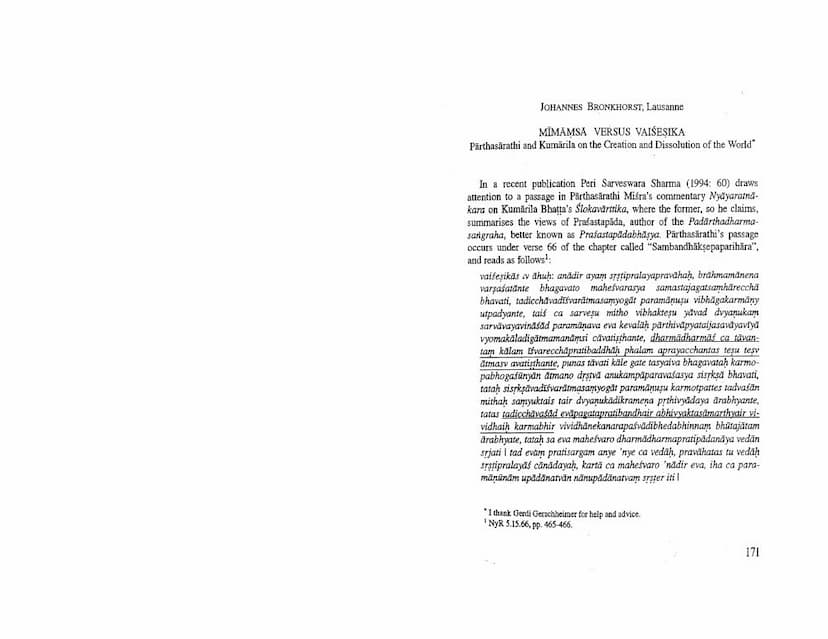
Bronkhorst highlights a passage in Parthasarathi Misra's commentary, Nyayaratnakara, on Kumarila Bhatta's Slokavarttika. In this passage, Parthasarathi purports to summarize the Vaisesika position on creation and dissolution. According to Parthasarathi, the Vaisesikas believe:
- The cycle of creation and dissolution is eternal.
- At the end of a Brahma-year (a cosmic epoch), God (Mahesvara) desires the dissolution of the entire world.
- This divine desire, in conjunction with the souls, causes the separation of atoms (the fundamental constituents of the universe).
- Atoms, devoid of their composite forms and separated from each other, along with ether, time, space, and souls (endowed with dharma and adharma), remain during this period of dissolution.
- When the time comes for creation, God, moved by compassion for souls who have not yet experienced the fruits of their karma, desires creation.
- This desire causes movements in the atoms, leading to their recombination into dyads, triads, and eventually the cosmos.
- God then creates the Vedas to guide beings in their righteous actions (dharma).
Comparison with Prasastapada's Padarthadharmasangraha:
Bronkhorst notes that Parthasarathi's account closely resembles a passage in Prasastapada's Padarthadharmasangraha, the foundational text of Vaisesika. However, he also identifies significant differences, particularly in the precise phrasing regarding God's desire and its interaction with atoms and souls. Bronkhorst suggests that Parthasarathi might have misinterpreted a complex Vaisesika term, leading to a potentially inaccurate representation of their doctrine.
Critique of Parthasarathi's Interpretation:
Bronkhorst questions whether Parthasarathi is accurately summarizing the Vaisesika view or perhaps misrepresenting it to serve his own Mimamsa agenda. He points out several discrepancies:
- God's Role in Dissolution: Bronkhorst argues that Kumarila Bhatta, a key Mimamsa figure, did not believe in cosmic dissolution in the same way as the Vaisesikas and certainly didn't attribute it to God's desire. Kumarila spoke of creation and dissolution as activities of Prajapati.
- Interference with Karma: A central claim attributed by Parthasarathi to the Vaisesikas is that God's desire interrupts the working of karma during dissolution. Bronkhorst finds this specific idea highly improbable for the Vaisesikas, suggesting it might be Parthasarathi's own polemical construction.
- Vaisesika Explanation of Karma: The article explains that the Vaisesika introduction of a creator God was primarily to solve the problem of how karma could be understood and effectively administered. Without a conscious agent, the seemingly automatic and just distribution of rewards and punishments seemed inexplicable to them. Prasastapada, for instance, posits God as guiding the adrsta (unseen forces of dharma and adharma) to ensure just outcomes.
Jayanta Bhatta's Nyayamanjari and a Different Vaisesika Account:
Bronkhorst introduces evidence from Jayanta Bhatta's Nyayamanjari, which presents a Vaisesika view of creation and dissolution that aligns more closely with Parthasarathi's description. Jayanta's text suggests that God's desire paralyzes the karma during dissolution and then activates it for creation. However, Bronkhorst carefully distinguishes this from the idea that God only interferes; Jayanta's argument that unconscious things require a conscious supervisor to act implies that divine intervention is necessary for karma to function at all, not just to pause it.
Parthasarathi's Shift in His Sastradipika:
Crucially, Bronkhorst notes that Parthasarathi's earlier work, the Sastradipika, presents a Vaisesika view that is less dramatically opposed to the school's core tenets. In the Sastradipika, Parthasarathi describes atoms as not dissolving, but composite substances dissolving due to God's desire, while atoms and souls with their dharma and adharma remain. Creation then occurs through God's desire and the souls' dharma and adharma. This earlier account is more in line with general Vaisesika doctrine.
Conclusion:
Bronkhorst concludes that in his later work, the Nyayaratnakara, Parthasarathi Misra presents a fundamental difference between Mimamsa and Vaisesika regarding the mechanism of karma. While the Vaisesikas introduced a creator God to explain karma and teleology, Mimamsakas, bound by their belief in the eternality of the Veda and the universe, struggled with this. Kumarila focused on criticizing the concept of a creator God, while Parthasarathi, according to Bronkhorst, goes further by depicting the Vaisesika system as one where God actively interferes with karma, a portrayal that Bronkhorst considers an inaccurate representation of the Vaisesika system, particularly in its earlier stages. Parthasarathi's argument that karma would function without divine interference, except that God's desire interrupts it, is presented as a Mimamsa-inspired twist on the Vaisesika problem of explaining the efficacy of karma.