
MIA Miscellany
Added to library: September 2, 2025
Summary
Here's a comprehensive summary of the provided Jain text, "MIA Miscellany" by H. C. Bhayani, focusing on the different sections:
MIA Miscellany by H. C. Bhayani
This collection of essays by H. C. Bhayani delves into critical interpretations of various Jain and Prakrit literary and linguistic aspects. The author engages with existing scholarship, particularly the English translation and notes by N.G. Suru on the Gaudavaho, and offers alternative readings and analyses.
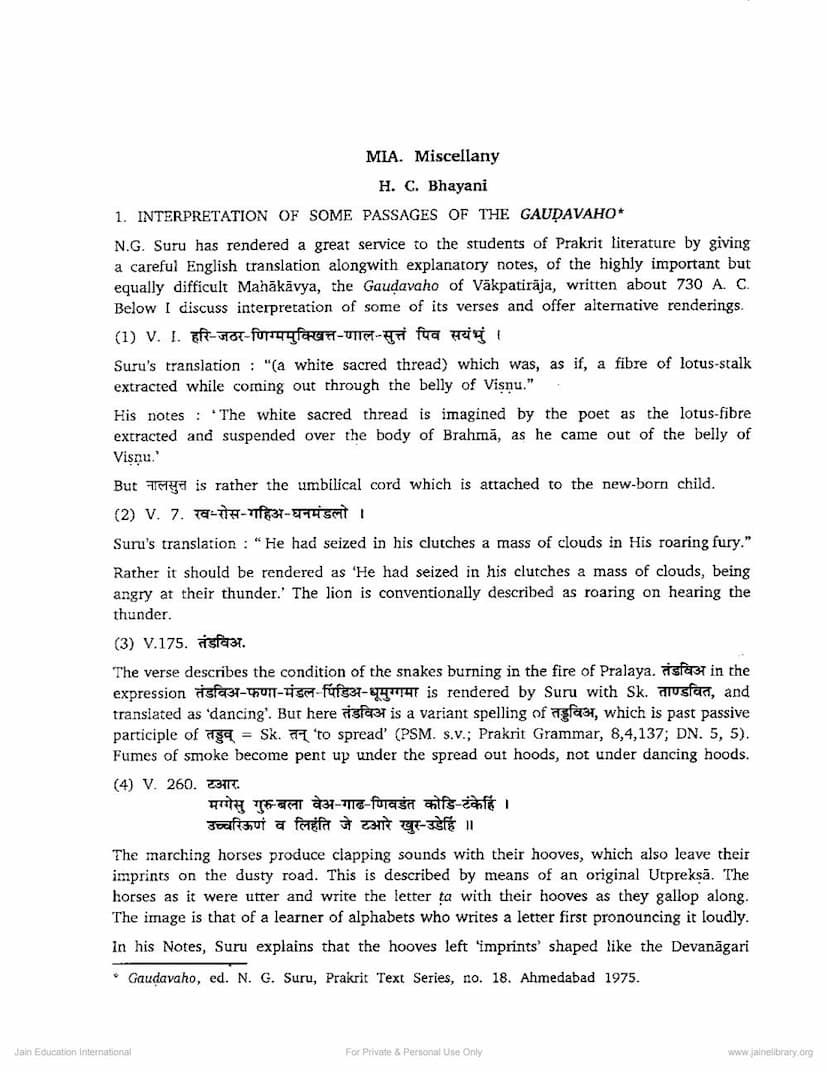
1. Interpretation of Some Passages of the Gaudavaho:
Bhayani provides a detailed re-examination of several verses from the Gaudavaho, a significant Mahākāvya by Vākpatirāja. He proposes corrections and alternative interpretations to Suru's translations, often highlighting subtle nuances of Prakrit vocabulary and grammar. Key points include:
- Verse 1: Reinterprets a "white sacred thread" described as a "fibre of lotus-stalk" not as an umbilical cord, but as a more literal depiction of a lotus fiber.
- Verse 7: Suggests the lion's anger is directed at the thunder, rather than a general furious seizure of clouds.
- Verse 175: Clarifies that a word associated with snakes burning in fire refers to "spread out" hoods rather than "dancing" hoods, based on variant spellings and etymology.
- Verse 260: Explains an utprekṣā (simile) involving horses' hooves imprinting the letter "ta" on a dusty road. Bhayani argues the shape matches early 8th-century scripts of the letter "ta" rather than a later Devanagari form.
- Verses 317, 479: Corrects the interpretation of a phrase describing a courtyard as "frequented by gusts of stormy winds" and attended by apparitions, rather than simply being "kept awake." The term indicates attendance or being marked by something.
- Verse 333: Challenges a translation that claims a corpse can "easily breathe." Bhayani suggests a textual corruption and proposes that the original word referred to swelling, which makes a corpse a more fitting "vehicle" for a deity in a symbolic sense.
- Verse 341: Critiques a translation misunderstanding the terms oḷibhāva and maṇaṇāhi. Bhayani posits that maṇaṇāhi refers to musk (mṛganābhi) and oḷibhā to white ants, and the verse describes the illusion of decorative designs created by white ants on a corpse's dusty face.
- Verse 495: Argues against Suru's interpretation of "city-gate" and "balcony." Bhayani states the verse refers to the "moat around the city" and the "sky itself" as a unique moat, signifying the city's ethereal ascent.
2. On the Appellations Madanamañjuka and Hepphaga in Some Brhatkatha Versions:
Bhayani examines variations in the names of Naravāhanadatta's queen (Madanamañjukā, Madanamañcukā, Madanamañjūsā, Madanamañjulā) and the hostile Vidyādharas (Hepphaa/Hephaa/Hephaga, Ipphaka, Ityaka) in different versions of Guṇāḍhya's Vaddakahā (Brhatkathā).
- He discusses the etymology and potential original forms, suggesting Madanamañcukā might be a later variation from Madanamañjukā. The latter can be interpreted as "beautiful as the God of Love," while Madanamañcukā could imply a "couch of the God of Love."
- For the hostile Vidyādharas, Bhayani proposes ipphaka as a possible original form, with hepphaka developing through Prakrit phonetic changes like prothesis of 'h'. The etymology of ipphaka remains obscure, with a tentative connection to Sanskrit terms related to Kama.
3. On the Prakrit Metre Nijjhāiyā (Nirdhyāyikā / Nidhyāyika):
This section focuses on the Prakrit metre Nijjhāiyā, comparing its definitions and structures in various prosodial manuals:
- Jānāśrayi (6th century): Defines Nirdhyāyikā with 17 mātras per line (4+4+u-u+uuu- or -u-).
- Vrttajātisamuccaya (Virahāňka): Calls the metre Niddhāiä or Nivvāiä, with the same structure as in Jānāśrayi.
- Chandonuśāsana (Hemacandra, 12th century): Defines Nirdhyāyikā (Pk. Nijjhāiā) with three types: 17, 14, or 19 mātras.
- Bhayani also discusses the metre's role within complex metres like Trikalaya or Tribhangi, suggesting these were song forms with three metrical units.
- He connects Nijjhāiyā to a list of 72 arts in Jain canonical texts, identifying niddaiya in the Rājapraśnīya as a corrupt form of nijjhāiya. He dates the list of arts to the 6th century, based on the Jānāśrayi's awareness of Nijjhāiā lyrics.
4. On the Language of the Song-Text of the Lāsyānga Saindhava:
Bhayani examines the Lāsyānga Saindhava, a dramatic element described in theatrical treatises.
- He notes that the Abhinavabhārati specifies the song text should be in Prakrit.
- The Nāṭakalakṣaṇaratnakośa defines Saindhava as relating to the "dialect of Sindhudeśa."
- Bhayani suggests that the language of the song-text was sometimes Apabhramśa, citing Anandavardhana's verse designated as Saindhavabhāṣā by Abhinavagupta, even though its language is standard Apabhramśa. This implies a connection between Apabhramśa and the Saindhava dialect in dramatic performances.
5. The Illustration of Utthakka Cited in the Svayambhūcchandas:
This section identifies the source of an anonymous verse cited as an illustration of the metre Utthakka in Svayambhū's Svayambhūcchandas.
- Bhayani successfully traces the verse to Svayambhū's own epic poem, Ritthanemicariya.
- This identification has significant implications: it confirms that Svayambhūcchandas was written after Ritthanemicariya, that its anonymous citations are from Svayambhū's works, and that a significant portion of the Ritthanemicariya is composed in the Utthakka metre.
- He notes the Utthakka metre's tradition of employing yamaka (alliteration/rhyme) and its similarity to other Apabhramśa and Prakrit metres.
In essence, "MIA Miscellany" showcases H. C. Bhayani's meticulous scholarship in deciphering and reinterpreting complex aspects of ancient Indian literature and linguistics, particularly within the Jain and Prakrit traditions. His work contributes to a deeper understanding of poetic conventions, metrical forms, and the evolution of language and terminology.