
Method Of Grow Crooked Bamboos For Palanquin Beams
Added to library: September 2, 2025
Summary
Here's a comprehensive summary of the provided Jain text, "ŚIBIKA-VAKRAVAMSA-LAKŞAŅAM : A Method to Grow Crooked Bamboos for Palanquin Beams," by K. V. Sarma:
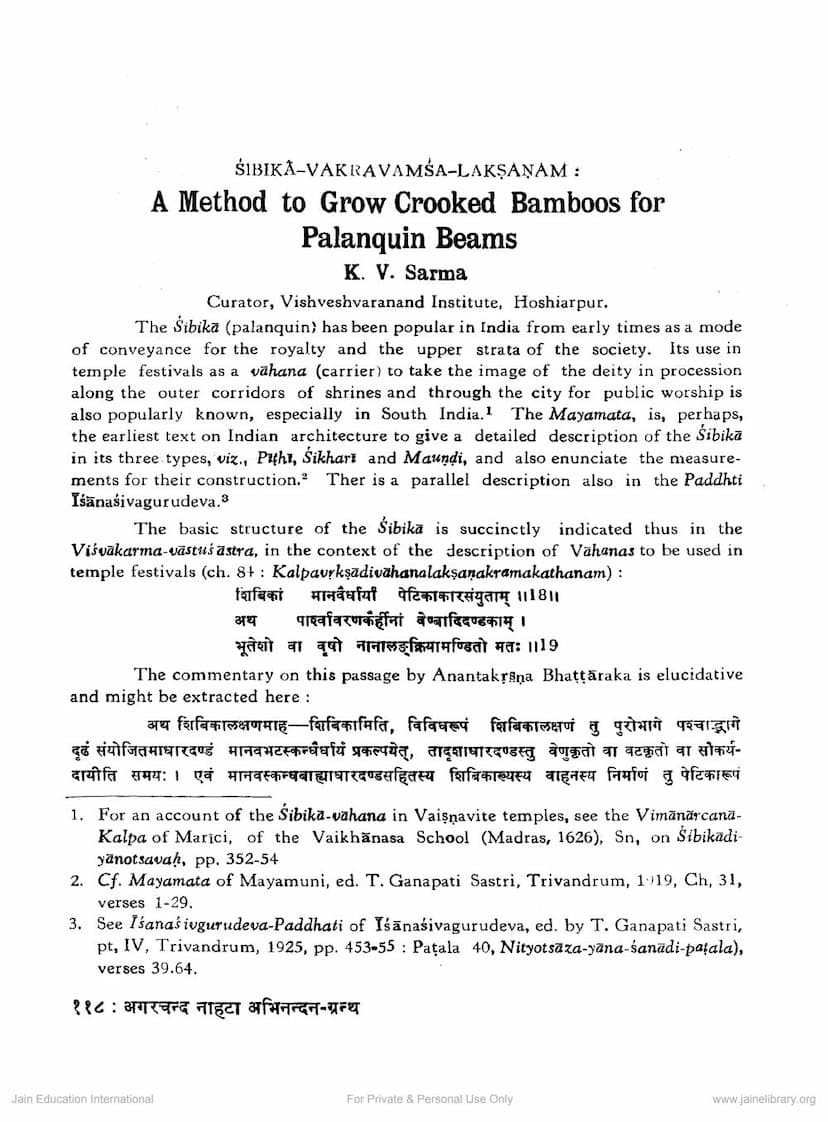
The text, "ŚIBIKA-VAKRAVAMSA-LAKŞAŅAM" (A Method to Grow Crooked Bamboos for Palanquin Beams), authored by K. V. Sarma, delves into a specific horticultural technique rooted in traditional Indian practices, likely associated with Jain architectural or artistic traditions. The article, sourced from the Z_Agarchand_Nahta_Abhinandan_Granth_Part_2_012043.pdf, discusses the importance and construction of the śibika (palanquin).
1. The Significance of the Śibika:
- The śibika (palanquin) is highlighted as a significant mode of conveyance in India, historically used by royalty and the upper echelons of society.
- Its religious importance is also emphasized, particularly its use in temple festivals as a vāhana (carrier) for deities during processions. This practice is noted as being especially prevalent in South India.
- The text references ancient architectural treatises like the Mayamata and Iśānaśivagurudeva Paddhati which provide detailed descriptions of śibikas, including their different types (Pithi, Sikhari, and Maundi) and construction measurements.
- A passage from the Višvakarma-vastuśāstra further clarifies the essential components of a śibika: a closed or open box-like structure mounted on a long beam of bamboo or wood that extends on both sides. This structure is carried on the shoulders of bearers.
2. The Aesthetic and Practical Advantage of Curved Beams:
- The author points out that śibikas with arched beams, rising in a steep curve over the box and slightly inclined upwards at the ends, are aesthetically superior to those with simple horizontal beams.
- Historically, obtaining naturally curved wooden beams of sufficient length and quality for these arches was difficult.
- While curved wooden beams could be artificially shaped using strong heat on green wood, this process often resulted in charring and damage to the material.
3. The Ingenious Solution: Growing Curved Bamboos:
- The core of the article introduces an ingenious and practical solution to the challenge of creating curved beams: growing bamboos with the necessary curves already incorporated into their structure.
- The short text, "Śibika-vakravanca-lakṣaṇam," which is edited and presented in the article, outlines this specific method.
4. The Method of Growing Crooked Bamboos (as described in the text):
The text then details the horticultural process for achieving these pre-curved bamboos, likely derived from an ancient manuscript. Key steps and principles include:
- Careful Selection and Nurturing: Starting with a promising bamboo shoot (śubhaṅkura), the plant must be carefully protected from pests and damage (insects, insects, larvae, etc.).
- Protection and Fortification: The young bamboo is to be enclosed and strengthened, possibly with materials like vacācūrṇa (a type of powder).
- Ritualistic Preparations: Before intervention, a ritualistic worship of Lord Ganesha (Vinayaka) is prescribed, along with offerings of water, incense, flowers, and parched grains.
- Installation of Guiding Structures (Yantra-stambha): Iron structures, designed with specific curves (yantra), are to be firmly planted on the sides of the bamboo sapling. These structures will guide the bamboo's growth.
- Dimensions and Measurements: The text provides detailed measurements for these guiding structures and the bamboos themselves. This includes:
- The length of the yantra (ten hasta or cubits).
- The width of the guiding paths (vīthī) (seven aṅgula or finger-widths).
- The thickness of the structures.
- Specific measurements for supporting planks (paṭṭikā) that attach to the guiding posts, their length (one and a half hasta, or more), and their thickness (one or two aṅgula).
- The placement of these planks at various points along the bamboo's height.
- Creating the Curves: The method involves a systematic placement of holes or openings in the guiding structures and planks. As the bamboo grows, it is directed through these openings, forcing it to adopt the desired curves.
- Specific distances (antara) are to be left between these guiding holes at different levels.
- The curves are to be progressively shaped, with measurements given in aṅgula for the degree of curvature.
- Ongoing Care and Protection:
- The bamboo must be continuously monitored and the guiding structures adjusted as needed.
- Protection from pests and physical damage is crucial throughout the growth process.
- The bamboo is to be treated with certain oils and powders, possibly for strengthening and pest resistance.
- Harvesting and Final Shaping:
- After a specific period (e.g., one year), the top of the bamboo is to be cut.
- Another ritualistic ceremony is mentioned before the final harvesting.
- The guiding structures are removed, and the bamboo is freed.
- Further shaping and smoothing of the nodes (kaṇṭaka) might be required.
- The ends of the bamboo (base and tip) might be reinforced or decorated with gold or silver.
- The final product is a curved bamboo (vakra-veṇu) suitable for śibika construction.
5. Variations and Refinements:
- The text also mentions variations in the number of curves and the precise degree of curvature, suggesting that skilled artisans (nipuṇa) would employ visual inspection and judgment (dṛṣṭilakṣaṇa) to achieve the optimal aesthetic outcome.
- The number of guiding holes or curves within the guiding structures is also specified, with different numbers of planks (pañcaka, sapta) and their respective placements indicating different bending profiles.
In essence, "ŚIBIKA-VAKRAVAMSA-LAKŞAŅAM" provides a detailed, albeit technical, account of a sophisticated agricultural technique used to cultivate bamboos with specific, pre-determined curves. This method allowed for the creation of aesthetically pleasing and structurally sound palanquins, overcoming the limitations of working with natural wood or artificially bending it. The inclusion of ritualistic elements suggests the integration of spiritual and practical considerations within traditional Indian craftsmanship.