
Meditation On Mind
Added to library: September 2, 2025
Summary
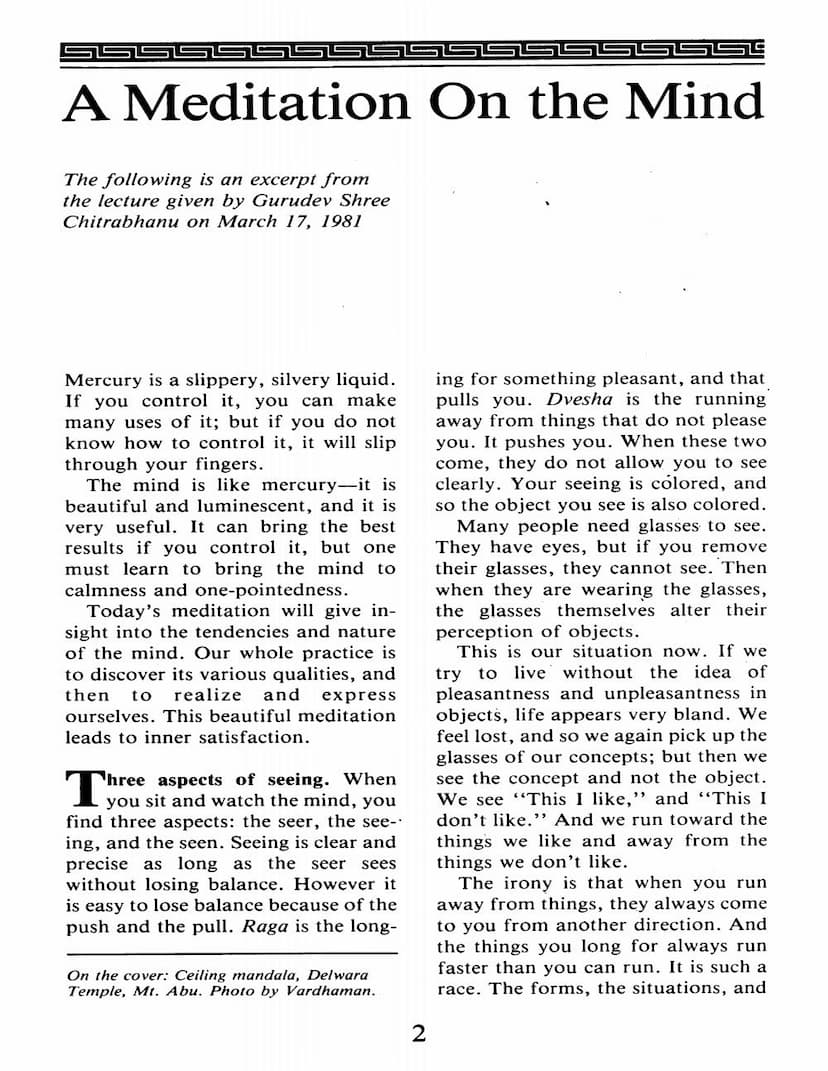
This document is an excerpt from a lecture given by Gurudev Shree Chitrabhanu on March 17, 1981, titled "A Meditation On the Mind." The core message emphasizes the nature of the mind and how to achieve inner peace and satisfaction through mindful observation and control.
Here's a comprehensive summary of the key points:
1. The Mind as Mercury:
- Gurudev compares the mind to mercury, a slippery but useful liquid. If controlled, it can bring excellent results.
- The practice of meditation aims to bring the mind to calmness and one-pointedness, enabling us to discover its qualities and express ourselves fully.
2. The Pull and Push of Desires (Raga and Dvesha):
- The mind is characterized by Raga (attraction/liking) and Dvesha (aversion/disliking).
- These desires color our perception, preventing us from seeing things clearly. We become attached to pleasant experiences and run away from unpleasant ones.
- This constant pursuit of pleasure and avoidance of pain creates a cycle where what we run from often finds us from another direction, and what we desire remains elusive.
3. Three Aspects of Seeing:
- When observing the mind, we encounter three aspects: the seer, the seeing, and the seen.
- Clear perception occurs when the seer remains balanced. However, Raga and Dvesha disrupt this balance.
4. The Story of the Young Woman in the Forest:
- This anecdote illustrates how the same event (the death of a young woman) is perceived differently by individuals based on their internal states.
- The lover sees loss and separation.
- The thief sees only material gain (jewelry).
- The wise observer sees the natural process of disintegration and change, understanding that all forms are impermanent.
5. Seeing Things as They Are:
- We are encouraged to observe the world without the "glasses" of like and dislike, pleasantness and unpleasantness.
- When we see things as they are, without our personal biases and concepts, we are not bound by them.
- Everything is transient; attachments create pain when the object of attachment departs.
6. The Myth of Protection:
- The desire for protection stems from fear and desires created by the mind.
- True protection lies within the soul, which is inherently protected.
- Attempts to protect external things are ultimately futile, as all external phenomena are impermanent.
7. The Root of Failure:
- Failure arises from the desire to become something other than what we are.
- A newborn child is happy because it simply is, without pre-conceived notions of what it should be.
- As we grow, we build mental images and aspirations, creating tension and seeking external validation, leading to the feeling of failure when these external goals are not met or are dependent on others.
8. The Benefits of Meditation:
- Meditation teaches us to relax, breathe calmly, and find inner peace, regardless of external circumstances.
- It involves going deep within to the root of desires and aspirations, rather than just focusing on the superficial "flowers and fruits."
- Discovering this inner source leads to freedom and true growth, which comes from within and is more profound than emulating others.
9. Intention in Meditation:
- The intention in meditation is to simply "be with yourself."
- By observing the mind's tendency to wander, we can gently guide it back to the present moment and to ourselves.
10. Inner Satisfaction:
- True inner satisfaction doesn't come from Raga or Dvesha, nor from "being something."
- It comes from simply "being."
- Living based on external qualities or achievements (adjectives) makes us vulnerable; living from our inherent self brings stability and freedom from the fear of failure.
In essence, the lecture advocates for a profound inward journey through meditation to understand and control the mind, detach from desires and aversions, and ultimately discover one's true, unconditioned self, leading to lasting peace and satisfaction.