
Meditation And Mental Health
Added to library: September 2, 2025
Summary
Here's a comprehensive summary of Jacques Vigne's article "Meditation and Mental Health" based on the provided text:
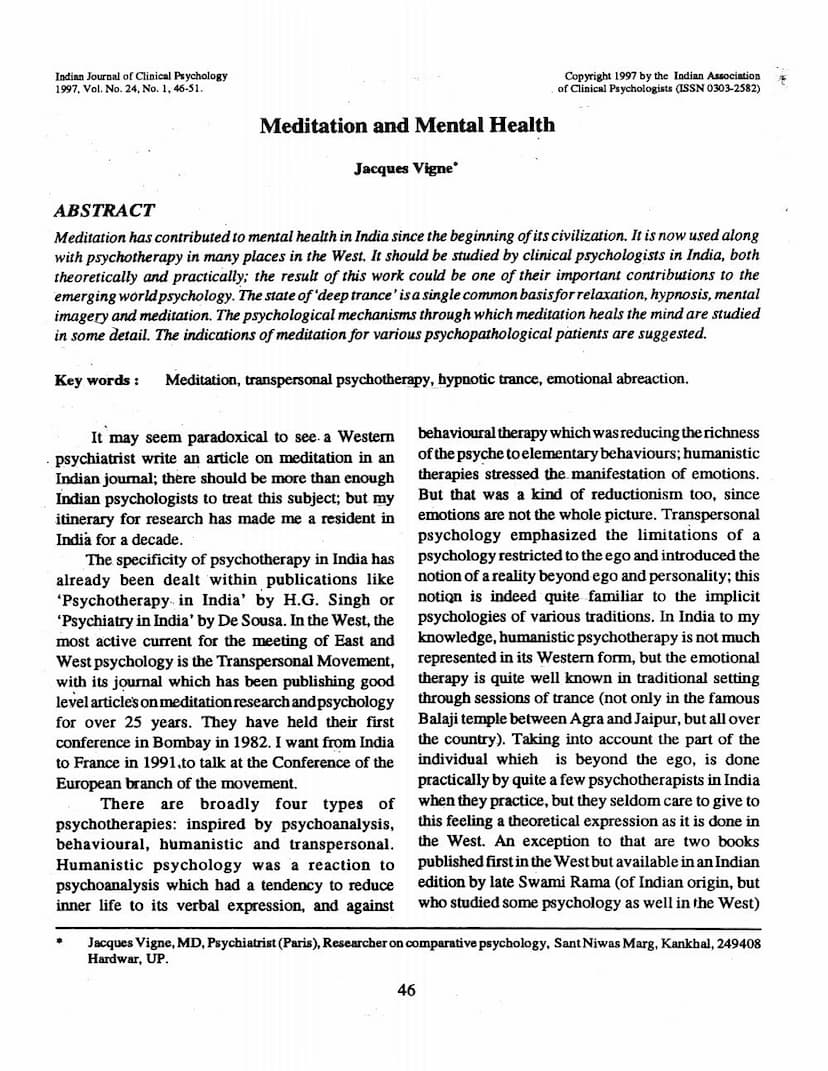
This article by Jacques Vigne, a Western psychiatrist residing in India, explores the significant contributions of meditation to mental health, particularly in the Indian context, and its growing integration with psychotherapy in the West. Vigne argues that clinical psychologists in India should study meditation both theoretically and practically, seeing it as a potential key contribution to emerging global psychology.
The Common Ground: Deep Trance
Vigne posits that a state of "deep trance" is the common underlying factor for various therapeutic and self-improvement techniques, including relaxation, hypnosis, mental imagery, and meditation. This deep trance state is characterized by:
- Easy communication between mind and body.
- Clear emergence of the unconscious into consciousness.
- Enhanced receptivity and integration of suggestions from self or others.
Mechanisms of Therapeutic Action of Deep Trance and Meditation
Vigne details several psychological mechanisms through which meditation facilitates mental healing:
- Facing Up to the Symptom: Meditation encourages confronting fears and symptoms directly. By "going in the sense of the symptom" and listening to it, rather than suppressing it, individuals can understand its message. This involves a "association-dissociation" mechanism where traumatic memories are linked to negative emotions and tension, but through deep relaxation, the traumatic image is dissociated from the emotion and tension, replaced by rest. This is akin to concepts in psychoanalysis ("following resistances"), behaviorism ("implosion," "flooding"), gestalt therapy ("stressing the symptom"), and systemic therapies ("paradoxical injunctions").
- Evaluating the Symptom: Patients are encouraged to rate the intensity of their symptoms. Observing the natural impermanence of these symptoms during deep trance, or simply by observing sensations in meditation, helps reduce their hold on the mind. This reinforces the understanding of impermanence.
- Returning to Inner Resources: Meditation helps individuals reconnect with their inherent inner resources, referred to as the "Self," "true Nature," or "Divine." This is seen as a foundational aspect of meditation, similar to the principles of Alcoholics Anonymous.
- Inter-Mental Function Communication: Meditation fosters communication between different mental functions (verbalization, imagery, emotions, sensations) that are often compartmentalized. This is achieved by redirecting attention back to the body, even amidst mental distractions, facilitating a flow of information across these levels.
- Ultradian Regeneration: Vigne highlights the effectiveness of short rest sessions (15-20 minutes) taken throughout the day when needed, a concept he believes was discovered long ago in Tibetan Buddhism. This contradicts the claims of some psychotherapies that emphasize highly specific actions.
- Emotional Abreaction: Emotions are crucial to the psyche and therapy. Vigne distinguishes between pathological (hysterical), therapeutic (during sessions), and meditative abreactions. Meditative abreactions are subtle, internal, and witnessed by the "Witness" (the Self), with the released energy being directed towards inner evolution.
- Other Mechanisms: These include sensory deprivation from prolonged practice, cutting off defense mechanisms (projection, transference) by returning to oneself, accelerated psychic life with quicker resolution of inner conflicts, and a "group effect" where meditators feel connected to others on the same path, even if physically absent.
The "Mechanism Without Mechanism" and the Role of Attention
Vigne emphasizes that not everything in meditation is reducible to mechanisms. The ultimate aim is the manifestation of consciousness itself, which perceives these mechanisms. He highlights the importance of the dissociation between psycho-physical phenomena and the observer, citing the example of Ramana Maharshi experiencing intense pain without identifying with it. This dissociation, or "drishti and drishta" (observation and the observed), is considered a spiritual path in itself. Ultimately, attention is presented as the most crucial element, a practice rather than a theory, as illustrated by the Zen story of the master's repeated advice: "Attention."
Meditation with Pathological Subjects
Vigne distinguishes between ordinary daily meditation and intensive retreat-style meditation. Intensive practice is not recommended for psychopathological patients due to its potential to intensify existing weaknesses. However, simple, short meditation sessions practiced multiple times a day can be beneficial for them, fostering "mental hygiene" and contributing to long-term stability.
Key considerations for using meditation with patients include:
- Duration and Frequency: Short, repeated sessions are more suitable than prolonged ones.
- Therapist Guidance: Sessions should be discussed with an experienced therapist.
- Method Selection:
- Concentration: beneficial for beginners and patients to gain control over the mind.
- Observation: more challenging for dispersed patients but can be adapted.
- Body Scan: helpful for grounding but potentially problematic for hypochondriacs.
- Symptom Approach: A balanced approach might start by aligning with the symptom (e.g., precise techniques for obsessional patients, relaxation for depressives) to build interest, and then gradually introduce antidotes (e.g., pure observation for obsessional, dynamic movement for depressive).
- Patient Interest and Collaboration: Active interest and collaboration are paramount.
- Therapist Experience: The therapist should have personal meditation experience and understand that helping others is an art, not a mechanical process.
In conclusion, Vigne advocates for the integration of meditation into mental health practices, recognizing its profound potential for healing and personal growth, while also stressing the importance of careful application, especially when working with individuals facing psychological challenges.