
Meditation
Added to library: September 2, 2025
Summary
Here is a comprehensive summary of the provided Jain text on meditation:
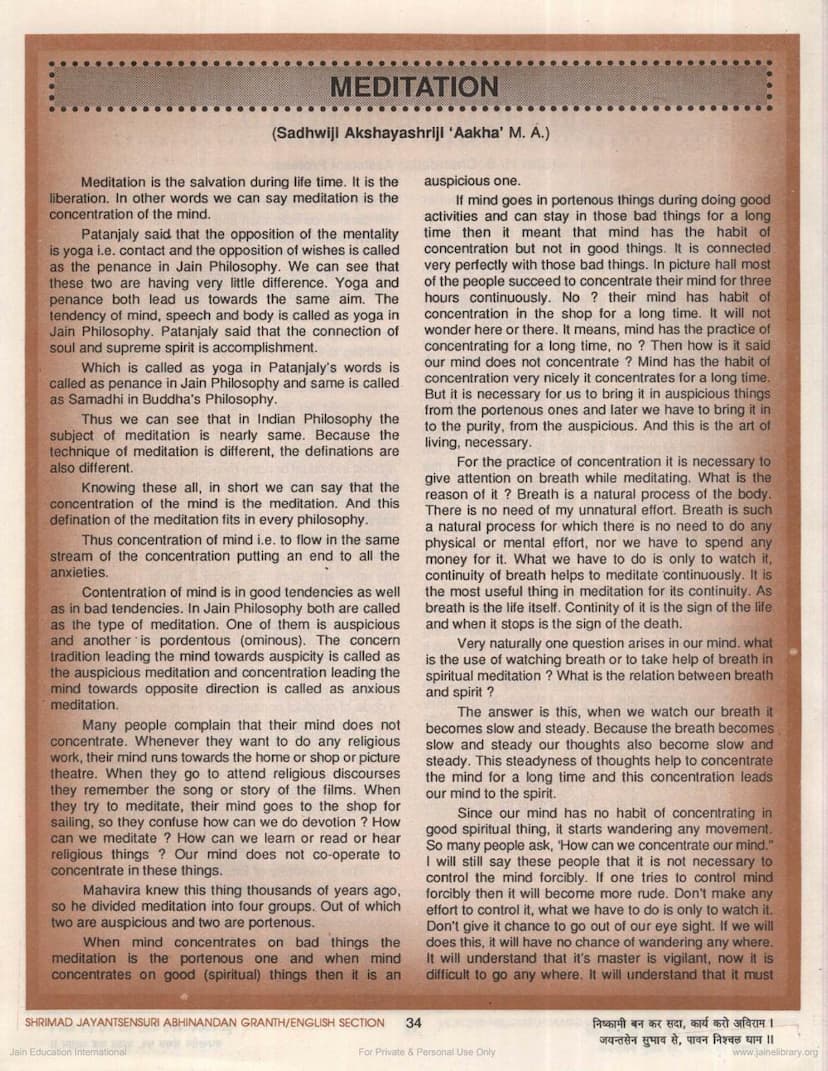
The text defines meditation (Sadhana) as liberation or salvation during one's lifetime, essentially the concentration of the mind. It draws parallels between Jain philosophy and other Indian traditions, noting that what Patanjali calls "yoga" (union) and the Buddha calls "Samadhi" is akin to "penance" in Jainism, with both leading to the same ultimate goal. The core understanding of meditation across these philosophies is the concentration of the mind, silencing anxieties and focusing on a single stream of thought.
The text distinguishes between two types of meditation within Jain philosophy:
- Auspicious Meditation: This involves concentrating the mind on positive, spiritual tendencies.
- Portentous (Anxious) Meditation: This involves concentrating the mind on negative or worldly concerns.
A common complaint is the inability to concentrate the mind on religious activities, as it tends to wander to mundane matters like homes, shops, or entertainment. The text argues that this isn't a lack of capacity for concentration but rather a habit of concentrating on the wrong things. People can focus for extended periods on films or business, demonstrating an inherent ability for sustained concentration. The challenge lies in redirecting this habit from portenous to auspicious matters, and eventually to purity. This redirection is presented as the "art of living."
To aid concentration, the text suggests focusing on the breath. This is because breath is a natural, effortless bodily process. Observing the continuity of breath helps maintain continuous meditation. The connection between breath and spirit is explained:
- Watching the breath slows and steadies it.
- This steadiness of breath leads to steadier thoughts.
- Steadier thoughts facilitate longer periods of concentration.
- This concentration ultimately guides the mind towards the spirit.
Instead of forcibly controlling the mind, which can make it "more rude," the approach recommended is to gently watch the mind, keeping it within one's "eye sight." This constant vigilance discourages wandering and trains the mind to serve its "master" (the spirit) with dedication.
The text also emphasizes the importance of meditating on the body in spiritual practice due to the close relationship between the spirit and the body, which is described as the spirit's "house of refugee." Lord Mahavira's teaching, "He who knows the internal knows the external; he who knows the external knows the internal," underscores this interconnectedness.
The advantages of meditation are highlighted as:
- Art of Self-Realization: It teaches one to look inward and recognize one's own faults rather than focusing on others.
- Conversion of Adverse Situations: Meditation purifies one's perspective, making all situations appear favorable.
- End of Ego: By observing the mind's actions, one becomes aware of one's position and humanity, leading to the vanishing of ego, which in turn fosters courtesy and humanity.
The latter part of the text touches upon the concept of equity (Samata), suggesting that the purification of souls, which are inherently equal, is achieved through regular meditation. This inner equity should then be extended to family, society, and the world. The text posits that true happiness is a spiritual experience, not something attainable from external sources, as the soul is inherently happiness itself. The pursuit of happiness is seen as misery; true happiness lies in the absence of desire.
The path to this spiritual experience and happiness involves:
- Studying religious literature.
- Practicing meditation with concentration.
- Keeping desires minimal and accepting their non-fulfillment.
- Adopting "simple living and high thinking."
- Using knowledge, wealth, and power wisely for the progress and happiness of all.
- Aspiring for higher values and deliverance.
In essence, the text presents meditation as a crucial tool for spiritual growth, self-understanding, and the attainment of lasting happiness by cultivating mental concentration and aligning oneself with inner spiritual values.