
Meaning And Historical Significance Of Term
Added to library: September 2, 2025
Summary
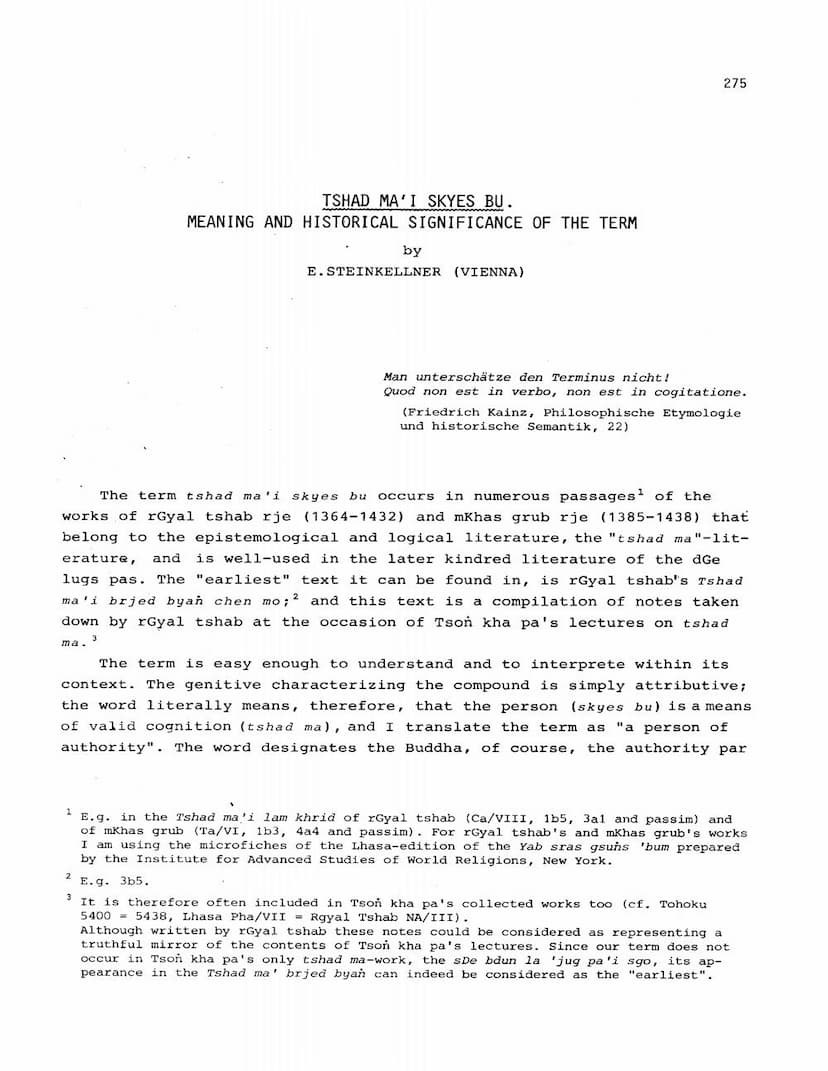
Here's a comprehensive summary of Ernst Steinkellner's "Meaning and Historical Significance of the Term tshad ma'i skyes bu," based on the provided text:
Core Meaning and Origin:
- The term tshad ma'i skyes bu (meaning "a person of valid cognition") literally translates to "a person who is a means of valid cognition."
- Steinkellner argues that this term, prominent in the epistemological and logical (tshad ma) literature of the dGe lugs school, specifically among the works of rGyal tshab rje and mKhas grub rje, originates from Dignāga's Pramāṇasamuccaya.
- Dignāga's benedictory verse uses the Sanskrit term pramāṇabhūta, meaning "one who has become a means of valid cognition." This Tibetan translation of the concept is tshad mar gyur pa.
- While Dignāga's concept is an attribute referring to the Buddha as the ultimate authority and source of valid cognition, the Tibetan term tshad ma'i skyes bu (Skt. pramānapurușa) appears to be a substantivation of this attribute.
Historical Development and Significance in Tibetan Buddhism:
- Early Tibetan Understanding: Initially, Tibetan scholars tended to view Buddhist epistemology and logic (tshad ma) as a branch of secular sciences, separate from the spiritual path. Their early focus was on Dharmakirti's Pramāṇaviniscaya, which is more analytical and less focused on the religious implications.
- Shift to Pramāṇavārttika: Towards the 12th and 13th centuries, there was a gradual shift towards studying Dharmakirti's Pramāṇavārttika, especially its second chapter, Pramāṇasiddhi ("Establishment of the means of valid cognition"). This chapter is crucial because it elaborates on the religious significance of the tshad ma tradition.
- Tson kha pa's Contribution: Tson kha pa, the founder of the dGe lugs school, championed the integration of the tshad ma tradition into the Buddhist path. He argued that the tshad ma tradition, particularly the Pramāṇavārttika's second chapter, provides the rational framework for understanding the Buddhist path.
- The Term "tshad ma'i skyes bu": Steinkellner posits that the term tshad ma'i skyes bu was a "flash of genius" created to bridge these two traditions. It symbolically combines the epistemological framework with the spiritual path.
- Connection to "skyes bu gsum": The term is directly linked to the dGe lugs concept of the "three kinds of persons" (skyes bu gsum), as outlined by Atiśa. The "superior person" (mchog pa), who strives for the liberation of all beings, is identified with the Buddha as the tshad ma'i skyes bu. rGyal tshab rje, in his Tshad ma'i lam khrid, elaborates on how the Pramāṇavārttika's teachings align with the path of these three types of persons, particularly highlighting the Buddha as the guiding authority.
- Apologetic Tone: The way rGyal tshab presents this integration, particularly by discussing topics like "selflessness of phenomena" and the perceived lack of spiritual stages in the tshad ma texts, suggests an apologetic stance. This indicates that the idea of combining epistemology with the path was a relatively new concept that needed justification.
Attribution of the "tshad ma'i lam" System:
- Steinkellner investigates who first propounded this integrated theory of tshad ma as part of the path, or the "tshad ma'i lam" system.
- He points to Red mda' ba Blo bzan grags pa (1349-1412) as a key figure. Red mda' ba, a respected teacher of Tson kha pa in both Madhyamaka and Tshad ma, is believed to have developed major theoretical ideas that Tson kha pa and rGyal tshab further elaborated.
- The loss of most of Red mda' ba's tshad ma works makes definitive attribution difficult, but his known works and the esteem in which he was held by the dGe lugs founders strongly suggest his pivotal role.
- Postscript Note: A postscript by János Szerb reminds Steinkellner that Bu ston's teacher, bSod nams mgon, was also referred to as Tshad ma'i skyes bu even earlier (mid-14th century). This potentially shifts the timeline of the concept's application, predating Red mda' ba's birth.
Overall Significance:
The term tshad ma'i skyes bu represents a significant development in Tibetan Buddhism, particularly within the dGe lugs school. It signifies the successful integration of rigorous epistemological and logical analysis into the spiritual path, providing a rational foundation for Buddhist practice and understanding. The creation of this term symbolizes the achievement of a new level of conceptual synthesis, allowing Tibetan Buddhism to embrace its profound rational traditions within its spiritual framework.