
Man Kahta Hai Nari Ko Poojo
Added to library: September 2, 2025
Summary
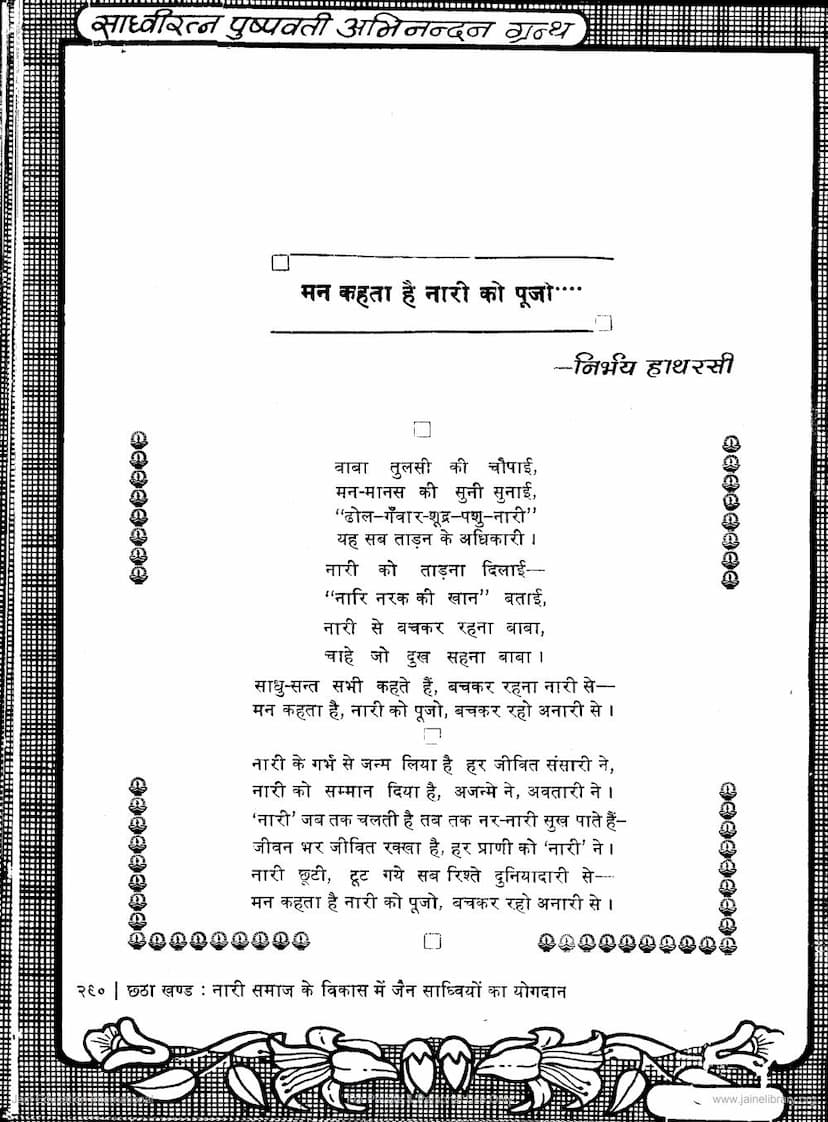
Here's a comprehensive summary of the Jain text "Man Kahta Hai Nari ko Poojo" by Nirbhay Hathrasi, based on the provided pages:
Title: Man Kahta Hai Nari ko Poojo (The Heart Says, Worship Woman) Author: Nirbhay Hathrasi Publisher: Z_Sadhviratna_Pushpvati_Abhinandan_Granth_012024.pdf Catalog Link: https://jainqq.org/explore/211624/1
Overall Theme:
This text is a powerful and eloquent defense of womanhood, directly challenging traditional negative portrayals of women often found in some religious and social discourse. The author, Nirbhay Hathrasi, argues vehemently for the worship and respect of women, highlighting their essential role in life, society, and spiritual progress. The recurring refrain, "मन कहता है नारी को पूजो, बचकर रहो अनारी से" (The heart says, worship woman, stay away from the non-woman/unwomanly), serves as the central thesis, advocating for the veneration of the feminine principle and cautioning against those who lack this respect.
Key Arguments and Points:
-
Challenging Negative Stereotypes: The author begins by directly confronting and refuting the controversial lines from Tulsidas's Chaupai ("Dhol, Gawar, Shudra, Pashu, Nari, ye sab taadan ke adhikari" - Drum, ignorant person, lower caste, animal, woman: these are all fit for beating). Hathrasi strongly rejects this sentiment, stating that while saints may preach staying away from women, his heart urges him to worship them. He labels the idea of women being "a mine of hell" as baseless.
-
The Fundamental Role of Women: The text emphasizes that every living being in the worldly cycle takes birth from a woman's womb. Even the unborn and the divine have given respect to women. Life and sustenance for all beings are sustained by women. When women are disregarded or abandoned, all worldly relationships and connections break.
-
Illustrious Examples of Feminine Strength and Devotion:
- Panna Dai: The text refers to Panna Dai (a historical figure known for her self-sacrifice) as an example of a mother's unwavering love and pain. She is presented as someone who would sacrifice anything for her son, and whose maternal devotion is unparalleled.
- Delhi Ki Indrani: This likely refers to a historical or legendary queen who, despite potential political struggles, embodies feminine resilience and influence.
- Parvati and Mira: The author invokes figures like Parvati (consort of Shiva) and Mira Bai (a devoted Rajput princess) to illustrate the power of women in achieving spiritual goals through tapasya (penance) and intense devotion (prem divani).
- Radha and Janak Dulari (Sita): Radha is cited as an example of the pain of separation from a beloved, while Sita is brought up to represent the difficulty of maintaining proximity and connection with a husband.
- Ahilya, Draupadi, Tara: These figures from the epics are mentioned as examples of women who, despite facing hardships and being subjected to unfavorable circumstances (like being cursed or wronged), ultimately became "deliverers" (tarak) or powerful figures.
- Earth and Ganga: The earth is used as an analogy for a woman's capacity to bear immense burdens with patience (dharak), while Ganga is presented as a divine purifier and deliverer (uddhaarak), highlighting women's purifying and life-giving qualities.
- Bhol Bhandari (Shiva): Even Shiva, referred to as the "simple keeper" or "benevolent one," is invoked in the context of the destructive aspect (samharak), suggesting women also possess a formidable power.
-
The Nature of Maya (Illusion/Attachment): The author explores the concept of Maya. He suggests that while worldly attachments and possessions are spread by those engrossed in Maya, even ascetics find liberation through devotion. He draws an analogy to pickpocketing: people exploit others financially ("pocket cutting") but condemn the pickpocket. Similarly, the author implies that those who exploit or misuse women's power or affection are wrong, but the essence of womanhood itself, which can be a source of attraction and sometimes a challenge, should not be inherently condemned. He warns against the seductive nature of worldly attachments, comparing it to the danger of "touch" (sparsh) after experiencing the pain of "pers" (a likely metaphor for deceitful attraction). He advises focusing on service to the sick and staying away from illness, a metaphor for avoiding harmful influences.
-
Women as Sources of Purity and Elevation:
- Lakshmi, Sita, Radha, Parvati: The author highlights that in divine couples like Lakshmi-Narayan, Sita-Ram, Radha-Shyam, and Shankar-Parvati, women (Lakshmi, Sita, Radha, Parvati) are often mentioned first or given prominence. Even when in a subordinate role (like Parvati in relation to Shiva's yogic path), the divine feminine is revered (Ganga being adorned on Shiva's head).
- Ascension to Heaven: The text refutes the notion of women being a "mine of hell" and instead declares them a "ladder to heaven" (swarg nasaini). This is contrasted with seeking wisdom from a celibate (brahmachari) and advised to seek it from those who are worldly (sansari), implying that worldly experience, often intertwined with relationships with women, provides practical wisdom.
-
Partnership and Balance: The final verses emphasize the importance of living in harmony with women. If one's heart is not unwomanly, then living with women leads to fulfillment. The analogy of swimming in a river versus drowning in a well is used: one should flow with the current of life (represented by the "river of grace" associated with feminine energy) and avoid the pitfalls of ignorance. The author concludes by suggesting that while one can remain fearless of "desire" (kaam), one must be cautious of the "dagger of desire" (kaam-katari), implying that a balanced and respectful approach to feminine energy, rather than outright avoidance or lust, is key.
In essence, "Man Kahta Hai Nari ko Poojo" is a passionate plea for the re-evaluation and elevation of women's status. It argues that women are not to be feared or denigrated but are fundamental to existence, capable of immense love, sacrifice, spiritual achievement, and purification. The text champions a perspective where the feminine is honored and respected as an integral and vital force in both the material and spiritual realms.