
Mahavira Golden Principals Of Life
Added to library: September 2, 2025
Summary
Here's a comprehensive summary of the provided text, "Mahavira Golden Principals Of Life" by T. J. Salgia, based on the five pages you've shared:
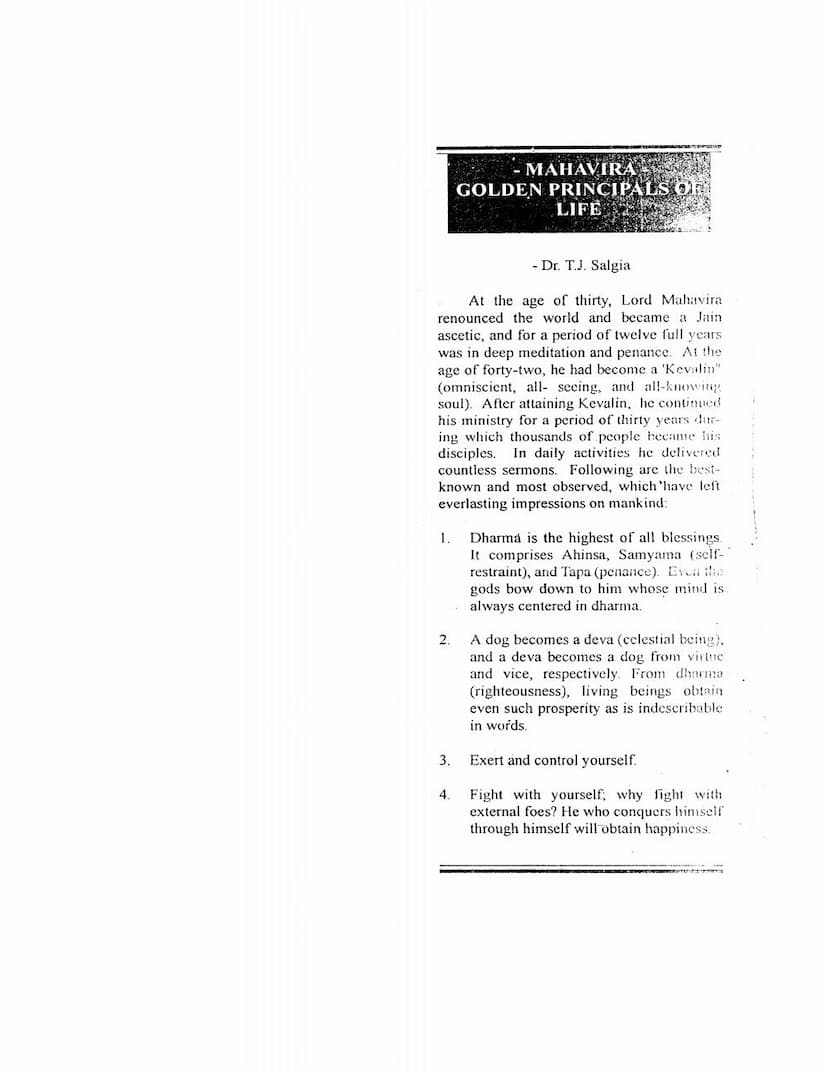
The book, "Mahavira Golden Principals Of Life," authored by Dr. T.J. Salgia, presents the core teachings of Lord Mahavira, the 24th Jain Tirthankara. Lord Mahavira renounced worldly life at age thirty, engaged in twelve years of deep meditation and penance, and attained omniscience (Kevalin) at forty-two. He then spent thirty years delivering sermons, influencing countless disciples. The book distills these teachings into a series of guiding principles for life.
Key Themes and Principles:
- Dharma as Supreme: The text emphasizes that Dharma (righteousness) is the highest blessing. It encompasses Ahinsa (non-violence), Samyama (self-restraint), and Tapa (penance). Even celestial beings are said to bow to those whose minds are centered in Dharma.
- Consequences of Actions (Karma): Living beings experience prosperity or hardship based on their actions. Virtue leads to prosperity, while vice leads to a lower state of existence. Individuals suffer and receive retribution for their own deeds.
- Self-Control and Inner Battle: A central message is the importance of self-exertion and self-control. The true battle is with oneself, not external foes. Conquering oneself leads to happiness. It is better to subdue oneself through self-control than to be subdued by others.
- Avoiding Sin and Worldly Attachments: The text strongly advises against sin, particularly lust, pleasure-seeking without control, deceit, greed, anger, and ego, as these lead to delusion and suffering. It highlights that life is finite and warns against being drowned in worldly desires.
- Fundamental Virtues: For householders, the observance of the five lesser vows (anuvratas) – Ahinsa, truthfulness, non-stealing, chastity, and limitation of possessions – along with refraining from wine, flesh, and honey, are presented as fundamental virtues.
- Critique of Superficial Practices: The book dismisses superficial religious practices like bathing in sacred rivers, worshipping stone idols, and self-immolation, labeling them as "follies."
- Equanimity and Compassion: All creatures are to be regarded as one's own self. Inflicting harm on others that one would find undesirable is condemned. Compassion towards all living beings is a core tenet.
- Mindfulness and Awareness: The importance of being awake and alert, even when others are not, is stressed. Trusting oneself and being aware of the fleeting nature of time and the weakness of the body are crucial.
- The Nature of the Soul and Reality: The embodied soul performs actions, experiences the cycle of birth and death, and reaps the fruits of its deeds. Material possessions, relationships, and external factors are ultimately separate from the true self (soul). The book encourages detachment from these ephemeral aspects of existence.
- The Pursuit of True Happiness: True happiness is found not in material wealth, fleeting pleasures, or external validation, but in self-knowledge, self-control, and spiritual understanding. The insatiable nature of greed is highlighted, stating that even immense wealth cannot satisfy a greedy person.
- The Path to Liberation (Nirvana): Liberation (Nirvana) is described as a state free from birth, old age, disease, death, grief, pain, and fear – an eternal state of pure bliss. This is achieved through subduing the self, practicing meditation and penance, and gaining self-knowledge.
- Ethical Conduct: Spreading one's own fame is discouraged. Meekness and thoughtful speech in the presence of the wise are recommended. Acquiring valuable knowledge and avoiding worthless pursuits are important.
- The Fleeting Nature of Life: Life is transient, and old age or death can arrive unexpectedly. Being careless and not exerting oneself is detrimental. The present moment is the best opportunity for self-improvement.
- The Futility of External Help: Wealth, relationships, and even eloquent speech or philosophical instruction are ultimately insufficient for salvation. True salvation comes from within.
In essence, "Mahavira Golden Principals Of Life" advocates for a life lived with self-awareness, strict ethical conduct, compassion for all beings, and a deep understanding of the transient nature of the material world. The ultimate goal is the liberation of the soul through self-mastery and spiritual realization, encapsulated by the powerful concluding summary: "Live and let live" and "He knows all, who knows Himself."