
Mahavira Anekantavada And World Today
Added to library: September 2, 2025
Loading image...
Summary
Here's a comprehensive summary of the Jain text "Mahavira Anekantavada and World Today" by Samani Charitrapragya, based on the provided pages:
The text explores the philosophical concept of Anekantavada (the doctrine of many-sided reality) as presented through the teachings of Lord Mahavira and its profound relevance to the contemporary world.
Core Teachings of Mahavira and the Genesis of Anekantavada:
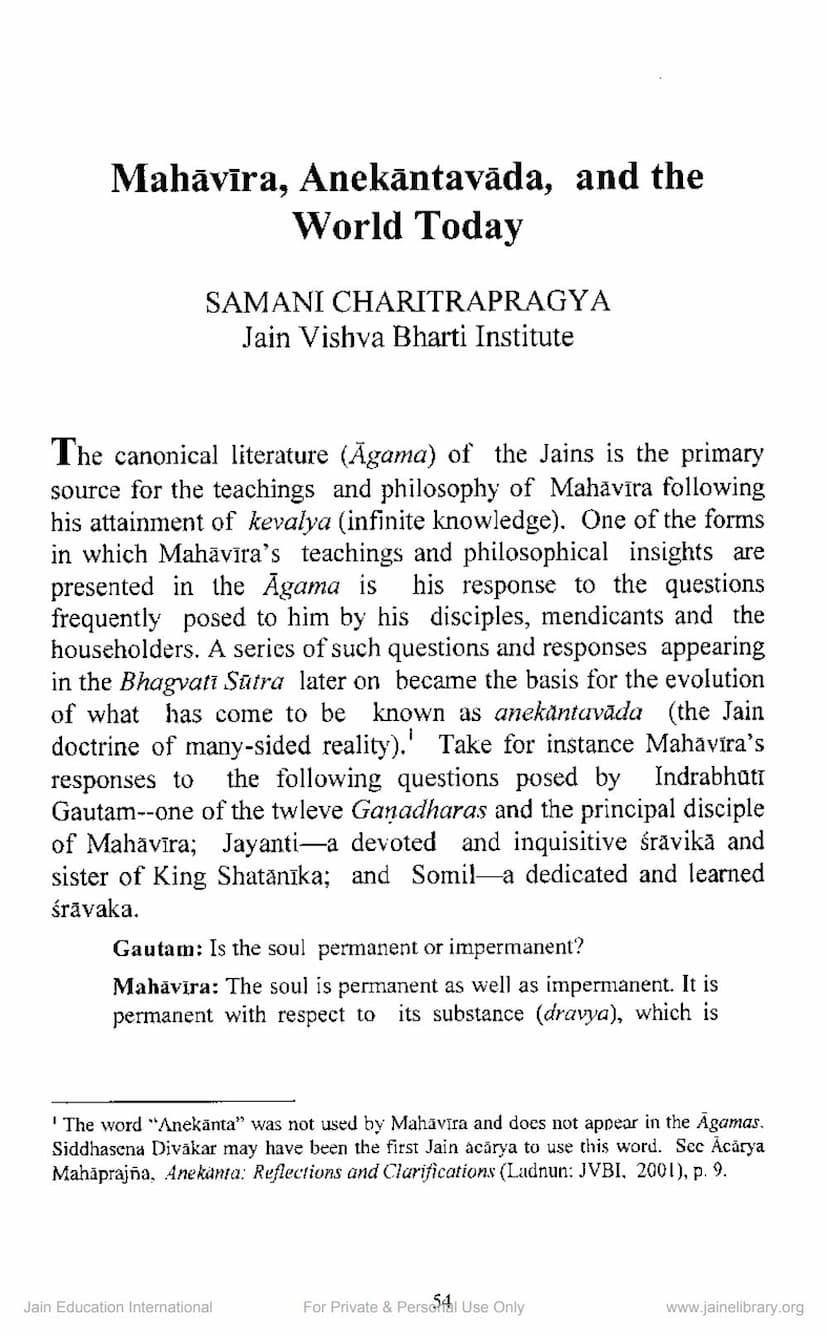
- Mahavira's Responses: The primary source for Mahavira's teachings after his enlightenment is the Jain canonical literature (Agama). His philosophical insights are often presented as responses to questions posed by his disciples and householders, such as Indrabhuti Gautam, Jayanti, and Somil.
- Illustrative Examples: The text highlights examples of Mahavira's responses that demonstrate the multi-faceted nature of reality. For instance, when asked if the soul is permanent or impermanent, Mahavira states it is both: permanent in its substance (dravya) but impermanent in its modes (paryaya). Similarly, he explains that an object is eternal in substance but changing in its attributes and modes.
- Beyond Simple "Either/Or": Mahavira's approach was to avoid definitive, singular answers ("either/or"). He recognized that reality is complex and has many sides, which cannot be fully captured by language. His responses demonstrate this by acknowledging multiple truths simultaneously.
- The Limits of Language: The author emphasizes that even an omniscient being like Mahavira acknowledged the limitations of language in fully expressing the totality of reality. The text quotes Mahavira stating that "Where there is truth, from there language returns."
The Role of Naya and Syadvada:
- Naya (Partial Expression of Truth): To navigate the complexity of reality within linguistic constraints, Mahavira utilized the concept of naya. Naya allows for the comprehension of reality part by part, offering partial expressions of truth.
- Nischaya Naya vs. Vyavahara Naya: The text explains two key types of naya:
- Nischaya Naya: Focuses on the substance (dravya), understanding reality from its core essence without denying the existence of modes.
- Vyavahara Naya: Focuses on the modes (paryaya) and attributes, comprehending reality from the perspective of its changing forms, without denying the underlying substance.
- Interdependence of Substance and Modes: The author stresses that both nayas are essential for a complete understanding of reality, as substance and modes are interdependent and cannot exist without each other.
- Syadvada (The Doctrine of Conditional Predication): Following Mahavira, Jain scholars developed the language of "syat" (meaning "perhaps" or "from a certain perspective") to express the multiplicity of views. Syadvada allows for the logical expression of modes from different viewpoints, forming conditional dialectics of existence, non-existence, and inexpressibility.
Evolution of Anekantavada and its Significance:
- Canonical Development: The text notes that the term "Anekanta" itself may not have been explicitly used by Mahavira but was later articulated by Jain acharyas like Siddhasena Divakar to reconcile seemingly opposing philosophical viewpoints.
- Philosophical Context: This development occurred during a period of intense philosophical debate in ancient India, where various traditions (like Vedanta and Buddhism) presented their own absolutist views on reality. Anekantavada emerged as a framework to bridge these differing perspectives.
- Key Acharyas: Acharyas like Umāsvāti (who articulated permanence, origination, and cessation), Siddhasena Divakar (coining the term "anekanta"), and later scholars like Samantabhadra and Akalanka were instrumental in applying nayas to philosophical problems.
- Definition of Anekanta: The term "anekanta" signifies that an object has "more than one" attribute or end. It highlights the interdependence of substance and modes, where reality is a combination of permanence and change.
Relevance to the World Today:
- Reconciling Diverse Views: Anekantavada's application to daily life allows us to reconcile the multiple views of reality prevalent in our diverse world. It fosters tolerance and understanding of others' perspectives, even if we don't agree with them.
- Tolerance and Non-Absolutism: An anekantika (one who recognizes multiple aspects of reality) is naturally more tolerant than an ekantika (one who holds an absolutist view). This leads to reduced conflict and the potential for avoiding wars.
- Foundation for Nonviolence (Ahimsa): The philosophy of Anekantavada is presented as a "manual for good life" that encourages open-mindedness, discourages absolutist thinking, and combats egotism. It fosters tolerance, equanimity, fraternity, love, and compassion, which are essential for a nonviolent world order.
- Mutual Precondition: The text suggests a reciprocal relationship: Anekantavada promotes Ahimsa, and Ahimsa (compassion and nonviolence) is necessary for practicing Anekantavada.
- Path to Peace and Harmony: Ultimately, the application of Anekantavada to a global scale can lead to a more peaceful, harmonious, and nonviolent world by decreasing enmity and increasing amity among humans.