
Madhyadesika Madhyoddesika And Madhyuddesika
Added to library: September 2, 2025
Summary
This article by J.W. De Jong delves into the varied readings and potential meanings of three related terms: Madhyadesika, Madhyoddesika, and Madhy'uddesika. These terms are significant because they appear in the introductory passages of important Buddhist texts, specifically those belonging to the Mahāsāmghika-Lokottaravādin school.
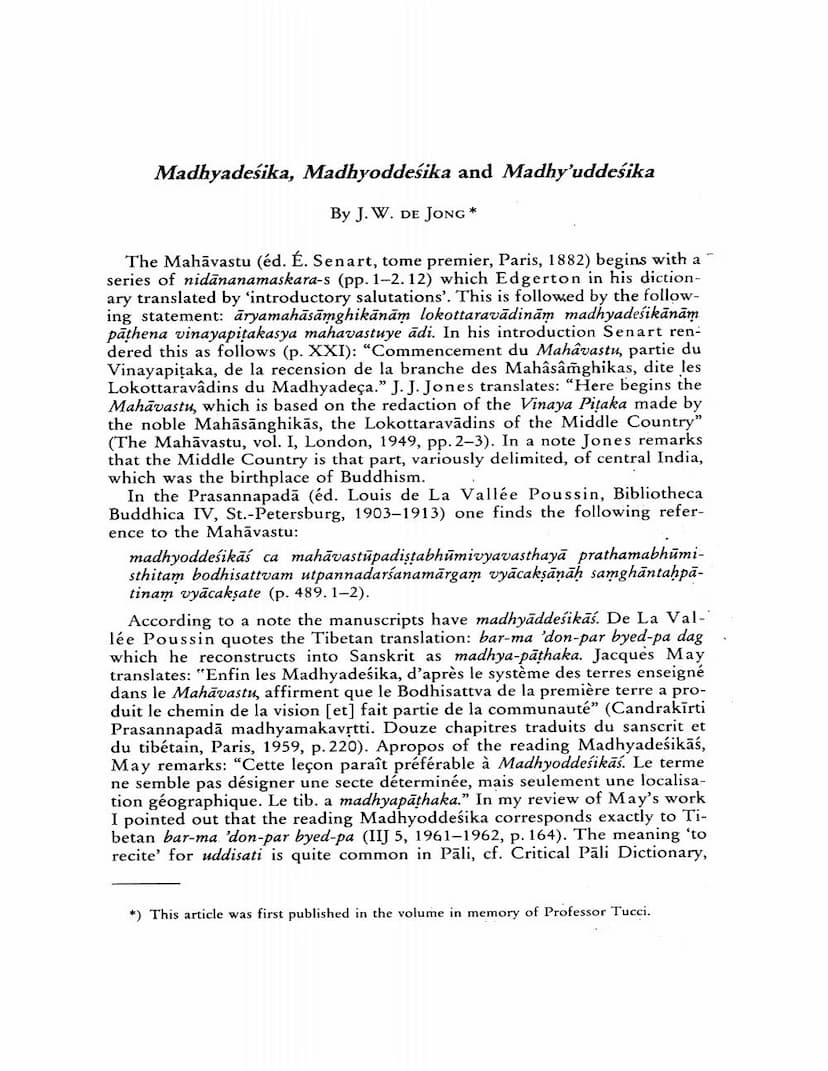
De Jong begins by examining the Mahāvastu, a foundational text of this school. He notes that different editions and scholars have interpreted the introductory phrase containing these terms in slightly different ways. Senart's edition reads "Madhyadeśikānām," which he translates as referring to the Lokottaravādins "of the Middle Country" (Madhyadeśa), a region in central India considered the birthplace of Buddhism. J.J. Jones offers a similar interpretation.
However, De Jong then points to a passage in Candrakīrti's Prasannapadā which references the Mahāvastu and uses the term "madhyoddeśikās." This is supported by Tibetan translations reconstructed by scholars like De La Vallée Poussin and Jacques May. May suggests that "Madhyadeśikās" might be preferable and signifies a geographical location rather than a specific sect. De Jong, in his review, argues that the reading "Madhyoddeśika" aligns perfectly with the Tibetan "bar-ma 'don-par byed-pa," where the root "uddisati" in Pāli means "to recite" or "to point out." He cites the Critical Pāli Dictionary to support this interpretation, suggesting "uddadesaka" refers to an "expounder" or "reciter" of texts like the Pātimokkha. Manuscript evidence further supports the reading "madhyoddesikās."
The article then shifts focus to Gustav Roth's edition of the Bhikṣuṇī-vinaya of the Ārya-Mahāsāmghika-Lokottaravādin, which begins with "madhy'-uddesikānām." De Jong highlights that other Vinaya texts from the same school also feature variations like "madhy'-uddeśa-pāṭhakanām" and "madhyoddesikānām." He notes discrepancies in editorial choices, with some editors altering readings to "madhyadeśapāthakānām" or "mādhyād-deśikānām." However, De Jong asserts that the readings "madhyoddesikānām" and "madhy'uddesikānām" are likely the original and correct ones, with "madhyadesikānām" being a possible corruption or later correction. He emphasizes that Senart's edition, based on manuscripts likely derived from a single Nepalese source, might not have preserved the earliest readings.
The discussion then expands to include historical accounts, particularly from Bu-ston's History of Buddhism, concerning the languages used by different Buddhist schools. Bu-ston quotes a passage from the Prabhāvatī that mentions scholars ceasing to recite scriptures in Prakrit, Apabhramsa, and an "intermediate dialect" (bar-mar 'don-pa'i tshig). De Jong analyzes translations by Obermiller and Yuyama of this passage, debating the meaning of the "intermediate dialect" and its relationship to Sanskrit and other Indian languages. He questions Yuyama's speculative interpretations, suggesting that "rgya-chen-po'i skad" (great extensive language) might indeed refer to Sanskrit, as proposed by Obermiller.
The article further explores similar phrases like "'brin-du 'don-pa" found in other texts, again translating and analyzing the Tibetan and Sanskrit terms. De Jong stresses that "bar-mar 'don-pa" and "'brin-du 'don-pa" likely represent the Sanskrit term "madhyoddeśika" or the Buddhist Hybrid Sanskrit "madhy'-uddesika." While these terms are used in the cited texts to refer to a language, De Jong cautions that this might not be the original meaning of the Sanskrit term. He suggests that the literal meaning of "madhyoddeśa" might be "intermediate recitation," and hopes that future textual discoveries will clarify the original meaning and evolution of "madhyoddesika."
Finally, De Jong acknowledges receiving photocopies of important Mahāvastu manuscripts from Dr. Gustav Roth. He highlights a twelfth or thirteenth-century palm-leaf manuscript that clearly reads "madhy'-uddesikānām." Another manuscript from 1694 A.D. reads "madhyumdeśikānām," which De Jong considers closer to "madhyuddesikānām" than "madhyadesikanām." This evidence reinforces his conclusion that "madhy'-uddeśikānām" and "madhyoddelikānam" are the correct readings for the Mahāvastu and are characteristic of the Lokottaravādin terminology.
In an additional note, De Jong mentions John Brough's suggestion that "madhyoddesika-" could mean "who preaches the Middle (Way)," linking it to the transcendental doctrines of the school. Brough posits that the sect might have identified itself as "Lokottaravādins who preach the Middle (Way)," representing a path between Śrāvaka-yāna and nascent Mahāyāna.
In essence, the article is a meticulous philological investigation into the etymology and usage of the terms Madhyadesika, Madhyoddesika, and Madhy'uddesika, tracing their presence in key Mahāsāmghika-Lokottaravādin texts and exploring their potential meanings, ranging from geographical location to a description of the method of recitation or even a doctrinal stance.