
Ludwig Alsdorfs Studies In Arya
Added to library: September 2, 2025
Summary
Here's a comprehensive summary of the provided Jain text, "Ludwig Alsdorf's Studies in the Āryā" by Klaus Bruhn:
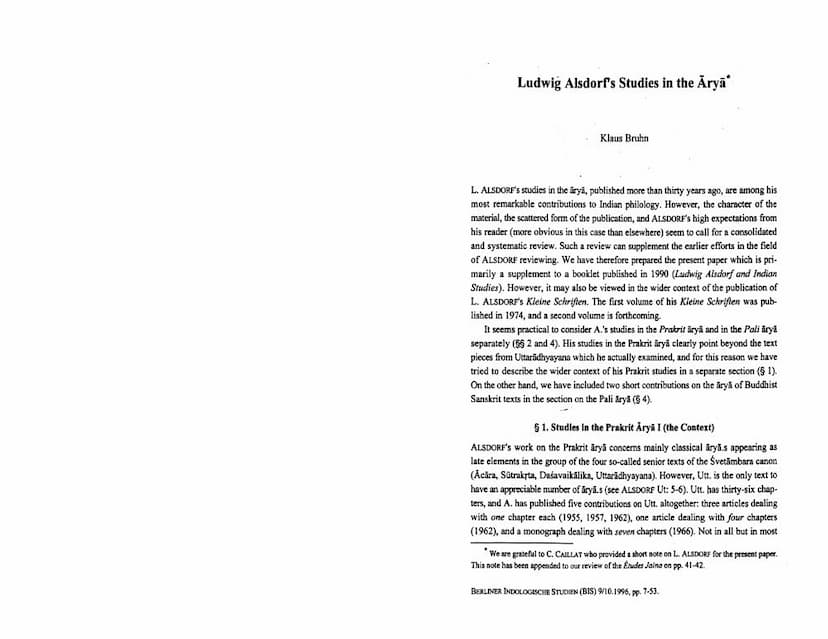
This paper by Klaus Bruhn provides a consolidated and systematic review of the significant contributions made by Ludwig Alsdorf to Indian philology, specifically focusing on his studies of the āryā meter in Jain texts. Bruhn aims to supplement previous reviews and place Alsdorf's work within the broader context of his collected writings.
Key Themes and Focus Areas:
-
Distinction between Prakrit and Pali Āryā: Bruhn initially proposes treating Alsdorf's studies in Prakrit āryā and Pali āryā separately.
-
Prakrit Āryā Studies (Context and Uttarādhyayana):
- Alsdorf's primary focus was on classical āryā found as later elements within the "senior texts" of the Svetambara canon, particularly the Uttarādhyayana (Utt.).
- Utt. is highlighted as containing a significant number of āryā verses, with Alsdorf publishing several influential studies on its chapters.
- Bruhn notes that Alsdorf's studies of Utt. were not solely focused on the āryā meter but also encompassed broader issues like the ākhyāna problem (early narrative literature), Jaina dogmatics, and Utt. itself.
- Alsdorf's work built upon the foundations laid by earlier scholars like E. Leumann, H. Jacobi, J. Charpentier, and W. Schubring, though Alsdorf was critically engaged with some of their conclusions.
- A central aspect of Alsdorf's research was his interest in narrative literature and how the "skeleton" (metrical form) was preserved while the "flesh" (oral or prose variations) evolved.
- Alsdorf's expertise in meter proved crucial for textual criticism, especially in texts showing a transition from older meters like śloka to āryā. He identified the complexities of mixed meters and the need for philological intuition and deep metrical knowledge.
- Alsdorf's analysis of the "seven dogmatic chapters" of Utt. revealed that many āryā verses found here could be traced in later Jain texts. This led him into the vast field of "late canonical and post-canonical verse (l.c. āryā) literature" (L.V.L.).
- Textual Transformation and Reconstruction: Alsdorf engaged with the concept of "transformations" in texts, where present forms result from changes like addition, reduction, substitution, and metrical shifts. He emphasized the importance of "parallel versions" for understanding these transformations and attempting reconstruction of original forms (Urform).
- Genre Problem: Bruhn addresses the complex issue of classifying Jaina exegetical literature (Niryuktis, Bhāṣyas, Cūrṇis, Tīkās), noting Alsdorf's own difficulties in defining these categories and his controversial hypothesis about the relationship between Bhāṣyas and Cūrṇis.
- Intertextual Studies and "Tracts": The paper introduces the concept of "tracts" as smaller, historically significant units of text that facilitate intertextual studies. This approach helps manage the vastness of L.V.L. material and analyze it through its various versions and connections.
- Alsdorf's Methodological Rigor: Bruhn highlights Alsdorf's radical textual criticism, his success in tracing parallels, restoring meters, and interpreting texts. While acknowledging that reconstruction efforts sometimes yielded probabilities rather than certainties, he commends Alsdorf's self-critical approach.
- Understanding and Clarity: A core ethos of Alsdorf's work was a drive for understanding and clarity, seeking to restore the rational element in traditions. His meticulous approach, even when occasionally lacking detailed explanation, reflected his deep commitment to precise scholarship.
- Preference for Early Strata: Alsdorf exhibited a preference for earlier literary strata (e.g., early Āgamas, Pali Tipitaka) due to their perceived simplicity and "living" quality, sometimes contrasting them with later, more scholastic phases of Jain literature. He found the "human element" particularly attractive.
- Specific Studies on Utt. Chapters: The paper then details Alsdorf's analyses of specific chapters of the Uttarādhyayana, examining issues like narrative structures, metrical transformations, secondary insertions, and the presence of āryā verses. Examples include:
- Citta and Sambhūta (Ch. 13): Alsdorf compared the Utt. version with the Pali Jataka, questioning Charpentier's reconstruction of the ancient legend.
- Nami's Renunciation (Ch. 9): Alsdorf identified an old śloka-based saṃvāda that was later supplemented with āryā verses.
- Dumapattayam (Ch. 10): Alsdorf identified metrical corruptions and interpolations, noting the transition from vaitaliya to āryā.
- Sa-bhikkho (Ch. 15): Alsdorf analyzed the complex metrical structure and the intrusion of Tristubh/Jagat verses.
- Hariešijjam (Ch. 12) and Jannalijjam (Ch. 25): Alsdorf analyzed these chapters dealing with withheld alms, focusing on textual criticism and identifying a specific instance of omission impacting textual history.
- Dogmatic Chapters (24, 36, 33, 26, 28, 30, 34): These chapters are discussed in detail, with Alsdorf's monograph Uttarādhyayana Studies (Ut) being central. He identified the significant number of āryā verses in these chapters (109) and their presence in later texts, analyzing transformations, interpolations, and the evolution of doctrines. Bruhn highlights Alsdorf's efforts to reconstruct earlier forms and his observations on the interplay between śloka and āryā meters.
-
Pali Āryā Studies:
- Alsdorf also made significant contributions to the study of āryā in Pali literature, particularly in the Thera-Theri-gātha and various other canonical texts.
- He noted that the āryā meter was less familiar and more corrupted in Pali tradition due to its emigration from India.
- His work involved critical editions and restorations of āryā verses in Pali texts, demonstrating the transition from śloka to āryā, similar to his findings in Jainism.
- Alsdorf's comprehensive approach extended to examining the entire corpus of āryā verses in the Pali canon.
Overall Significance:
Klaus Bruhn's paper emphasizes that Ludwig Alsdorf's studies on the āryā meter were groundbreaking. Alsdorf's meticulous philological approach, his deep understanding of prosody, and his keen eye for textual transformations and parallels provided invaluable insights into the development of Jain and Buddhist literature. His work not only shed light on the evolution of the āryā meter but also contributed significantly to our understanding of the literary history, dogmatic development, and textual transmission within these traditions. The paper serves as a tribute to Alsdorf's scholarly legacy and a guide for future research in the field.