
Ludwig Alsdorf
Added to library: September 2, 2025
Summary
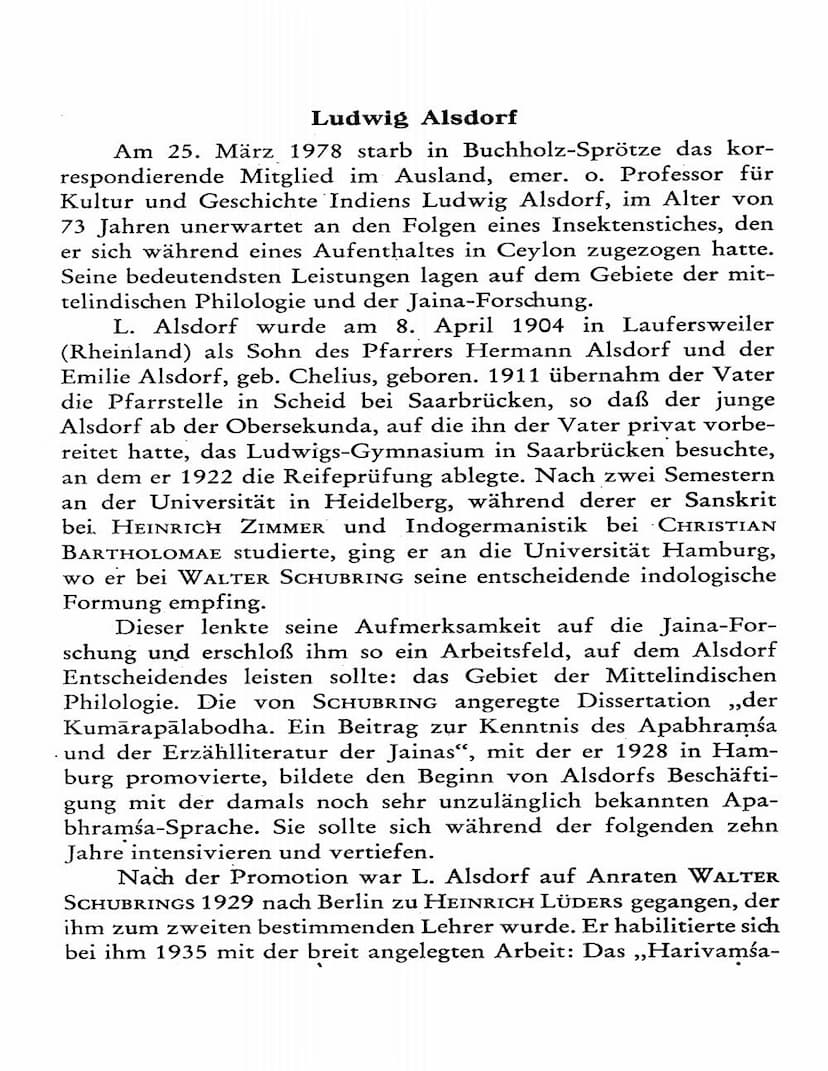
Here is a comprehensive summary in English of the provided Jain text, which is a German obituary for Ludwig Alsdorf:
This document is an obituary for Ludwig Alsdorf, a prominent German Indologist, who passed away unexpectedly on March 25, 1978, at the age of 73 due to complications from an insect sting in Ceylon. Alsdorf's most significant contributions were in the fields of Middle Indian Philology and Jaina Research.
Born on April 8, 1904, Alsdorf pursued his academic career after studying Sanskrit and Indo-Germanic studies at the universities of Heidelberg and Hamburg. His foundational Indological training was significantly shaped by Walter Schubring in Hamburg. Schubring directed Alsdorf's attention to Jaina research, leading him to a field where he would make crucial advancements in Middle Indian Philology.
Alsdorf's doctoral dissertation, "Der Kumārapālabodha. Ein Beitrag zur Kenntnis des Apabhramśa und der Erzählliteratur der Jainas" (1928), marked the beginning of his extensive engagement with the then poorly understood Apabhramśa language. This period of intensive study lasted for ten years.
Following his doctorate, Alsdorf moved to Berlin in 1929 to study under Heinrich Lüders, who became his second influential teacher. His Habilitation thesis in 1935 was "Das Harivamśapurāna. Ein Abschnitt aus der Apabhraínsa-Welthistorie 'Mahāpurāna Tisatthimahāpurisagunālamkara' von Puspadanta." This work further solidified his expertise in Apabhramśa and enriched the understanding of Jaina narrative literature and Indian literary history in general. Notably, he recognized that the Vasudevahindi, a section of the mythical universal history of the Jainas related to Krishna's father Vasudeva, represented an old version of the influential, lost Bṛhatkathā by Guṇādhya. He further dedicated the work "Apabhramśa-Studien" (1937) to Apabhramśa research. A planned comprehensive study on the Bṛhatkathā problem based on the Vasudevahindi was never realized.
A pivotal experience for Alsdorf was his extended stay in India from 1930 to 1932. This period allowed him to gain firsthand knowledge of Indian culture and landscapes, which he later stated was a crucial foundation for his lifelong scholarly work, informing both his classical Indological research and his understanding of modern India. During this time, he worked as a German and French lecturer at the University of Allahabad, but also diligently studied manuscripts and traveled extensively throughout India, Burma, and Ceylon to familiarize himself with historical monuments.
Alsdorf's career trajectory shifted due to external circumstances. While he continued his Middle Indian and Jaina research until the war, his focus expanded to contemporary India and its modern history. He contributed to a publication on India during the war and subsequently joined the Foreign Office in Berlin, where he was part of a special department for India. This led to a lecturing position and eventually an extraordinary professorship for "Volks- und Landeskunde Indiens" (Ethnology and Geography of India) at the University of Berlin. His wartime publications on modern India demonstrated his commitment to this new field, and he continued to publish on Indian history and contemporary issues post-war. His 1955 book, "Vorderindien, Bharat, Pakistan, Ceylon. Eine Landes- und Kulturkunde," was a significant work on the region. This period, though an interruption to his core research, allowed him to become the most informed German Indologist of his time on contemporary India, broadening German Indology beyond its Romantic-era perceptions.
After the war, Alsdorf's professorship in Berlin was dissolved. He continued his work on modern India but soon returned to more traditional Indological areas, particularly Vedic philology, to complete the unfinished three-volume work on the Vedic god Varuṇa, left by his former teacher H. Lüders. Alsdorf dedicated nearly a decade to this demanding task, prioritizing it over his own research plans, showcasing his scholarly integrity and commitment.
His personal circumstances improved when he returned to academia. In 1948, he was a visiting professor at the University of Münster, and in 1950, he succeeded Walter Schubring as professor in Hamburg. This position was particularly significant as it allowed him to continue Schubring's legacy in Jaina Research. He expressed a strong sense of duty to carry on this tradition in Germany, noting in his 1965 lectures at the Collège de France that Hamburg was likely the only German university then significantly engaged in Jaina studies.
During his twenty-two years as a professor in Hamburg, his Jaina research led to three dissertations and two Habilitation theses by his students. His own contributions to Jaina studies from this period include numerous smaller works and the significant study "The Arya Stanzas of the Uttarajjhāyā. Contribution to the Text History and Interpretation of a Canonical Jaina Text" (1966). This work meticulously analyzed the history of the Arya meter in Jain and Buddhist literature. His 1973 essay "Nikṣepa - a Jaina Contribution to Scholastic Methodology" highlighted his ability to grasp the historical significance of abstract Jaina interpretive methods. Earlier, in his 1933 study "Die pratyayas. Ein Beitrag zur indischen Mathematik," he had interestingly connected Jaina metrics and Indian mathematics to Pascal's triangle.
Beyond Jaina canonical texts, Alsdorf also increasingly engaged with Buddhist Middle Indian texts, noting similarities in their textual history to Jaina traditions. He published significant research on the inscriptions of Emperor Aśoka, including his 1962 study "Aśokas Separatedikte von Dhauli und Jaugada." He also delved into the textual history of the Buddhist Jātakas, discovering pre-Buddhist narratives within their metrical sections. Four of his five studies on the Jātakas were published in the "Wiener Zeitschrift für die Kunde Südasiens," to which he contributed as a staff member since 1957. His last major work was "Das Bhūridatta-Jātaka. Ein antibrahmanischer Nāga-Roman" (1977).
In the final decade of his career, Alsdorf's research shifted further towards Pali philology. In 1968, he became Editor-in-Chief of the Critical Pali Dictionary, a project he had helped internationalize and advance since 1959. After his retirement in 1972, he dedicated most of his time and energy to this monumental undertaking, overseeing the publication of six fascicles. Once again, he deferred his personal research interests to contribute to a critical academic project.
Alsdorf's scholarly achievements were recognized internationally. He was a member of the Mainz Academy of Sciences and Literature (since 1950), the Joachim Jungius Society of Sciences in Hamburg (since 1958), the Royal Danish Academy of Sciences and Letters (since 1967), and the Austrian Academy of Sciences (corresponding member abroad, 1977). He was scheduled to attend a meeting of the Commission for Languages and Cultures of South Asia in Vienna in 1978, but his death prevented this.
The obituary concludes with a supplement to his bibliography, listing publications from 1974-1979, and mentions other obituaries and appreciations for Alsdorf.