
Literary Source For Late 18th Century Spoken Tibetan
Added to library: September 2, 2025
Summary
Here's a comprehensive summary of the provided text, "A Literary Source For Late 18th Century Spoken Tibetan (Amdowa)" by Ernst Steinkellner:
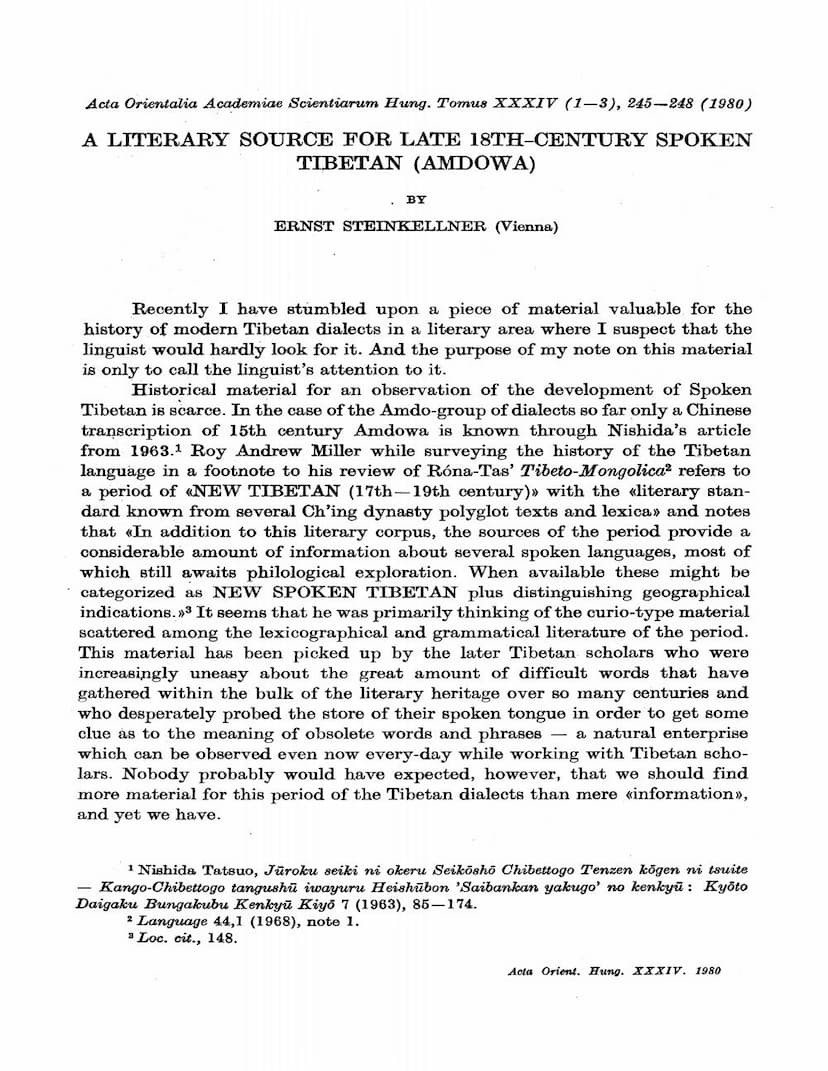
Core Argument: The author, Ernst Steinkellner, introduces a significant literary work from the late 18th century that serves as a valuable, and perhaps unexpected, source for understanding spoken Tibetan, specifically the Amdo dialect. He aims to draw the attention of linguists to this material.
The Problem of Historical Spoken Tibetan: Steinkellner highlights the scarcity of historical data for observing the development of spoken Tibetan. While some Chinese transcriptions of 15th-century Amdo are known, and later scholars have used spoken language to interpret obsolete literary terms, concrete literary sources for spoken Tibetan of this period are rare. He notes that Roy Andrew Miller alluded to such "new spoken Tibetan" material scattered within lexicographical and grammatical literature, but it largely remained unexplored.
The Discovered Source: Steinkellner's discovery comes from a philosophical essay on the "three doors towards liberation" (rnam thar ago gsum) written by Gun than 'Jam pa'i dbyans (also known as Gun than dKon mchog bstan pa'i sgron me). This prominent scholar lived from 1762 to 1823 and was born in the Amdo region (specifically mDzod dge smad, South-East mDo smad).
Key Features of the Text:
- Colloquial Language: The essay, included in Volume 10 of Gun than's Collected Works, is explicitly titled "Phal skad zab chos" (The profound teaching in colloquial language). Its verse title further emphasizes its intent to be understood by "all people of simple mind" through colloquial language.
- Author's Background: Gun than was born and raised in the Amdo region, suggesting the dialect used is likely his native tongue (potentially the "Dzoge" dialect). He also spent significant time in Central Tibet and returned to his home region (Bla bran/Labrang), influencing his linguistic environment.
- Author's Capabilities: Gun than was not only a highly respected scholar but also an esteemed poet. This suggests he possessed a significant ability to render spoken language into written form effectively, choosing appropriate orthographical means.
- Conscious Use of Dialect: Crucially, Gun than knew he was writing in dialect. This means the text is less likely to be heavily corrupted by literary conventions compared to other contemporary materials. While some parts are clearly in literary Tibetan, the remainder is believed to be representative of the spoken dialect (either "Dzoge" or "Labrang," or a combination) as used by an educated individual.
- Content and Dating: The text is a conversational sermon on Buddhist principles, presented in a question-and-answer format. It is written in prose and is eleven folio-pages long, though likely incomplete. It was probably composed between 1792 and 1823, after Gun than's return to Bla bran.
Significance for Linguistic Study:
- Late 18th Century Amdowa: The text offers a unique glimpse into the Amdowa dialect as spoken in the late 18th century, a period with scarce linguistic data.
- Grammatical and Lexicographical Material: It will provide new insights into the grammar and vocabulary of Amdowa.
- Phonetic Information: The "educated orthography" used is expected to offer perceptions into the phonetics of the dialect and potentially 18th-century Tibetan phonetics more broadly, as it transcends regional Amdo limits.
- Precision: Given the cultural context and the author's abilities, Steinkellner believes the dialect material is as precisely recorded as could be expected.
Call to Action: Steinkellner concludes by expressing hope that a specialist or team will undertake the linguistic research this text deserves, as he himself is not equipped for it. He also encourages other scholars to share similar discoveries. He notes that Professor Róna-Tas has expressed interest in studying the text.
In essence, this article is an announcement and a call for linguistic research on a newly identified, highly valuable literary artifact that captures a specific moment in the history of spoken Tibetan, specifically the Amdo dialect, by a prominent scholar of the period.