
Letter
Added to library: September 2, 2025
Summary
Here is a comprehensive summary of the Jain text "Letter" by A.N. Upadhye, based on the provided pages:
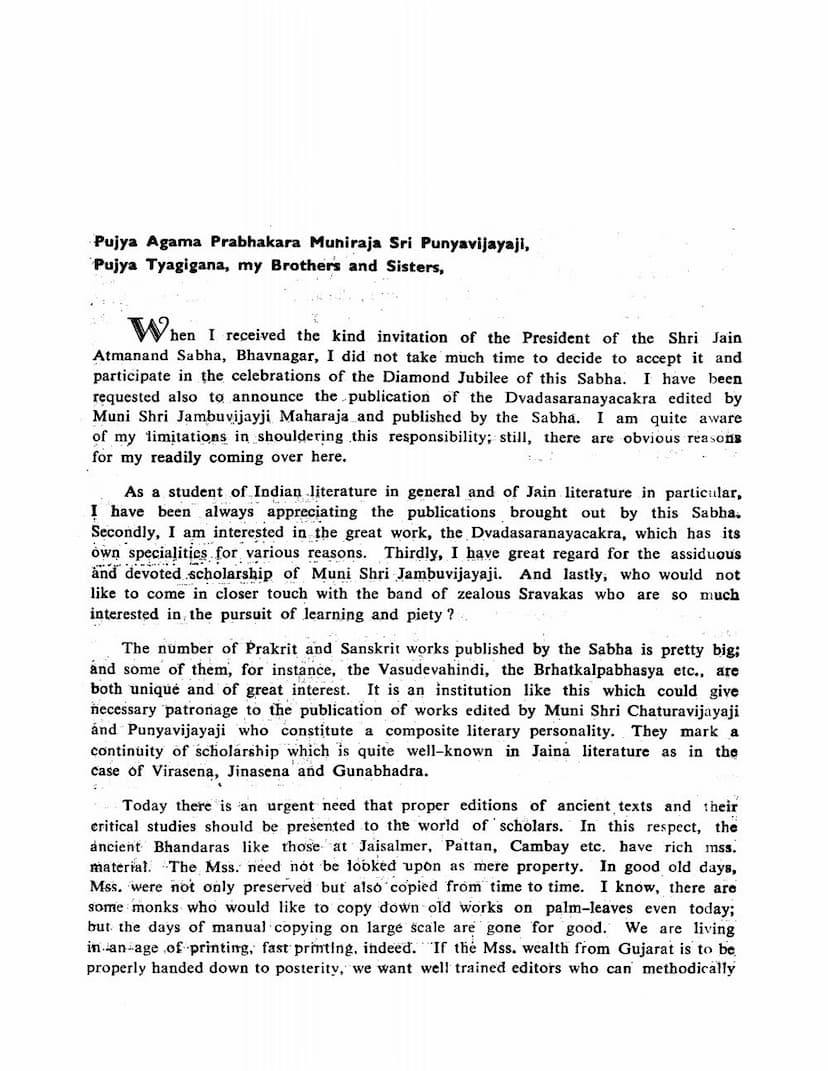
This document is a letter written by A.N. Upadhye, a scholar of Indian literature and particularly Jain literature. He is addressing the audience at the Diamond Jubilee celebrations of the Shri Jain Atmanand Sabha in Bhavnagar. The letter primarily serves as an announcement and endorsement of the publication of the Dvadasaranayacakra, edited by Muni Shri Jambu vijayji Maharaja and published by the Sabha.
Upadhye begins by expressing his pleasure and reasons for accepting the invitation to participate in the celebrations. These include his appreciation for the Sabha's publications, his interest in the Dvadasaranayacakra itself, his high regard for Muni Shri Jambuvijayaji's scholarship, and his admiration for the zealous Jain lay followers (Sravakas) dedicated to learning and piety. He highlights the significant number of Prakrit and Sanskrit works published by the Sabha, mentioning the Vasudevahindi and Brhatkalpabhasya as examples of unique and important publications. He praises the Sabha for supporting scholars like Muni Shri Chaturavijayaji and Punyavijayaji, who represent a continuation of established Jain scholarship.
A significant portion of the letter emphasizes the urgent need for critical editions of ancient Jain texts. Upadhye stresses the importance of utilizing the rich manuscript material available in ancient Bhandaras (libraries) across Gujarat, such as those at Jaisalmer and Pattan. He notes the shift from manual copying to printing and the necessity of well-trained editors who can meticulously study manuscripts to produce authentic editions for future generations of scholars. He quotes the late Dr. V.S. Sukthankar, editor of the Mahabharata, on the foundational importance of sound critical texts for further research, stating that without them, subsequent research is a waste of time and energy. He reiterates the valuable service rendered by the Bhandaras, monks like Muni Shri Punyavijayaji, and institutions like the Atmananda Sabha in publishing Jain works. He also mentions the inspiration drawn by Pt. Nathuramaji Premi from the Sabha's publications and his own efforts, along with Dr. Hiralal Jain, to revitalize Pt. Premiji's Granthamala.
Upadhye then delves into his personal interest in the Dvadasaranayacakra and his relationship with Muni Shri Jambuvijayaji. He acknowledges the peculiar challenges of critically editing this text and has been observing various attempts to do so. He shares his personal connection with Muni Shri Jambuvijayaji, recalling their discussions on textual criticism when the Muni visited Kolhapur. He expresses his surprise and pride at the Muni's dedication to learning and piety after renouncing the world. He also recounts a meeting with the Muni in Ahmedabad, observing his physical frailty but recognizing his intense zeal for learning and his progress in studying Tibetan and other languages. He concludes this section by offering felicitations to Muni Shri Jambuvijayaji for completing the first part of the Dvadasaranayacakra.
The letter transitions to discussing the significance of the gathering itself. While Jain communities often gather for religious festivals, this occasion is marked by solemnity to witness the publication of a scholarly work edited by a monk whose authority stems from his scholarship and devotion. He draws a parallel with the Jain tradition of Shastradana (gift of scriptures), citing the example of Attimabbe from Karnatak who distributed one thousand copies of a work, saving it from oblivion.
Upadhye then provides a concise yet insightful overview of core Jain philosophical and ethical principles. He describes Jainism as "Ethical Realism" with a twofold objective in its Acara-dharma (conduct-dharma):
- Spiritual purification: This stems from the Jaina theory of Karma, an automatic law where individuals are responsible for their actions and their consequences, without divine intervention. Karma is seen as subtle matter or energy that affects the soul.
- Social responsibility: This aims to cultivate equality towards all beings, respect for individual life, attitudes, and possessions. The moral code is graded, and adherence depends on individual willingness and environment.
He highlights Ahimsa (non-violence) as the foundation of Jaina ethics, defining it as the recognition of the inherent right of every living being to live. He quotes Albert Schweitzer on the significance of the commandment "not to kill and not to damage." He notes the Jain moralist's practical approach to Ahimsa by classifying sentient beings according to their biological development, encouraging gradual abstention from harming higher forms of life and eventually lower forms. He also reiterates the importance of respecting the sanctity of attitudes, personality, and possessions, which are encapsulated in the five vows: Ahimsa, Satya (truthfulness), Asteya (non-stealing), Brahmacharya (celibacy/chastity), and Aparigraha (non-possession).
Satya (truthfulness) is also emphasized for its value in worldly affairs and in understanding religious and philosophical principles. He contrasts the Jaina approach of "Saccam logammi sara-bhuyam" (Truth is the essence in the world) with the more common "Satyamev Jayate" (Truth alone triumphs), highlighting the differing philosophical implications and approaches to truth in critical situations.
The letter then introduces the Jaina doctrine of Anekanta (non-absolutism) as a solution to the confusion caused by conflicting truths presented by different teachers. Anekanta enables viewing situations from multiple perspectives, pooling partial viewpoints for a comprehensive understanding. This awareness of reality's complexity, its changing modes, and human limitations gives rise to Nayavada (doctrine of standpoints), where "Naya" represents a point of view or approach.
Upadhye discusses the chronological stratification of the Ardhamagadhi canon, noting that while scholars like W. Schubring began this study, it has been largely ignored in India. He points out attempts to trace the seeds of Nayavada within the canon and mentions the various alternative predications discussed by Mahavira and his disciples. He elaborates on the different "Nayas" (approaches) like Drvyarthika, Paryayarthika, Niscaya, and Vyavahara, and how they are related to Dravya, Ksetra, Kala, and Bhava. He cites Umasvati's pramana-nayair adhigamah (reality is understood through pramāṇa and naya) and his enumeration of seven Nayas, suggesting that Umasvati systematized existing traditions.
He then highlights Siddhasena Divakara as a significant Jaina logician who prioritized rationality over tradition, evident in his views on the simultaneity of jnana and darsana in a Kevalin, his preference for Sanskrit, and his attempt to Sanskritize the canon. Siddhasena's approach, which emphasizes that all systems of thought are partial attempts while Jainism offers a comprehensive view, is further elaborated with his famous verse: "As many are the modes of speech, so many are the Nayavadas; as many are the Nayavadas, so many are the other systems (Parasmaya)." The letter also references Jinabhadragani's Visesavasyaka-bhasya in the context of Nayavada.
The letter returns to the Dvadasaranayacakram of Mallavadi Ksamasramana, whom Hemachandra praised as a leading logician. It is mentioned that Mallavadi likely wrote a commentary on Siddhasena's Sanmati Tarka, which further honed his rationalist faculties and led to the Dvadasaram Nyacakram, where he elaborates on the development of the Naya doctrine. The substance of Mallavadi's work is existential, describing reality as endowed with inherent qualities and superimposed modes that persist through change, understood through various Nayas referring to Samanya (generality) and Visesa (particularity).
Mallavadi's approach, inherited from grammatical vocabulary, classifies understanding based on substance (general affirmation/vidhi) and special features (restricted statement/niyama). He also includes a third mode combining both. From these, he develops twelve modes arranged in a circular wheel, hence the name Nayacakram. These twelve modes can be grouped under Dravyar hika and Paryayarthika and correspond to Umasvati's seven Nayas. The letter lists these twelve modes of consideration.
The primary objective of Mallavadi's exposition, clarified by his commentator Simhasuri, is to categorize various philosophical systems under these modes and refute them. This requires Mallavadi's proficiency in diverse philosophical schools and his methodical rigor. The letter outlines how the first volume of the Dvadasaram Nayacakram covers four viewpoints: the common man's view, doctrines of Purusa, Niyati, Kala, Svabhava, and Bhava, the Samkhya system and Isvaravada, and the discussion of Isvara versus Karma.
The title "Dvadasaranayacakra" is explained: the Nayas are the twelve spokes of a wheel, each with a refutative and a positive part. The rim has three sections, each containing four Nayas, and the nave is Syadvada. Simhasuri's commentary, Nyayagamanusarini, is crucial for reconstructing Mallavadi's original text, which is often presented indirectly.
The importance of the Dvadasaranayacakra is twofold: it's a major contribution to the Naya doctrine in Jainism, and it provides valuable material for the history of Indian philosophy, reviewing numerous contemporary and diverse systems (Vedic, Samkhya, Nyaya, Vaisesika, Mimamsa, Advaita, Bauddha, Yoga, grammarians) and quoting various Jain and non-Jain sources chronologically.
The letter notes that a work named "Nayacakra" was known through references but took time to be published. Mallavadi's work is distinguished from other smaller texts with similar names. Its difficulty, daring innovations, accommodative rather than polemic approach, and the obscurity of its original text within commentaries made it less accessible. The lack of a lucid commentary also contributed to its limited appreciation.
The letter mentions recent scholarly interest in the Dvadasaranayacakra, with articles written by scholars and Muni Shri Jambuvijayaji himself. It highlights the work of Pt. Malavania and the casual reference by Dr. V. Raghavan. It also notes Dr. E. Frauwallner's interest in Naya and his introduction to the edition by Shri Jambuvijayaji.
Upadhye then offers crucial advice on chronology and research methodology in comparative philosophy. He stresses the importance of evidence over opinions, fairness in presenting facts (favorable or unfavorable), and avoiding speculation without clear evidence. He cautions against tendencies that prioritize supporting conclusions over objective research, citing observations on Muni Shri Vikramavijayaji's writings.
The letter then details recent editions of the Dvadasaranayacakra. The first part of the Gaekwad's Oriental Series edition (edited by Muni Chaturavijayaji and Pt. Lalchardaji) was published in 1952. Shri Vijayalabdhisuri's edition was completed in four parts. Upadhye states that the present edition by Muni Shri Jambuvijayaji is a definite improvement, characterized by a closer study of the text, more definitive restoration, exhaustive manuscript material, critical handling of variants, and clear specification of editing methods. He praises the Tippanis as remarkable scholarship and the presentation of the commentary in paragraphs as a testament to the editor's understanding of the complex text. He also commends the edition of the Pramana-samuccaya and the Introduction, which reconstructs Mallavadi's biography and places him around Samvat 414 (A.D. 357), making him a contemporary of Siddhasena.
In conclusion, Upadhye offers his respectful felicitations to Muni Shri Jambuvijayaji for this model edition of a Nyaya work and solemnly announces its publication, expressing hope for the remaining part. He adds a final thought that a critical edition is merely the beginning of advanced studies, urging specialists in Indian philosophy to engage with the Dvadasaranayacakra to shed more light on its aspects and the history of Indian philosophy. He thanks the Atmananda Sabha for the opportunity and for their significant contribution to Indian and Jain literature, mentioning their reputation for bringing to light works like the Brhatkalpabhasya. He concludes by offering his respects to Agama Prabhakara Muniraja Shri Punavijayaji for inspiring scholarly work. The letter is dated Kolhapur, April 1st, 1967, and signed by A.N. Upadhye.