
Lamotte And Doctrine Of Non Self
Added to library: September 2, 2025
Summary
Here is a comprehensive summary of the provided Jain text, "Lamotte And Doctrine Of Non Self" by J. W. de Jong:
This text is a scholarly discussion, specifically a critique by J.W. de Jong of Frits Staal's interpretation of the work of Étienne Lamotte on the Buddhist doctrine of anātman (non-self).
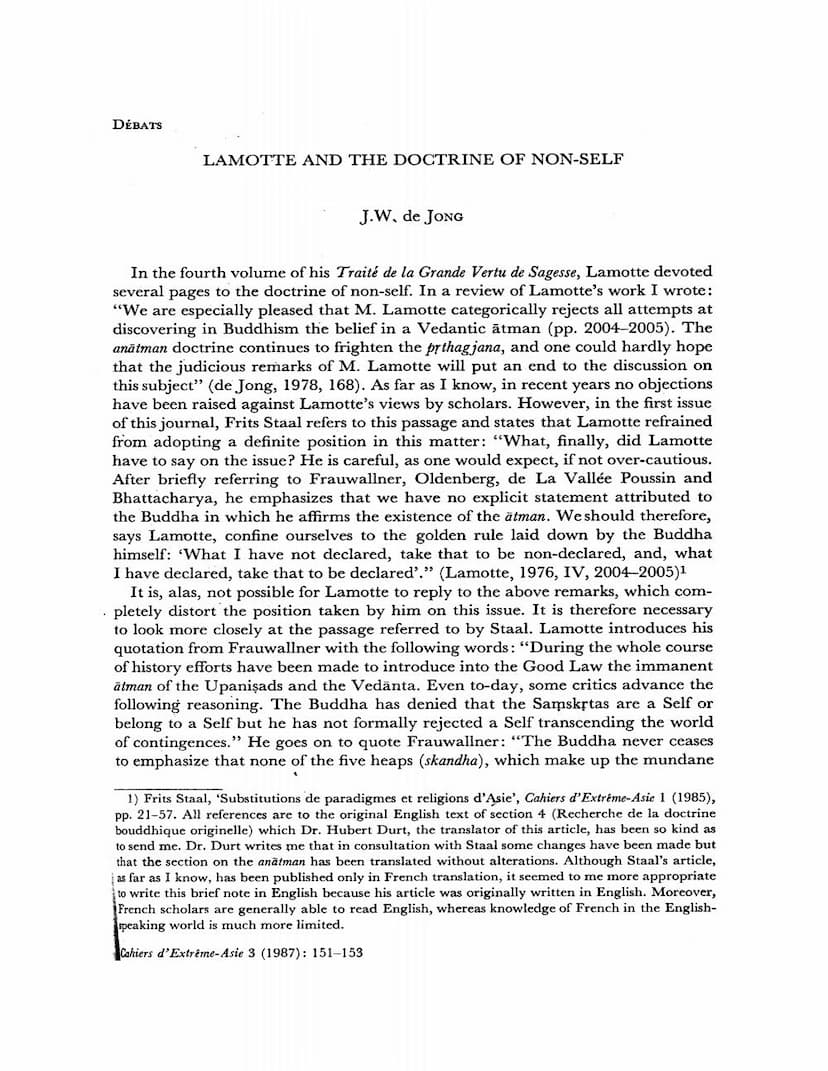
De Jong's primary aim is to defend Lamotte's clear rejection of the idea that Buddhism, and particularly the Buddha, believed in a "Self" or ātman akin to the Vedantic concept. De Jong feels that Staal misrepresented Lamotte's position by suggesting Lamotte was overly cautious or refrained from taking a definitive stance on the anātman doctrine.
Here's a breakdown of the key points:
-
De Jong's Initial Praise for Lamotte: De Jong begins by commending Lamotte's Traité de la Grande Vertu de Sagesse for its "categorical rejection of all attempts at discovering in Buddhism the belief in a Vedantic ātman." He notes that Lamotte's remarks should ideally settle the discussion on this matter.
-
Staal's Counter-Interpretation: De Jong addresses Staal's reference to a specific passage in Lamotte's work. Staal quotes Lamotte stating that the Buddha did not explicitly affirm the existence of an ātman and advises adhering to the Buddha's own rule: "What I have not declared, take that to be non-declared, and, what I have declared, take that to be declared." De Jong argues that Staal's interpretation of this passage is a distortion of Lamotte's actual position.
-
Lamotte's Nuanced Argument: De Jong clarifies Lamotte's argument. Lamotte acknowledges the efforts throughout history to introduce the Upanishadic ātman into Buddhism and references critics who argue that while the Buddha denied a conditioned Self, he didn't formally reject a transcendent Self. Lamotte, however, examines dialogues involving Sāriputra and Yamaka, and the Buddha and Anurādha, concerning the "Tathāgata" (referring to the liberated saint).
- Lamotte notes that the Tathāgata is described as not being one of the five skandhas (components of personality), not found within them or elsewhere, not the sum of them, but also not different from them.
- Lamotte's commentary on the difficult phrase "anupalabbhiyamāno" (not to be apprehended or found) is crucial. De Jong points out that while Lamotte refers to de La Vallée Poussin's interpretation (which denies the Tathāgata can be spoken of as existing), Lamotte's own position is identical. Lamotte explicitly states he translates nopalaḥyate as "does not exist" and aligns himself with Miss Horner's interpretation of "not to be known, or, not existing."
-
Lamotte's Strong Affirmation of Non-Self: De Jong emphasizes that Lamotte goes beyond simply noting the lack of explicit affirmation of an ātman. Lamotte points out that the Sūtras repeatedly state that all phenomena, conditioned or unconditioned, are anātmanaḥ (non-self). He highlights Satkāyadrști (belief in a personal existence or self) as the most profound ignorance.
-
The Buddha's Golden Rule and Its Significance: De Jong underscores that Lamotte, after quoting the Buddha's rule about declared vs. undeclared teachings, adds a crucial point that Staal overlooks: for twenty-five centuries, monks have found spiritual peace and joy by realizing the profound meaning of the Buddha's doctrines, particularly the doctrine of non-self. This, for De Jong, demonstrates Lamotte's conviction that the doctrine of non-self provides spiritual solace.
-
Consistent Position of Lamotte: De Jong supports his claim that Lamotte "categorically rejects" the Vedantic ātman in Buddhism by citing earlier works of Lamotte:
- A rejection of J.G. Jennings' view that the Buddha believed in a paramātman.
- Lamotte's statement that "There is no ātman, no individual Self."
- Lamotte's remark that passages seemingly referring to an ātman are "aberrant" and "drowned in the mass of other passages in which the nonexistence of the atman is formally affirmed."
- Lamotte's lecture statement that "The soul, the person, does not exist; it is only a name given to a collection of changing formations."
-
De Jong's Defense of His Own Terminology: De Jong also defends his use of the term pṛthagjana (ordinary, unenlightened person), which Staal criticized. De Jong clarifies that he used it in accordance with Buddhist teachings, as Lamotte also does, to describe those bound by attachments like the belief in personality (satkāyadrști).
In essence, de Jong's article is a vigorous defense of Étienne Lamotte's scholarly stance on the Buddhist doctrine of non-self. He argues that Lamotte firmly and consistently rejects any attempts to equate Buddhist non-self with the Vedantic concept of the Self and that Staal's summary of Lamotte's position is misleading. Lamotte, according to de Jong, presents the doctrine of non-self not as an absence of definitive statement, but as a central, affirming truth of Buddhism that has provided spiritual solace for centuries.