
Lamotte And Concept Of Anupalabdhi
Added to library: September 2, 2025
Summary
Here is a comprehensive summary of the provided text, "Lamotte And Concept Of Anupalabdhi" by Ernst Steinkellner, focusing on its arguments and conclusions:
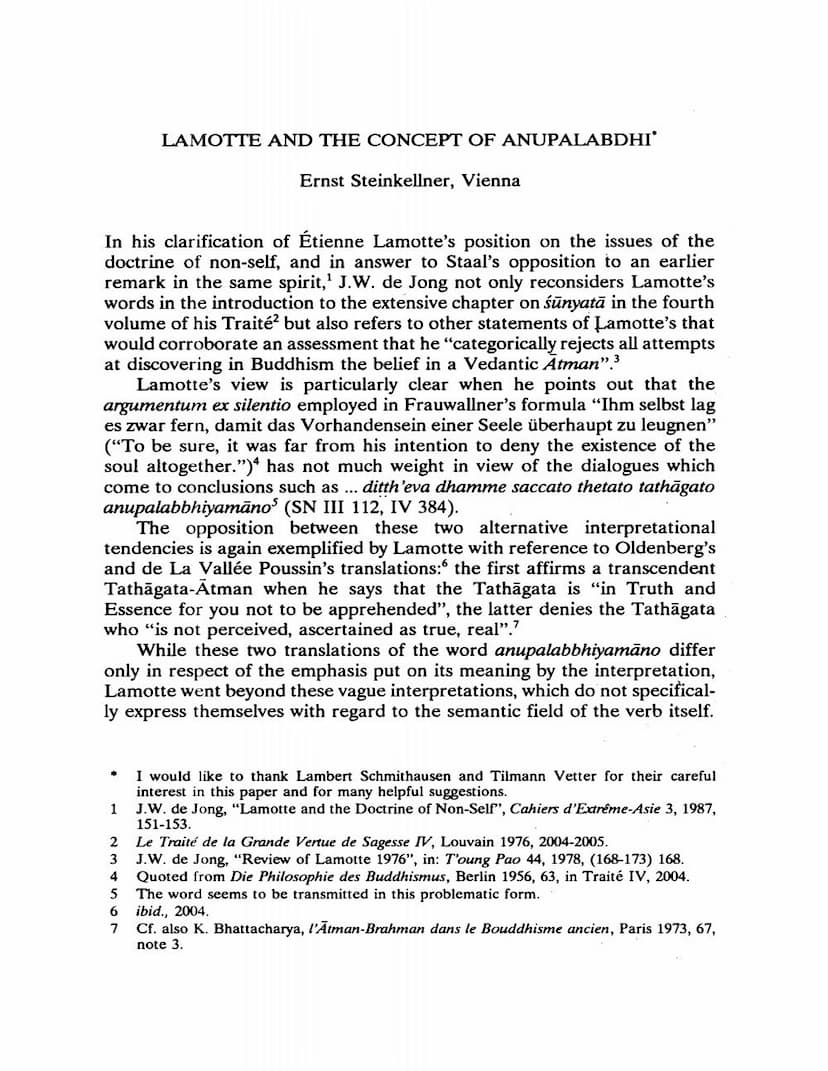
The article by Ernst Steinkellner delves into the complex interpretation of the Pali term anupalabdhi (and its related verb forms like anupalabbhiyamāno and nopalabhyate) within early Buddhist texts, particularly in relation to the doctrine of anātman (non-self) and the nature of the Tathāgata. The author engages with the work of Étienne Lamotte and others, particularly J.W. de Jong, who argue that Lamotte "categorically rejects all attempts at discovering in Buddhism the belief in a Vedantic Ātman."
Central Argument:
Steinkellner's core argument is that anupalabdhi (non-perception) in early Buddhist contexts does not inherently mean "non-existence." Instead, it primarily refers to a cognitive limitation – the inability to perceive something. While non-existence might be implied by non-perception in certain situations, this implication is not the direct meaning of the term itself. He posits that a clear and systematic understanding of anupalabdhi as a concept related to negative cognition and non-existence only emerged later with the philosophical developments of Dharmakīrti.
Key Points and Supporting Arguments:
-
Lamotte's Stance and the Debate: The article begins by highlighting Lamotte's strong stance against interpreting early Buddhist texts as affirming a "transcendent Tathāgata-Ātman." Lamotte's position is supported by his translation of anupalabbhiyamāno as "not to be apprehended" or "does not exist," which de Jong considers more aligned with a rejection of inherent existence.
-
Critique of Early Interpretations: Steinkellner challenges interpretations that equate anupalabdhi directly with non-existence, citing differing translations of passages (e.g., Oldenberg vs. de La Vallée Poussin on the Tathāgata). He argues that Lamotte's preferred translation of nopalabhyate as "does not exist" and anupalabbhamāne as "not-existing" (as explained by J.B. Horner) is problematic if taken as the sole or direct meaning.
-
The Development of Dharmakīrti's Theory: A crucial part of the argument is the tracing of the concept of anupalabdhi through philosophical history.
- Pre-Dharmakīrti: Before Dharmakīrti, the understanding of anupalabdhi was less systematized. While it might have implied non-existence, there wasn't a robust theory of negative cognition.
- Dharmakīrti's Innovation: Dharmakīrti, in the "post-systematical period," developed a sophisticated theory of negative cognition. He distinguished between:
- Unqualified general non-perception: Non-perception of something imperceptible (adriya). This leads to a "negation of cognition, word and activity with reference to existence."
- Qualified non-perception: Non-perception of something perceptible (driya). This leads to a "certain cognition of non-existence."
- Steinkellner emphasizes that for Dharmakīrti, the non-perception of something imperceptible cannot definitively prove its non-existence.
-
Analysis of Key Texts and Phrases: Steinkellner examines specific canonical passages to illustrate his point:
- SN III 112 / IV 384: The phrase ditthe va dhamme saccato thetato tathāgato anupalabbhiyamāno (in this very life, the Tathāgata is not apprehended as true and real). Steinkellner argues this means the Tathāgata is imperceptible (adriya), not that he does not exist. Non-perception of an imperceptible being supports the rejection of affirmative statements about its existence, but it doesn't directly prove non-existence.
- Aggivacchagottasutta (MN 1.72): The Buddha's description of the Tathāgata as "deep, immeasurable, unfathomable as the great ocean" (gambhīro appameyyo duppariyogālho seyyathā pi mahāsāmuddo) is used to suggest the Tathāgata's imperceptibility. The metaphor of the ocean, while vast, is not used to denote non-existence.
- Alagaddūpamasutta (MN I 138): The rejection of the view of a permanent Self (attā) when the Self and what belongs to the Self are saccato thetato anupalabbhamāne (not perceived as true and real). Steinkellner interprets this as the Self being imperceptible, which leads to rejecting the view of its permanent existence, rather than the Self not existing. He critiques Horner's translation of this phrase, which implies a contradiction if "not to be known" is paired with "non-existing."
- Buddhaghosa's Visuddhimagga: This passage shows that "not to be perceived" is given as a reason for the concept of non-existence, but it doesn't equate the two.
- Brahmanical Literature (Patañjali, Nyāyasūtras, Mīmāmsā): Steinkellner briefly surveys early Brahmanical usage. Patañjali lists reasons for non-perception of existent things (e.g., subtlety), indicating anupalabdhi as a purely cognitive term for existent but unperceived entities. While some traditions like Nyāya and Mīmāmsā connect non-perception with non-existence, Steinkellner suggests this connection becomes more systematized later.
-
Rejection of "Not to be Known" as "Not to Exist": Steinkellner strongly asserts that historical reasons make it impossible to accept the semantic hypothesis that "not to be known" means "not to exist" within the Buddhist context.
-
Dharmakīrti as a Foundation: The article concludes that Dharmakīrti's systematic theory of non-perception is a valuable tool for understanding earlier, presystematic canonical expressions. His theory provides a coherent framework that explains the basic Buddhist intellectual attitude of refraining from definite views on certain matters, demonstrating its epistemological validity.
Conclusion:
Steinkellner argues that the interpretation of the Tathāgata's or the Self's non-perception (anupalabbhiyamāno) as saccato thetato (as true and real) should be understood as indicating imperceptibility. This imperceptibility, when understood through the lens of Dharmakīrti's later systematic thought, serves as the primary reason for rejecting views that affirm their existence. This approach offers a "middle way" that avoids the extreme positions of either affirming a transcendent Ātman or succumbing to nihilistic non-existence, reflecting a core Buddhist intellectual attitude. The article ultimately supports Lamotte's overall rejection of Vedantic Ātman-like interpretations of Buddhism by demonstrating that the key terms in the relevant passages refer to cognitive limitations (imperceptibility) rather than inherent non-existence.