
La Fascination Jaina Pour Lalchimie
Added to library: September 2, 2025
Summary
Here's a comprehensive summary of the provided Jain text "La fascination jaina pour l'alchimie" by Nalini Balbir, based on the given pages:
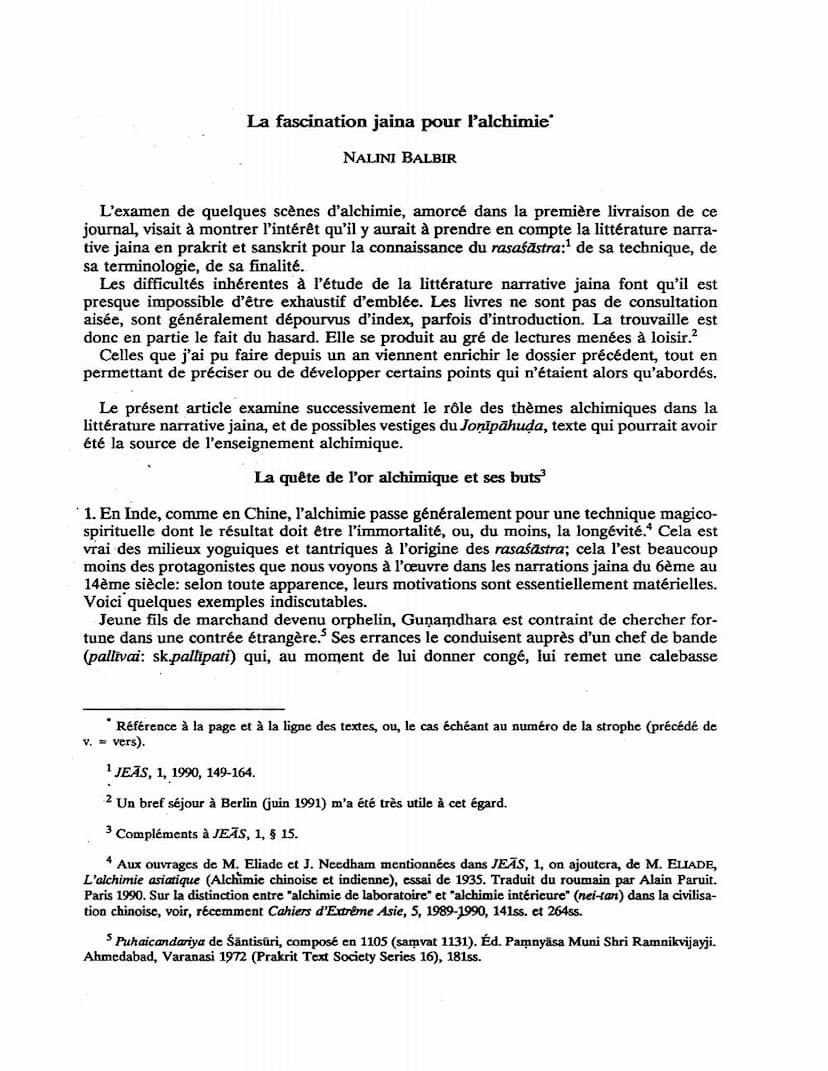
This article, a continuation of a previous one in the same journal, explores the Jain fascination with alchemy, particularly as depicted in Prakrit and Sanskrit narrative literature from the 6th to the 14th centuries. The author, Nalini Balbir, aims to illuminate the technical aspects, terminology, and ultimate goals of rasashastra (alchemy) through these narratives. She acknowledges the difficulty of exhaustively studying this literature due to the lack of indexes and introductions in many texts, noting that discoveries often happen by chance.
The article focuses on two main areas: the role of alchemical themes in Jain narrative literature and the potential influence of the Jonipāhuda, a text possibly serving as a source for alchemical teachings.
The Quest for Alchemical Gold and its Goals:
-
Materialistic Motivations: Unlike alchemy in China and yogic/tantric traditions in India, which often aimed at immortality or longevity, Jain narratives frequently portray alchemists whose motivations are primarily material – the pursuit of wealth through the transmutation of base metals into gold (aurifaction).
- Example 1: Gunamdhara: An orphan merchant's son, Gunamdhara, is given a gourd filled with mercury by a bandit chief. This mercury is capable of transmuting its own weight in base metal a hundred thousand times. The narrative emphasizes how easily this mercury grants riches, allowing him to obtain luxuries.
- Ambivalence towards Alchemy: While the pursuit of wealth through alchemy is presented as a means to enrich oneself with little effort, it is also viewed with suspicion. Some texts consider alchemy a vice, akin to a "demon that turns the head."
- Example 2: Elasādha (from Dhūrtākhyāna): Elasādha, an ambitious young man, finds a pool of mercury that can transmute metals a thousandfold. He uses this wealth for luxurious living and even for charity. However, his ill-gotten gains are stolen, and he loses his head, highlighting the dangerous and morally ambiguous nature of such pursuits. His fate, along with others in similar narratives, underscores the risks involved in alchemy.
-
Alchemy as a Rite of Passage: In other instances, successful alchemical operations serve as a way for young men to prove themselves, demonstrate their capabilities, and gain independence. It's portrayed as a necessary step in their education and a rite of passage into adulthood.
- Example 3: Sulocana (from Bhavabhāvanāprakarana): A noble but frivolous prince, Sulocana, squanders his father's fortune. To earn his own wealth, he joins a group of metallurgists. He witnesses their fruitless labor and then demonstrates his own skill, succeeding where they failed. This success is attributed to his personal qualities, moral and spiritual strength, overcoming mere brute technique. The narrative uses alchemical success as a literary motif, with recurring elements and variations.
- Common Formula: The phrase "Vasuhārā ihaim padau" (May the Earth bestow upon us here and now!) appears to be a password or invocation among alchemists, signifying a wish for success and wealth, possibly invoking the goddess Vasudhārā.
- Specialized Language: The term dhauvāya-bhāsā indicates the existence of a specific code language used by alchemical specialists.
-
Other Narratives:
- Example 4: Kumārapālapratibodha: Similar to Sulocana's story, a prince escapes confinement and, after encountering metallurgists and using the "Vasuhārā ihaim padau" formula, achieves immediate success due to his charisma.
- Example 5: Śirīpāla (from Śirīśirivalakaha): Śrīpāla seeks recognition for his own merits, not just through his father-in-law. He learns the craft of alchemy, gaining prestige and paternal approval, unlike in the Lilāvaṭīsāra where it caused familial discord. His journey culminates in becoming a monk, suggesting that alchemical knowledge was not entirely alien to monastic circles.
-
Monastic Orthodoxy and Alchemy: While canonical texts generally condemned alchemy along with other practices, some writers found ways to incorporate it.
- Jineśvarasūri (11th century): This Svetambara master, belonging to the Candrakula of the Kharataragaccha, actively defended alchemy in his Kathakośaprakarana. He argued for its public utility, suggesting it could help fulfill religious and social duties. He traced his lineage to Vaira (Vajrasvāmin), a figure associated with magical powers, and to Uddyotanasūri, the author of Kuvalayamālā, known for his alchemical knowledge. Jineśvarasūri cites the Jonipāhuda as his source, asserting that alchemy was explained in the "Ancient Texts enunciated by the Jina" for the benefit of the community.
The Jonipāhuda (Jp. / Yp.):
-
Nature of the Text: The Jonipāhuda (Skt. Yoniprābhta) is a text described as a brief treatise in verse or a subsection of a Purva. Its original text is lost, and knowledge of it is indirect and fragmented. The title itself suggests it deals with "generation" (yoni).
-
Twofold Applications: According to commentaries and authors like Jinabhadra and Uddyotanasūri, the Jp. discusses:
- Generation of Living Beings: Creating creatures from inert substances. Anecdotes mention masters creating horses and buffaloes.
- Alchemy (Transmutation): Transforming base metals into gold and gemstones through contact with other substances. This aligns with the concept of "Allogenesis" (the production of different things from alien sources).
-
Jaina Alchemy: The Jp. is cited as the authentic source for alchemical teachings by Uddyotanasūri and Jineśvarasūri. The strophes attributed to it are didactic and concise, possibly intended for oral transmission among initiates.
-
Key Alchemical Concepts Mentioned:
- Distinction between Dhātuvāda and Rasavāda: While dhātuvāda often refers to all alchemical operations, a distinction is made between working with metals (dhāuvvāo) and the "mercury craft" (rasa-vão).
- Mercury's Transmutative Power: The text describes mercury's ability to transmute base metals by a hundred, thousand, hundred thousand, ten million, or myriads of times its weight, and even through vapor (dhūma-vehi).
- Mercury Fixation (rasa-bandha): Various methods of fixing mercury are mentioned, categorized by forms like 'ash-fixation' (bhūti-bandha), 'electuary-fixation' (kalka-bandha), 'ball-fixation' (khoṭa-bandha), and 'dissolution-fixation' (drāvaṇa-bandha).
- Auxiliary Substances: Herbs and plants (rasabandhin or rasabandhakāra) are crucial for mercury fixation, with specific plant names listed.
- Assimilation (samskāra): Mercury needs to assimilate and calcine base metals. Processes like puṭa (heating method), use of urine, alkalis, salt, and plants are described.
- Boiling (svedana): The use of the dolā-yantra (swinging apparatus) for boiling is mentioned.
- Seed Theory (bīja): Adding a "seed" of gold or silver to mercury enhances its power and transmutation capacity.
-
The Manuscript: The only known manuscript titled Yoniprabhṛta appears to be a composite text on Ayurveda and magic. While it contains a small section on dhātuvāda, it doesn't seem to include the specific strophes attributed to the Jonipāhuda by later authors, leading to questions about the transmission and identification of the original Jp. However, this manuscript does reveal a technical vocabulary related to alchemy, including terms for various metals, processes, and apparatus.
Conclusion:
The Jain literatures, both technical and edificatory, demonstrate the Jain community's awareness of metallurgical techniques and alchemy. While the Jain canon was critical of such practices, some monastic masters justified their study and practice by arguing for the need to understand all knowledge to defend the Doctrine, cater to popular interests, and thus enhance their own prestige and the community's generosity. The Jonipāhuda emerges as a significant, though largely lost, source for alchemical knowledge within Jainism, influencing prominent authors and highlighting the complex relationship between religious authority and esoteric sciences.