
Kathavatthu And Vijnanakaya
Added to library: September 2, 2025
Summary
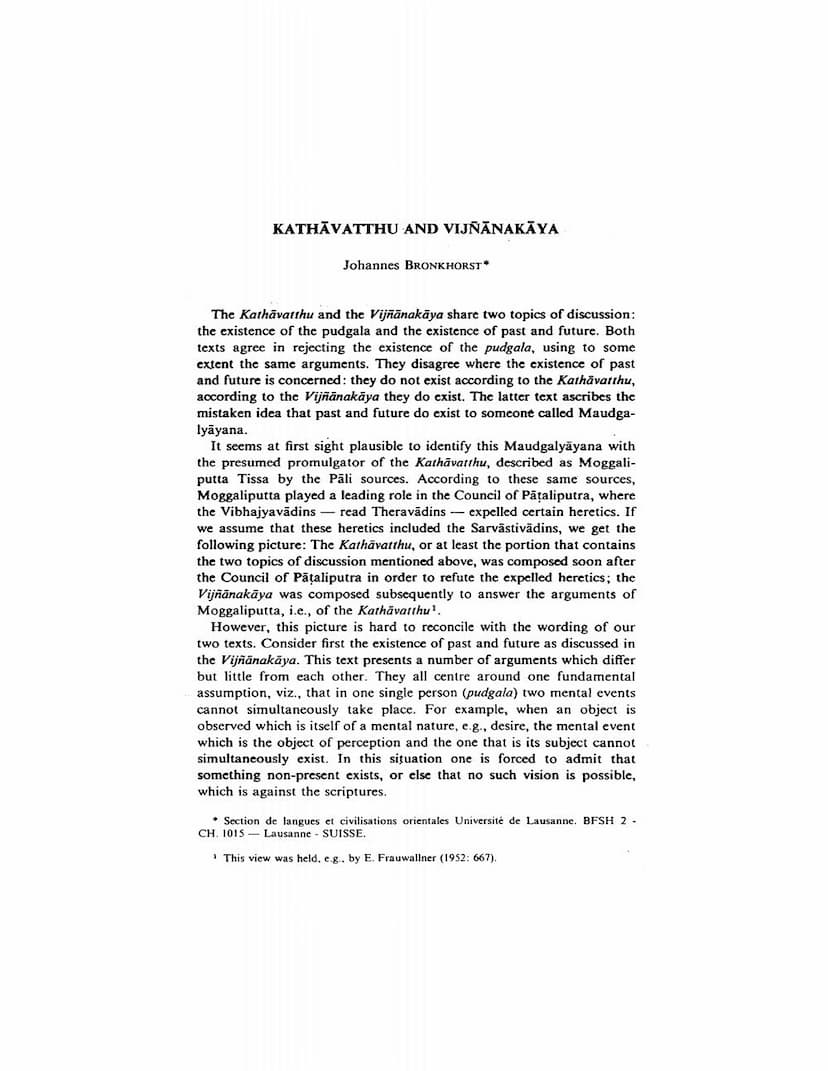
Here is a comprehensive summary of the provided text from Johannes Bronkhorst's "Kathavatthu And Vijnanakaya":
This academic article by Johannes Bronkhorst analyzes the relationship between two Jain texts, the Kathavatthu and the Vijñānakāya, focusing on their shared discussions regarding the existence of pudgala (a concept akin to a self or substantial entity) and the existence of past and future.
Key Points of Agreement and Disagreement:
- Pudgala: Both texts agree in rejecting the existence of pudgala and employ similar arguments to do so.
- Past and Future: They disagree on the existence of past and future. The Kathavatthu denies their existence, while the Vijñānakāya affirms it. The Vijñānakāya attributes the belief in the existence of past and future to a figure named Maudgalyāyana.
Challenging Traditional Interpretations:
Bronkhorst initially considers the traditional identification of Maudgalyāyana with Moggaliputta Tissa, the purported promulgator of the Kathavatthu and a key figure in the Council of Pataliputra. This historical account suggests the Kathavatthu was composed to refute expelled heretics (potentially Sarvāstivādins), and the Vijñānakāya was written later to counter the arguments within the Kathavatthu.
However, Bronkhorst finds this timeline problematic based on the textual evidence.
Analysis of Arguments:
-
Existence of Past and Future:
- The Vijñānakāya presents arguments against the existence of past and future that are rooted in the principle that two mental events cannot occur simultaneously within a single person. For instance, when observing desire (a mental object), the mental event of perception and the mental event of desire cannot co-exist at the same time. This forces an admission of non-present existence or the impossibility of such perception, contradicting scriptures.
- Bronkhorst notes that these arguments are logical and likely early Sarvāstivādin positions.
- Crucially, the Kathavatthu appears to completely ignore these arguments. It presents its own refutation by arguing that if all conditions for perception exist in the past, then past perception with past sense-organs should occur, which it deems absurd. The Kathavatthu insists that only present objects are cognized by the present mind.
- This lack of engagement suggests the author of the Kathavatthu was unaware of the Vijñānakāya's arguments, casting doubt on the traditional narrative of direct confrontation.
-
Existence of Pudgala:
- The Vijñānakāya refutes pudgala through several distinct arguments:
- Identity Argument: The same pudgala cannot be one thing at one time and another at a different time (e.g., a hell-dweller then an animal).
- Consequential Argument: Accepting pudgala leads to unacceptable views.
- Object of Benevolence Argument: The pudgala is not the object of benevolence (maitri). This section is particularly significant as it shows the Vijñānakāya directly responding to a Pudgalavādin text that argued benevolence requires a pudgala as its object, arguing instead for a mechanism of knowledge where the object of benevolence is not a substantial being.
- Unconditioned/Conditioned Argument: The pudgala is neither samskṛta (conditioned) nor asamskṛta (unconditioned), thus it cannot exist.
- Observability Argument: No pudgala is observed. This extensive discussion likely addresses claims that pudgala can be perceived.
- Bronkhorst observes that the Vijñānakāya seems to be directly engaging with and refuting specific "proofs" offered by Pudgalavādins.
- The Kathavatthu, however, contains sections corresponding to the Vijñānakāya's identity, consequential, and unconditioned/conditioned arguments against pudgala but lacks responses to the object of benevolence and observability arguments.
- Many of the Kathavatthu's arguments regarding pudgala appear to be logical exercises rather than direct refutations of opponent's specific claims. This again suggests the Kathavatthu did not have intimate knowledge of the opposing doctrines.
- The Vijñānakāya refutes pudgala through several distinct arguments:
Revisiting the Council of Pataliputra:
Bronkhorst supports Bechert's analysis that the Council of Pataliputra was not primarily about doctrinal disputes among Buddhists but rather about expelling monks who violated Vinaya rules. If the Kathavatthu is a product of the monks remaining after this purification, its aim might have been to record their positions on existing disputes rather than a direct engagement with opposing schools. This implies the author of the Kathavatthu might not have had direct contact with or deep knowledge of the doctrines they criticized.
Conclusion:
Bronkhorst concludes that the relationship between the Kathavatthu and Vijñānakāya is complex and not one of direct, sequential exchange. The portions of the Kathavatthu discussed here appear to attack alternative viewpoints without fully understanding or addressing the arguments supporting them, suggesting a more indirect or even uninformed engagement with opposing doctrines. The Vijñānakāya, conversely, seems to engage more directly with the specific arguments of the Pudgalavādins. The article raises doubts about the traditional historical accounts that portray the Kathavatthu as a product of direct doctrinal confrontation.