
Kamalasila Nyayabindu Purvapaksesamksipta
Added to library: September 2, 2025
Summary
This is a summary of the provided Japanese text and its accompanying English preface, which discusses Kamalasila's Nyayabindupurvapakṣesamkṣipta.
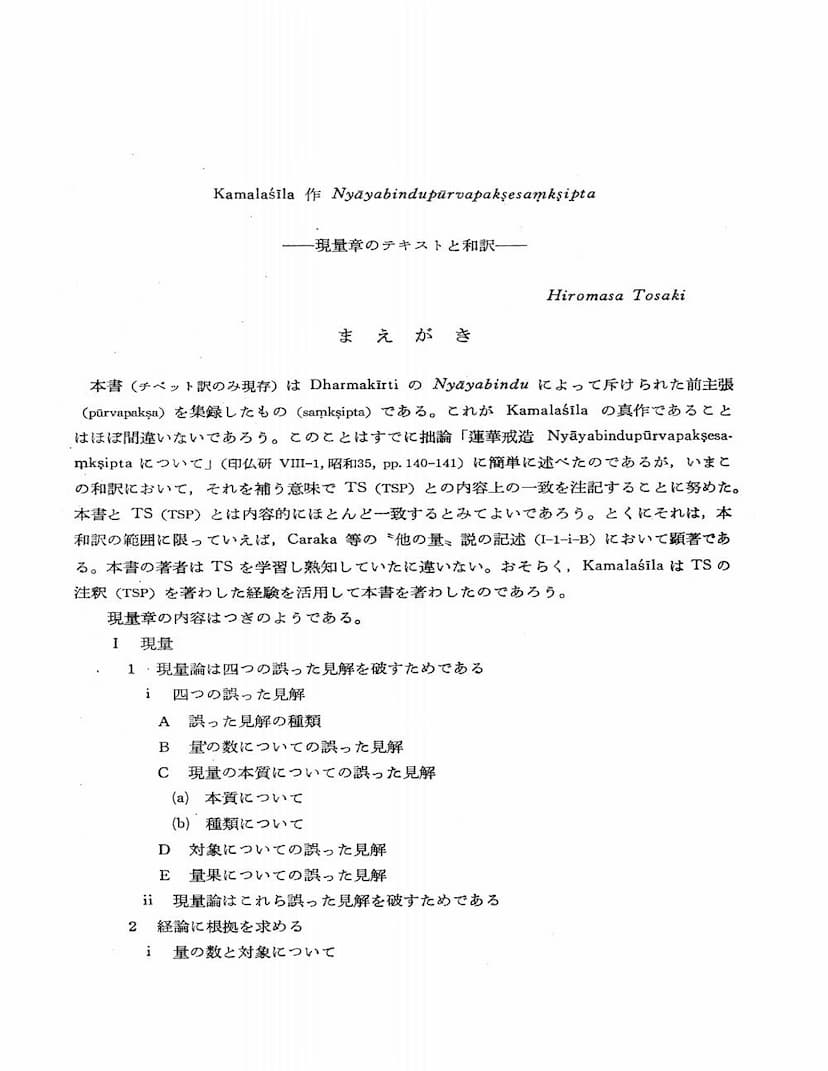
Book Title: Kamalasila Nyayabindu Purvapaksesamksipta Author: Hiromasa Tosaki Publisher: Hiromasa Tosaki Content: This book is a compilation of the purvapakṣa (opponent views) that were refuted in Dharmakirti's Nyayabindu. It is highly likely that this work is by Kamalasila, as indicated by its title and its close thematic alignment with Kamalasila's known commentary, the Tattvasamgrahapanjika (TSP). The author, Hiromasa Tosaki, suggests that Kamalasila likely wrote this work after studying and commenting on his teacher Santaraksita's Tattvasamgraha (TS).
Structure and Main Topic (Pratyakṣa Chapter):
The provided text focuses on the Pratyakṣa chapter (Chapter on Direct Perception) of the Nyayabindupurvapakṣesamkṣipta. This chapter systematically presents and refutes four types of incorrect views regarding the concept of pramana (means of valid cognition), specifically concerning pratyaksa (direct perception).
The Four Incorrect Views Discussed:
-
Incorrect Views on Number (saṃkhyā): This section outlines various schools' differing opinions on the total number of valid means of cognition. Examples cited include:
- Barhaspatya (Carvaka): Only pratyaksa is a valid means.
- Samkhya: Pratyaksa, anumana (inference), and shabda (verbal testimony) are the three valid means.
- Naiyayika (Nyaya): Pratyaksa, anumana, upamana (comparison), and shabda are the four valid means.
- Jaiminiya (Mimamsa): Pratyaksa, anumana, upamana, shabda, arthapatti (postulation), and abhava (non-existence) are the six valid means.
- Caraka et al.: Acknowledge additional means such as yukti (reasoning), anupalabdhi (non-perception), sambhava (probability), aitihya (tradition), and pratibha (intuition).
-
Incorrect Views on Essence (svarūpa): This section delves into differing views on the fundamental nature of pratyaksa.
- Some argue that pratyaksa is always savikalpaka (conceptualized or discursive).
- Others contend that only the initial moment of perception is nirvikalpaka (non-conceptual), and subsequent perceptions are savikalpaka.
- There are also views that even erroneous perceptions (e.g., seeing a conch shell as yellow) are valid.
- The debate extends to whether perception is the mere conjunction of senses and objects, or involves the self, or is the function of sense organs like hearing.
-
Incorrect Views on Object (gocara): This section addresses what pratyaksa can cognize.
- It discusses whether pratyaksa can cognize universals (sāmānya) and whether inference (anumana) can cognize particulars (svalakṣaṇa).
- The debate touches upon the relationship between direct perception and the object it apprehends.
-
Incorrect Views on Result (phala): This section examines the nature of the "result" of cognition.
- It explores the idea that the result of cognition is something distinct from the means of cognition itself, drawing parallels with the distinction between an action and its outcome.
- The text introduces a framework of four elements: the cognizer (pramātr), the cognizable (prameya), the means of cognition (pramāṇa), and the cognition itself (pramiti).
- It further elaborates on how, in some views, the subsequent cognition is the "result" while the preceding cognition is the "means."
Kamalasila's Purpose and Refutation:
The Nyayabindupurvapakṣesamkṣipta aims to systematically present these opposing views to refute them. Kamalasila's work is structured to respond to these challenges, often by adhering to the teachings of the Buddha and prominent Buddhist scholars like Dignaga.
Key Buddhist Arguments Presented (Implied Refutation):
- Emphasis on Critical Examination: The text quotes the Buddha advising disciples to examine his teachings critically, like testing gold, rather than accepting them solely out of reverence.
- Two Essential Characteristics of Perception: The Buddhist view, as presented, emphasizes that valid direct perception (pratyaksa) has two key characteristics: it is nirvikalpaka (free from conceptualization/linguistic overlay) and avikalpaka (unerrring or non-delusive).
- Rejection of Unwarranted Enumerations: The text implicitly challenges the broad enumerations of pramana by other schools, suggesting that only pratyaksa and anumana (and possibly others validated by the Buddha) are true means of cognition.
- Critique of Non-Buddhist Epistemologies: Through the presentation of various opposing views, Kamalasila highlights their inconsistencies and lack of grounding in valid reasoning.
In essence, Hiromasa Tosaki's work provides a critical edition and translation of a crucial Jain text that meticulously dissects and refutes non-Buddhist philosophical arguments about the nature of knowledge and reality, particularly concerning direct perception. The preface by Tosaki emphasizes the historical and scholarly significance of this compilation for understanding the development of Buddhist epistemology.