
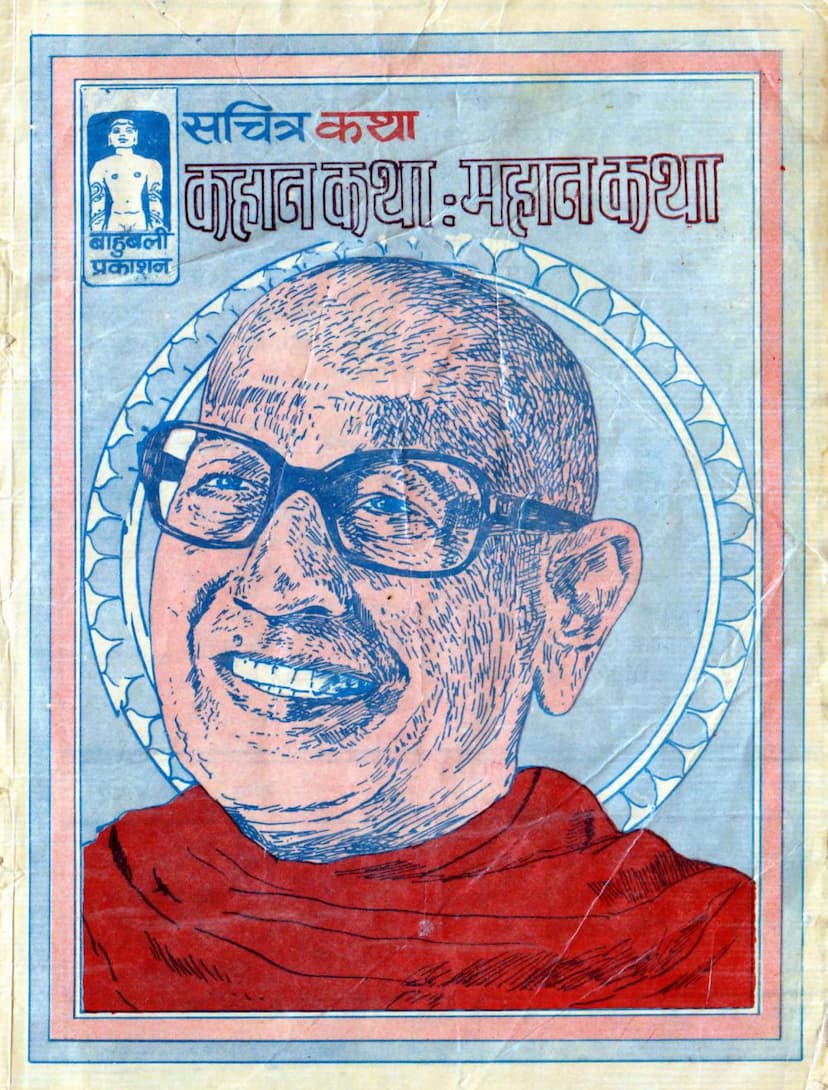
Kahan Katha Mahan Katha
Added to library: September 2, 2025
Summary
Here's a comprehensive summary of the Jain text "Kahan Katha Mahan Katha," detailing the life and teachings of Pujya Shri Kanji Swami:
Book Title: Kahan Katha Mahan Katha Author: Akhil Bansal Publisher: Bahubali Prakashan
Overview:
"Kahan Katha Mahan Katha" is a biographical and illustrated account of the life of Pujya Shri Kanji Swami, a highly revered spiritual leader in Jainism. Published by Bahubali Prakashan, Jaipur, the book aims to illuminate his life journey and spiritual teachings, especially on the occasion of his birth centenary. It highlights his profound influence in guiding numerous individuals towards the spiritual path and emphasizes his significant contributions to the Jain community.
Key Aspects of Shri Kanji Swami's Life and Teachings:
-
Early Life and Spiritual Inclination:
- Born in 1946 VS (1909 AD) in Umrala village, Kathiawar, to Motichand and Ujam Bai, within the Sthanakvasi Jain sect.
- Even as a child, he displayed a serene countenance and a tendency towards detachment from worldly affairs, as observed by a Jyotishi (astrologer) and his parents.
- His childhood name was Kahan Kumar. He received his initial education in his village and later in a Jain pathshala.
- Despite excelling academically, he felt a lack of spiritual fulfillment in conventional education, expressing his desire for something more profound than mere practical knowledge.
- His brother, Khushaldas, was inclined towards business, while Kahan expressed a desire to renounce worldly pursuits and engage in spiritual sadhana.
-
Turning Points and Influences:
- The early demise of his parents had a profound impact on him and his brother.
- He experienced a significant shift in his perspective after witnessing the plight of animals during a severe drought in Umrala in 1956 VS (1900 AD), which filled him with compassion.
- His reading of spiritual texts, particularly "Adhyatma Kalpadrum" and later, "Samaysar" by Acharya Kundkund, deeply influenced his spiritual outlook. He was often engrossed in these texts, even at his shop.
- Attending plays, especially those with themes of renunciation, like the Ramleela, had a strong impact on him. A particular scene involving Anusuya and her son deeply resonated with him.
- A pivotal moment was his vow of non-consumption of pickles after discovering tiny organisms in it at the age of 19, demonstrating his acute sense of ahimsa (non-violence).
- His experiences in Mumbai, witnessing instances of dishonesty and unethical business practices, further solidified his detachment from worldly possessions and activities.
- He was inspired by the teachings of Acharya Kundkund, particularly the emphasis on self-realization and the path of renunciation.
-
Transition to Digambara Jainism:
- Shri Kanji Swami initially belonged to the Sthanakvasi sect.
- However, his deep study of scriptures like "Samaysar" led him to believe that the Sthanakvasi practices, particularly the use of a 'mukhapatti' (mouth cloth), were not aligned with the pure Digambara Jain path as expounded by Acharya Kundkund.
- He formally renounced the Sthanakvasi sect and declared himself a Brahmachari (celibate ascetic) in Sonkhed on the auspicious day of Mahavir Jayanti in 1991 VS (1935 AD), signifying his commitment to the Digambara tradition.
- This decision was met with initial opposition from some within his former community, but he remained steadfast in his convictions.
-
Spiritual Mission and Teachings:
- Shri Kanji Swami dedicated his life to propagating the true essence of Jainism, particularly the teachings of Acharya Kundkund, as found in scriptures like "Samaysar" and "Asht Pahud."
- He emphasized the importance of "Tattva Nirnay" (determination of truth) and "Samyagdarshan" (right faith) as the key to spiritual liberation.
- His discourses (pravachans) were known for their clarity, depth, and adherence to scriptural principles. He aimed to guide seekers towards self-realization and understanding the nature of the soul.
- He initiated numerous spiritual programs, including teaching camps and discourse sessions, attracting large crowds from diverse backgrounds.
- His teachings focused on the soul's inherent purity and the path to achieving liberation through self-effort and right understanding, rather than external rituals or devotion alone. He articulated concepts like "Samyak Niyativad" (right determinism) as a means to understand the workings of karma and the soul's journey.
- He was a proponent of a rigorous, ascetic lifestyle and inspired many to adopt vows of celibacy and a life of spiritual pursuit.
- His influence extended internationally, with his teachings leading to the establishment of Jain temples and centers in places like Nairobi, Africa.
-
Legacy and Impact:
- Shri Kanji Swami’s profound spiritual wisdom and unwavering commitment to Jain principles led to a significant revival and reinterpretation of Jain philosophy, particularly the teachings of Kundkundacharya.
- He inspired thousands, including many from the Sthanakvasi and Svetambara traditions, to embrace the Digambara Jain faith.
- He founded the Shri Kundkund Gyan Mandir in Sonkhed and was instrumental in the construction of numerous Jain temples and the organization of "Panchkalyanak Pratishtha Mahotsavs" (five auspicious ceremonies for the consecration of idols).
- The book highlights his humility and his ability to convey complex philosophical concepts in an accessible manner.
- He is revered as "Gurudev" by his followers, and his teachings continue to guide many on the spiritual path.
- The book concludes with his passing in Mumbai on November 28, 1980, at the age of 91, after a life dedicated to spiritual propagation. His mortal remains were brought to Sonkhed for the final rites.
Publisher's Note:
Bahubali Prakashan expresses pride in publishing this illustrated biography, acknowledging the immense contribution of Pujya Shri Kanji Swami in guiding people to the righteous path. They also mention the success of their previous publication, "Kavivar Banarasidas," and announce upcoming works on Acharya Vidyanand and Gommateshwar Bahubali. The publication aims to instill religious values in children.
In essence, "Kahan Katha Mahan Katha" is a tribute to a spiritual luminary whose life and teachings left an indelible mark on Jainism, promoting a deeper understanding of its philosophical underpinnings and inspiring a renewed commitment to spiritual practice.