
Jainism And Western World
Added to library: September 2, 2025
Summary
Here's a comprehensive summary of the provided text, focusing on the themes and arguments presented by Peter Flugel in his article "Jainism and the Western World: Jinmuktisūri and Georg Bühler and Other Early Encounters":
Overview:
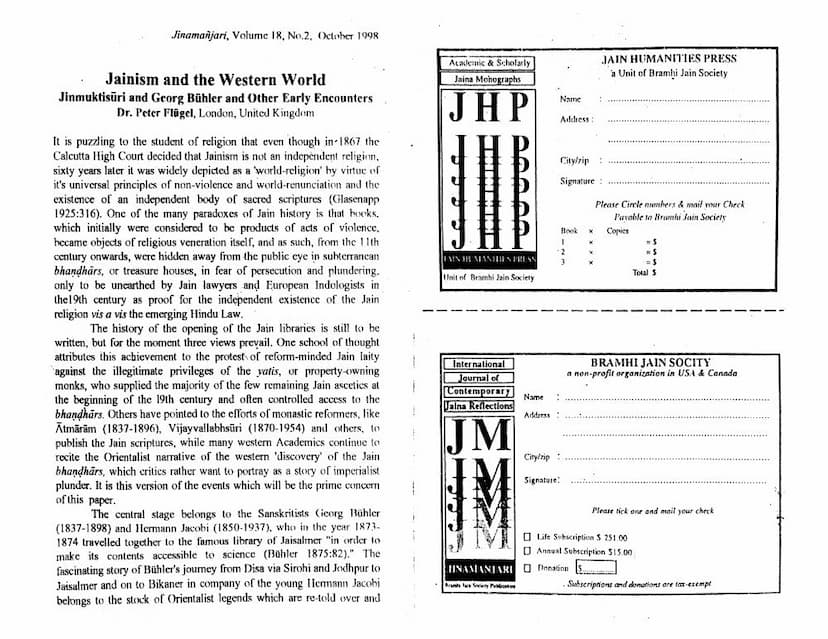
This article, published in Jinamasjari in 1998, explores the complex and often paradoxical relationship between Jainism and the Western world, particularly during the 19th and early 20th centuries. Peter Flugel highlights the "discovery" of Jain manuscripts by Western Indologists, the role of these manuscripts in establishing Jainism as an independent religion, and the evolving interactions between Western scholars and the Jain community.
Key Themes and Arguments:
-
The Paradox of Manuscript Preservation and Discovery: The text begins by noting the irony that Jain scriptures, once hidden in subterranean "bhandhárs" (treasure houses) due to fear of persecution, were later unearthed by both Jain lawyers and European Indologists. These manuscripts, initially viewed with suspicion due to their origins in potentially violent acts of copying, became crucial evidence for Jainism's independent religious status, especially in contrast to emerging Hindu Law.
-
Multiple Perspectives on the "Opening" of Jain Libraries: Flugel outlines three prevailing views on how Jain libraries became accessible to outsiders:
- Lay Protest: Reform-minded Jain laity protesting against the privileges of property-owning monks ("patis") who controlled access to the bhandhárs.
- Monastic Reform: Efforts by monastic reformers to publish Jain scriptures.
- Orientalist Discovery: The "discovery" narrative from Western academics, which critics often reframe as a story of imperialist plunder. Flugel states his paper will primarily focus on this latter perspective.
-
Georg Bühler and Hermann Jacobi: Pioneering Indologists: The article centers on the significant work of Sanskritists Georg Bühler and Hermann Jacobi. Their 1873-1874 journey to the Jaisalmer library is presented as a seminal event in the Western engagement with Jainism.
-
Bühler's Mission and Challenges: Bühler, initially tasked with cataloging indigenous libraries for a digest of Hindu Law, embarked on several journeys. He recognized the immense value of Jain libraries, containing both Jain and rare Brahmanical literature, but also acknowledged the significant difficulties in gaining access. The "Panch" (community committees) often restricted access, requiring a "hard struggle" for Europeans.
-
Interactions with Jain Monks and the Importance of Jinmuktisūri: The article details Bühler's meetings with Jain monks, highlighting his positive and collaborative relationship with Śrīpūj Jinmuktisūri, the head of the Khartara Gaccha sect.
- Jinmuktisūri is portrayed as a highly intelligent, learned, and amiable individual who spoke Sanskrit skillfully and possessed deep knowledge of Jain scriptures and sciences.
- Despite holding a prominent position, even Jinmuktisūri had not been granted access to the main Osval library, suggesting a deep-seated caution within the Jain community regarding their sacred texts.
- Jinmuktisūri's personal library, which included a Hindustani Bible, demonstrated his openness to other faiths and his respect for knowledge.
- Jinmuktisūri actively assisted Bühler, offering advice and support in his negotiations with the library committee. He also provided Bühler with a crucial clue: if the books shown did not contain all 45 Angas (canonical Jain scriptures), then not everything had been revealed.
-
The "Opening" of the Jaisalmer Library: A Strategic Sacrifice: Bühler's pursuit of manuscripts in Jaisalmer encountered resistance. Initially, he was shown a limited number of manuscripts, leading to frustration. However, through Bühler's persistence and threats to report to the government, and with Jinmuktisūri's indirect guidance, the "real library" was eventually accessed.
- The article suggests that the Jain committee and Jinmuktisūri collaboratively decided to "sacrifice" a portion of the manuscripts to science. This strategy aimed to satisfy external demands and protect the larger collection from further interference or potential loss.
- The actual size of the Jaisalmer collection was significantly larger than what Bühler was initially shown, underscoring the deliberate withholding of material.
-
Conflict of Interest and Differing Values: Flugel emphasizes the inherent conflict of interest between European scholars and the Jain custodians of the manuscripts.
- For Europeans, the value lay in the content for historical reconstruction.
- For Jains, the primary value was in their role as sacred objects.
- This conflict also played out within the Jain community between conservatives (who wanted to keep bhandhárs locked) and reformers (who sought to publicize and preserve the texts).
-
The Role of Manuscripts in Establishing Jainism's Independence: The materials collected by Bühler were instrumental in Hermann Jacobi's work, which provided textual proof of Jainism's independent origin from Buddhism. This academic validation was crucial for overturning a Calcutta High Court judgment that denied Jainism its status as an independent religion. Jain lawyers like Padmaraja Pandit, Jugrhandir Lal Jaini, and Champat Rai Jain played a vital role in this legal and academic struggle by publishing Jain scriptures and legal texts.
-
The Transition to Modern Scholarship and Dissemination: The article notes the shift from Western scholars "discovering" manuscripts to modern Jain research institutions taking over the critical editing and commenting of Jain heritage. The advent of printing and widespread dissemination of Jain knowledge is highlighted, although it also raises questions about the future relevance of physical manuscripts.
-
Evolving Relationship and Mutual Learning: The text points to the development of close contacts between Western Jainologists and reformist Jain monks in the 20th century, fostering mutual scholarly interests. The example of Muni Jina Vijay's visit to Hermann Jacobi in Germany illustrates a reversal of the trend, with Jain scholars seeking to learn from Western academic methods.
-
Jainism as a World Religion: The article concludes by touching upon the ongoing aspiration of Jainism to become a "world-religion." This involves making the religion accessible globally, which may necessitate doctrinal and organizational innovations to achieve universal acceptance.
In essence, Flugel's article provides a nuanced historical account of how Western academic interest, driven by figures like Bühler and Jacobi, interacted with the Jain community's deep-seated traditions of manuscript preservation and religious practice. It reveals a complex dynamic of collaboration, resistance, and mutual influence that ultimately contributed to a greater understanding and recognition of Jainism on a global scale.