
Jainalogy In Western Publications
Added to library: September 2, 2025
Summary
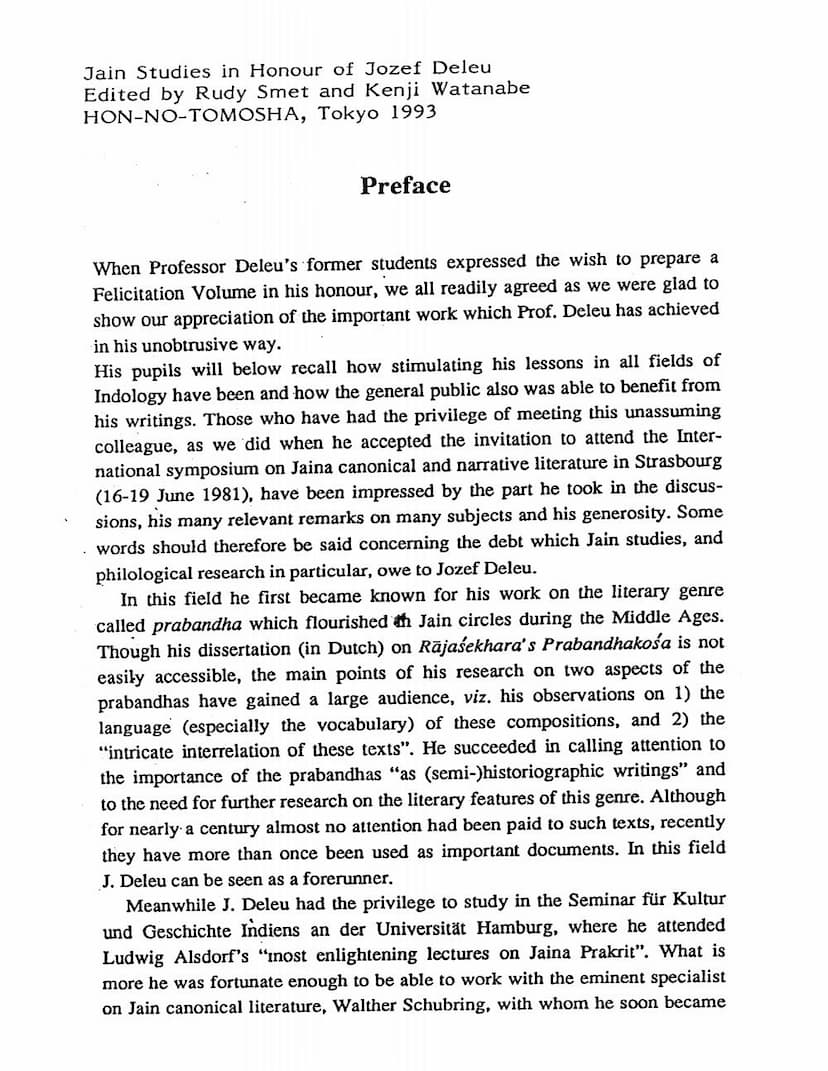
This document is a review of "Jainology in Western Publications II," edited by Rudy Smet and Kenji Watanabe, published in 1993. The review, authored by Colette Caillat, focuses on linguistic studies of Jain texts conducted in Western countries.
The review begins by acknowledging the significant contributions of Professor Jozef Deleu to Jain studies, particularly his work on the prabandha literary genre and his critical editions and analyses of key Jain canonical texts like the Mahāniśiha and the Viyahapannatti (Bhagava). Deleu's scholarship is praised for its meticulous approach, insightful analysis, and its role in reviving interest in previously overlooked aspects of Jain literature. His work is presented as a cornerstone of the "Schubring Jainological school."
The bulk of the review then surveys Western publications in Jainology, with a specific emphasis on linguistics. Caillat categorizes these publications into several areas:
- Apabhramsa: While acknowledging pioneering work in Europe, she notes that most recent publications have originated from India, though Colin Mayrhofer's work on an Apabhramsa Dictionary in Australia is highlighted.
- Old Gujarati: Similar to Apabhramsa, Indian scholars have led the way in editing Old Gujarati Jain texts. However, the review mentions Ernest Bender's critical edition and grammatical analysis of "The Salibhadra-Dhanna-Carita" as a significant Western contribution.
- Jain Sauraseni (JŚ): The review discusses scholarly debates regarding the classification of this Prakrit idiom, with K. Oetjens (following L. Alsdorf) suggesting it represents an older stage of ArdhaMāgadhi rather than a distinct language. The recurring idiosyncrasies in some texts are noted as requiring further investigation.
- Svetambara Canon: The majority of linguistic and grammatical research has focused on the Svetambara canon, particularly early ArdhaMāgadhi and Jain Māhārāștrī. Pischel's foundational grammar is acknowledged as still remarkably accurate, while acknowledging recent detailed studies on specific aspects like dialectal mixtures and the stylistic effects of morphological choices. The importance of metrics for textual criticism is also emphasized, following the work of W. Schubring and L. Alsdorf.
- Specific Grammatical Subjects: The review details papers and books that focus on:
- Phonetics: Studies examining the general rules of Prakrit phonetics and specific instances within various Jain Prakrits. K.R. Norman's work on the palatalization and labialization of vowels in Middle Indo-Aryan is mentioned.
- Morphophonetics: Works exploring remnants of the dual in ArdhaMāgadhi and the verbal adjective in Middle Indo-Aryan.
- Morphology: Discussions on the stylistic effects of morphological choices and evidence for dialectal variety in Jain Māhārāṣṭrī.
- Syntax: Acknowledged as a less-explored area, with a mention of a study on nominal sentences in Sanskrit and Middle Indo-Aryan.
- Metrics: Its use in establishing critical editions and studies on the origins of metrical patterns.
- Lexicography: The significant contribution of the Āgama sabdakośa (Word-Index of Angasuttāni) from India is highlighted, along with the critical material in the Jaina Agama Series. Comparisons between ArdhaMāgadhi/Jain Māhārāṣṭrī and their Buddhist counterparts are noted as valuable for understanding semantic evolutions and technical terms. Several specific studies on technical terms and the etymology of words are also listed.
In essence, "Jainology in Western Publications II" is a comprehensive survey of the linguistic scholarship on Jain texts conducted in the West up to 1993, showcasing the depth and breadth of research in areas like phonetics, morphology, syntax, metrics, and lexicography, while also acknowledging the foundational work of scholars like Jozef Deleu and the ongoing dialogue with Indian scholarship.