
Jaina Literature From Eearliest Time To C 10th AD
Added to library: September 2, 2025
Summary
Here's a comprehensive summary of the provided text from "Jaina Literature From Earliest Time To C 10th AD" by Sagarmal Jain:
Overview of Jaina Literature and its Development
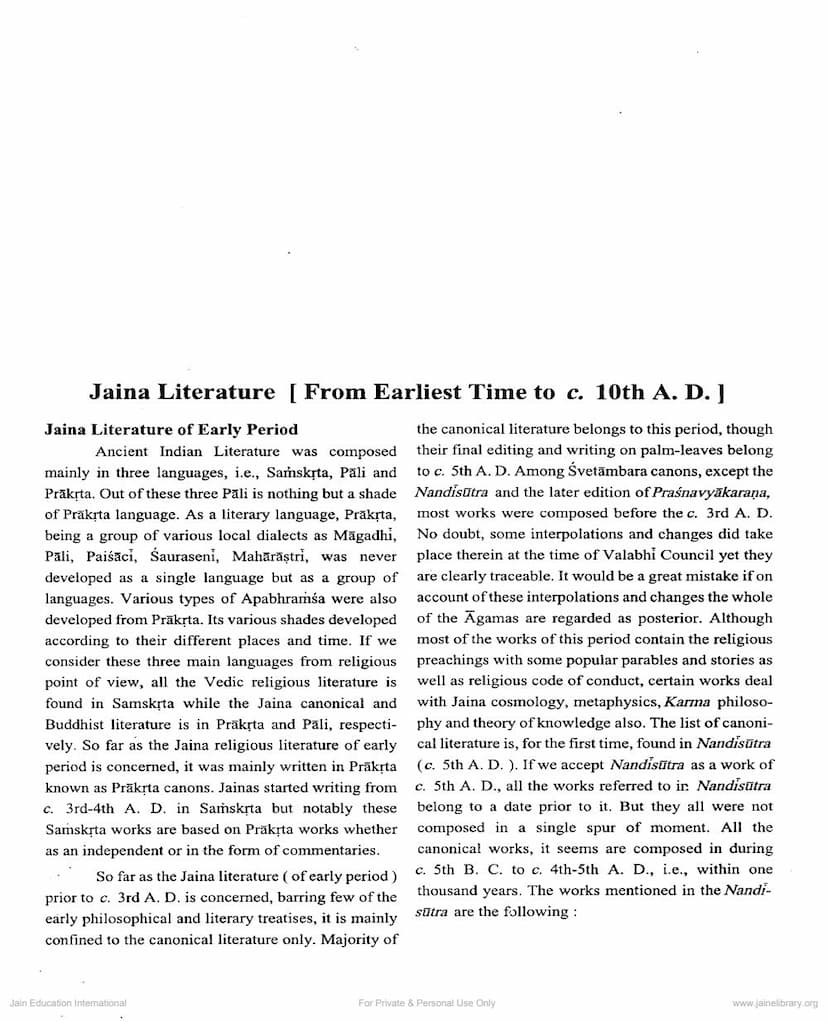
The text details the evolution and scope of Jaina literature from its earliest known periods up to the 10th Century AD. It highlights that ancient Indian literature was primarily composed in Sanskrit, Pali, and Prakrit. Jaina canonical and religious literature is predominantly found in Prakrit (including its various dialects like Magadhi, Pali, Sauraseni, and Maharashtri), while Vedic literature is in Sanskrit, and Buddhist literature is in Pali. Jaina literature began appearing in Sanskrit around the 3rd-4th century AD, but these works often built upon or commented on earlier Prakrit texts.
Canonical Literature (Agamas):
The core of early Jaina literature consists of the canonical works, known as Āgamas. While their final compilation and writing on palm-leaves occurred around the 5th Century AD, their composition dates back much earlier, generally between the 5th Century BC and the 4th-5th Century AD. The text notes that most Śvetāmbara canons predate the 3rd Century AD, with some modifications and interpolations evident from the Valabhi Council. These works primarily contain religious teachings, parables, ethical codes, and also delve into Jaina cosmology, metaphysics, karma philosophy, and epistemology.
The Nandisūtra (c. 5th AD) is mentioned as the first text listing canonical literature, implying that all works referenced within it predate it. The Āgamas are broadly categorized into Anga and Angabahya.
-
Angas: These are the twelve primary canonical texts. The text discusses several key Angas:
- Ācārānga: Considered the oldest, its first part (c. 5th-4th BC) contains the original teachings of Lord Mahavira on non-violence and conduct. The second part, Āyāracūla, is an appendix detailing rules for monks and nuns.
- Sūtrakṛtānga: (c. 4th-3rd BC) Also contains spiritual and moral teachings, but notably presents various philosophical views prevalent at the time.
- Sthānānga and Samavāyānga: These are described as encyclopedias of early Jaina thought, focusing on numbers and providing insights into Jaina order and thought development up to the 3rd-4th Century AD.
- Bhagavati (Vyakhyāprajñapti): A voluminous work discussing various aspects of Jaina philosophy, with references to later works, indicating its composition over different phases.
- Jñātādharmakatha: Contains stories taught by Lord Mahavira.
- Upāsakadaśānga: The first work focusing on the code of conduct for lay devotees (Śrāvakas), detailing the lives of ten prominent followers.
- Antakṛddaśānga and Anuttaraupapatikadaśānga: Deal with the lives of individuals who attained salvation. The current versions show significant additions compared to earlier ones.
- Praśnavyākaraṇa: The original contents are lost, with the present version dating around the 7th Century AD, focusing on āsravas (inflows) and samvaras (restraints).
- Vipākasūtra: Deals with the fruits of merit and demerits.
- Dṛṣṭivāda: The twelfth Anga, believed to contain five parts and primarily addressing philosophical doctrines of other schools and the Pārśva tradition. Its loss is attributed to its content not fully aligning with Mahavira's tradition and a strict prohibition on writing.
-
Angabahya: These are secondary canons. The text lists several categories, including Āvaśyaka, Kalika, Uttarādhyayana, Daśāśrutaskandha, Kalpa, Vyavahāra, Niśitha, Mahāniśitha, Rṣibhāṣita, and others.
- Āvaśyaka: Six works are counted as one.
- Kalika and Utkalika: Certain works within these categories are lost. The text details specific lost works like Kṣullikāvimānapravibhakti and Kalpikākalpika.
Lost and Extinct Works: The text acknowledges that many of the mentioned canonical works are not entirely intact. Some are lost, while others have undergone significant changes or additions. The loss of Dṛṣṭivāda is particularly highlighted, with reasons including its philosophical content and the Jaina monks' reluctance to write due to non-violence concerns.
Key Early Period Works:
- Rṣibhāṣita (Isibhāsiyāim): Considered one of the earliest canonical works (c. 4th-3rd BC), it reflects the catholicity of early Jaina thinkers by including ethical and philosophical views from Upanishadic, Buddhist, Pārśva, and Mahāvira traditions.
- Uttarādhyayana and Daśavaikālika: Important works of this phase, containing religious preachings and metaphysical doctrines.
- Niśitha, Daśāśrutaskandha, Vyavahāra, and Kalpa: Authored by Ārya Bhadrabāhu (c. 3rd BC), these deal with conduct, transgressions, and atonements.
The Period of Commentaries (c. 3rd-10th AD):
This period is crucial for the final editing and composition of many Jaina works. The literature is categorized into:
-
Agamas and their Commentaries: While Agamas were composed earlier, their final editing occurred around the 5th Century AD, leading to interpolations. Commentaries like Niryuktis (c. 3rd-4th AD), Bhāṣyas (c. 5th-6th AD), and Cūrṇis (c. 7th AD) emerged.
- Niryuktis: These explain the meaning of technical terms and subject matter of Āgamas. Aryabhadra (c. 2nd-3rd AD) is considered a likely author for many of these.
- Bhāṣyas: More exhaustive than Niryuktis, these were written in Prakrit verses and discussed philosophical concepts, conduct rules, exceptions, and punishments. Notable authors include Jinabhadragani and Sanghadasagani.
- Cūrṇis: Written in prose mixed with Sanskrit, these are crucial for their social and cultural insights and information about the period (c. 1st-6th AD). Jinadāsagani Mahattara is credited with many important Cūrṇis, completed around 676 AD.
- Sanskrit Commentaries (Vittis/Vivaraṇas): Flourished from the 8th Century AD onwards. Haribhadrasuri (mid-8th AD) was an early commentator, followed by Śilānkācārya (9th AD) and Abhayadevasūri. These commentaries explained Āgamic topics and critically examined philosophical concepts.
-
Philosophical Works:
- Tattvārthasūtra by Umāsvāti: A foundational, systematic work on Jaina philosophy, written in Sanskrit (c. 3rd AD). It is equally respected by both Śvetāmbara and Digambara traditions.
- Sanmatitarka by Siddhasena Divākara: (c. 4th AD) A critical exposition of Jaina theory (Anekāntavāda) and critique of other philosophical views.
- Nyāyāvatāra by Siddhasena: The first work on Jaina logic.
- Aptamimāṁsa by Samantabhadra: (c. 5th AD) A scholarly work in Sanskrit establishing Jaina concepts through critical evaluation of others.
- Dvādaśāranayacakra by Mallavādi: (c. 5th AD) Also aimed at establishing Anekāntavāda through critical examination of philosophical schools.
- Akalanka's Tattvārtha-vārttika and Vidyānandi's Ślokavārttika: (c. 8th AD) Important works critically evaluating other philosophical systems.
- Works on Karma: Independent works on the doctrine of Karma began around the 4th Century AD, with significant contributions from Digambara tradition (e.g., Mahākarma-prakrti-prabhrta, Kaṣāyapāhuḍa, Satkhaṇḍāgama) and Śvetāmbara tradition (e.g., Karmaprakṛti).
- Haribhadrasuri: Prolific writer who contributed significantly to Jaina philosophy, religion, and yoga.
-
Works on Religious Practices and Ethics: This category includes hymns, works on worship, rituals, religious preachings, Jaina sadhana and yoga, and codes of conduct. Notable works include Dvātrimsikās of Siddhasena Divākara, Svayambhūstotra of Samantabhadra, Daśabhakti of Kundakunda, and Dharmabinduprakaraṇa of Mānatunga. Works on Jaina yoga like those by Haribhadra are also significant. Codes of conduct for monks and laypeople are found in works like Śrāvaka-prajñapti (Śvetāmbara) and Ratnākaraṇḍa-śrāvaka-cāra (Digambara).
-
Jaina Narrative Literature: This genre, primarily for religious exhortation, includes biographies of illustrious personalities (Śalākapuruṣas), religious tales in romantic form, semi-historical prabandhas, and story compilations (kathākoṣas).
- Biographies: Works like Caupannamahāpuruṣacariyam (Śvetāmbara) and Mahāpurāṇa (Digambara) detail the lives of significant figures.
- Romantic Tales: Paumacariya by Vimalasuri (c. 2nd-5th AD) is a pioneer Jaina work on the Ramakatha. Vasudevahindi by Sanghadasagani (c. 6th AD) and Samaraiccahakkaha by Haribhadra are also important.
- Story Compilations: Works like Dharmopadeśamālā and Bṛhatkathākośa served as moralistic story collections.
-
Secular Literature of Jainas: Recognizing the need for specialized works on worldly phenomena, Jaina ācāryas composed secular literature covering astronomy, astrology, geography, mathematics, biology, arts and architecture, linguistics, and medicine (Ayurveda). Notable works include Lokavibhāga and Tiloyapannatti (Astronomy and Geography), Jivasamasa and Jivavicara (Biology), and various works on grammar like Jainendra Vyakarana.
Conclusion:
The evolution of Jaina literature, particularly from the 5th Century BC to the 10th Century AD, showcases the versatility and genius of Jaina ācāryas. They extensively contributed to philosophical, religious, ethical, narrative, and secular fields, demonstrating a deep engagement with both spiritual and worldly knowledge. The literature serves as a mirror to the cultural development and intellectual dynamism of Jainism during this formative period.