
Jaina Heritage In Gujarat
Added to library: September 2, 2025
Summary
Here's a comprehensive summary of the provided text, "The << True Vaisnava >> : A Jaina Heritage in Gujarat" by Françoise Mallison, focusing on its core arguments and findings:
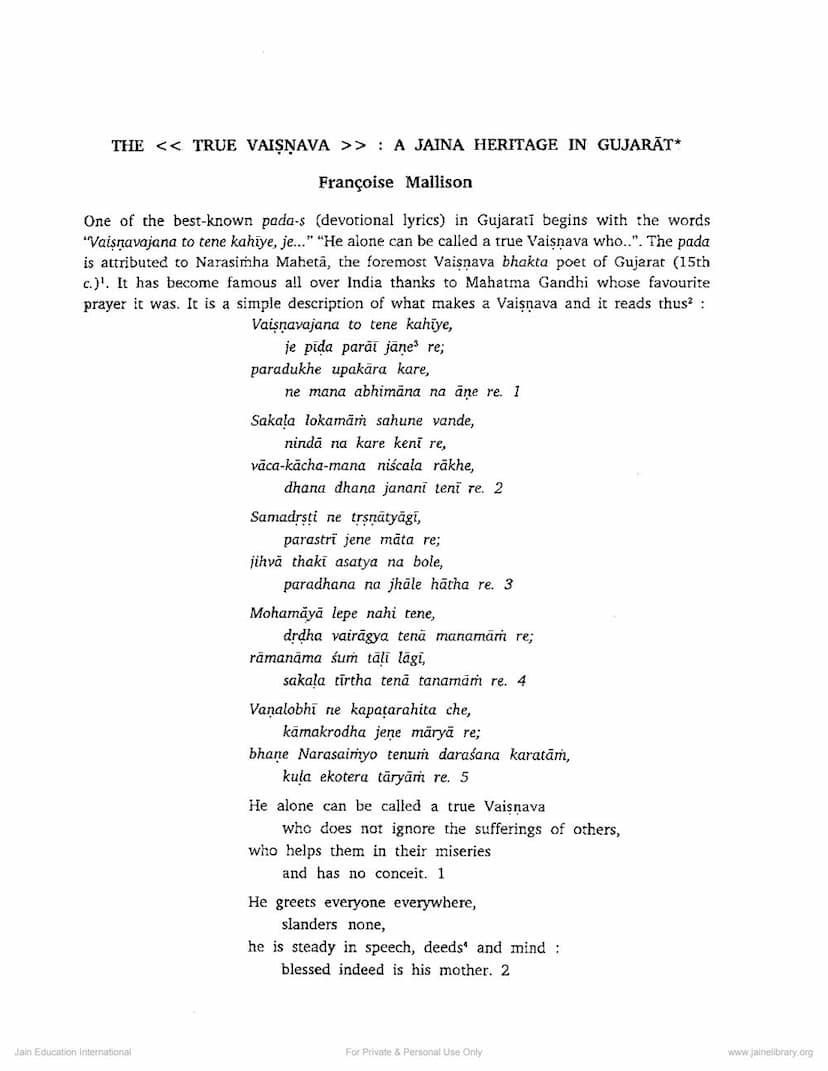
The article explores the renowned Gujarati devotional lyric (pada) "Vaisnavajana to tene kahīye, je..." ("He alone can be called a true Vaisnava who..."), traditionally attributed to the Vaisnava poet Narasimha Mahetā (15th century). The author, Françoise Mallison, argues that the ideal of the "true Vaisnava" presented in this pada has significant connections to Jainism and represents a broader ethical framework that transcends sectarian Vaisnavism in Gujarat.
Key Arguments and Findings:
-
The Universal Ideal of the "True Vaisnava": Mallison highlights that the pada's definition of a "true Vaisnava" emphasizes universal virtues like compassion, humility, tolerance, control of passions, truthfulness, and detachment from greed and anger. Importantly, it doesn't primarily focus on devotion to Vishnu. The mention of "Rāma" in the pada is interpreted not as the specific avatar of Vishnu but as the all-pervading God, akin to the Upanishadic "Ātmarāma," reflecting a puritanic, nirguni (formless) Santa tradition.
-
Questioning Authorship and the Non-Sectarian Nature: The author notes that due to the pada's universal ethical appeal, its authorship by Narasimha Mahetā has been questioned, with some attributing it to reformist writers or even Christian missionaries. However, the discovery of older manuscripts bearing Narasimha Mahetā's signature confirms his authorship. The existence of similar texts attributed to Vacho and Nākara further suggests that the ideal expressed in the pada was not exclusive to a single author or tradition.
-
The Vallabhans' Ambivalent Relationship with Narasimha Mahetā: The article examines the perspective of the Vallabhans, a major Vaisnava sect in Gujarat. They do not prominently feature Narasimha Mahetā in their hagiographies and rarely incorporate his padas into their liturgy. While acknowledging him as a maryādā-bhakta (one who follows religious duties) rather than a pusti-bhakta (one who surrenders to Krishna's grace), their approval of the "Vaisnavajana..." ideal demonstrates its broader cultural acceptance, even by a specific Vaisnava denomination. They perceive Narasimha Mahetā as an important figure predating Vallabhism in Gujarat, embodying a pure Vaisnava ideal.
-
Jaina Influence on the "Vaisnavajana" Ideal: A crucial part of Mallison's argument is the significant influence of Jainism on the formation of this "true Vaisnava" ideal. She points to the Vaisnava bhakta prabandha copai by Mavo Vaisnava (written around 1530 AD). This text, found in a Jaina manuscript, lists characteristics of a Vaisnava that closely mirror Narasimha Mahetā's pada.
- Specific Jaina Practices: Mavo Vaisnava explicitly incorporates Jaina ethical principles into his definition of a Vaisnava. These include:
- Observing jīvadayadharma (virtue of compassion for living beings).
- Abstaining from the evening meal (a common Jaina practice).
- Never drinking unfiltered water (a strict Jaina rule).
- Restraining the eight kinds of karma (a core Jaina concept).
- Ethical Convergence: Mallison argues that Mavo Vaisnava's text, with its focus on ethical perfection and clear norms of behavior, alongside the inclusion of Jaina observances, demonstrates the deep penetration of Jaina influence into pre-Vallabhite Vaisnuism in Gujarat. The shared emphasis on strict adherence to ahimsa and vegetarianism, even with differing motivations (pollution avoidance for Vallabhans, karma annihilation for Jains), highlights this convergence.
- Specific Jaina Practices: Mavo Vaisnava explicitly incorporates Jaina ethical principles into his definition of a Vaisnava. These include:
-
Broader Ethical Parallels: The author draws parallels between the ideal of the "true Vaisnava" and similar ethical definitions found in Buddhism (the "true Brahmana" in the Dhammapada) and Jainism itself (also describing the "true Brahman" as pure in mind, words, and deeds, a nirgrantha). This suggests that the pursuit of high moral conduct, independent of strict sectarian affiliation, was a prominent theme in various Indian religious traditions.
-
Conclusion: Mallison concludes that while the ideal of a "true Vaisnava" is not unique to Gujarat, the specific manifestations and the enduring interest in this theme in Gujarati bhakti might be attributed to the sustained influence of Jainism in the region. Jainism's survival and dominance in Gujarat, unlike Buddhism in the north, may have contributed to a lasting emphasis on moral perfection within Gujarat's devotional landscape and the persistence of non-sectarian forms of Vaisnuism. The later composition by Dayārāma, which critiques those who aren't true Vaisnavas, further illustrates the continued importance of this ethical standard in Gujarati devotional life.
In essence, the article posits that the celebrated "Vaisnavajana" ideal, though associated with a Vaisnava poet, draws significantly from Jaina ethical frameworks, presenting a universal code of conduct that resonated deeply within the religious milieu of Gujarat.