
Jaina Exegetical Terminology Pk Vibhasa Detailed Exposition
Added to library: September 2, 2025
Summary
Here is a comprehensive summary of Nalini Balbir's "Jaina Exegetical Terminology Pk. vibhāsā 'Detailed Exposition'", based on the provided text:
Overview and Context:
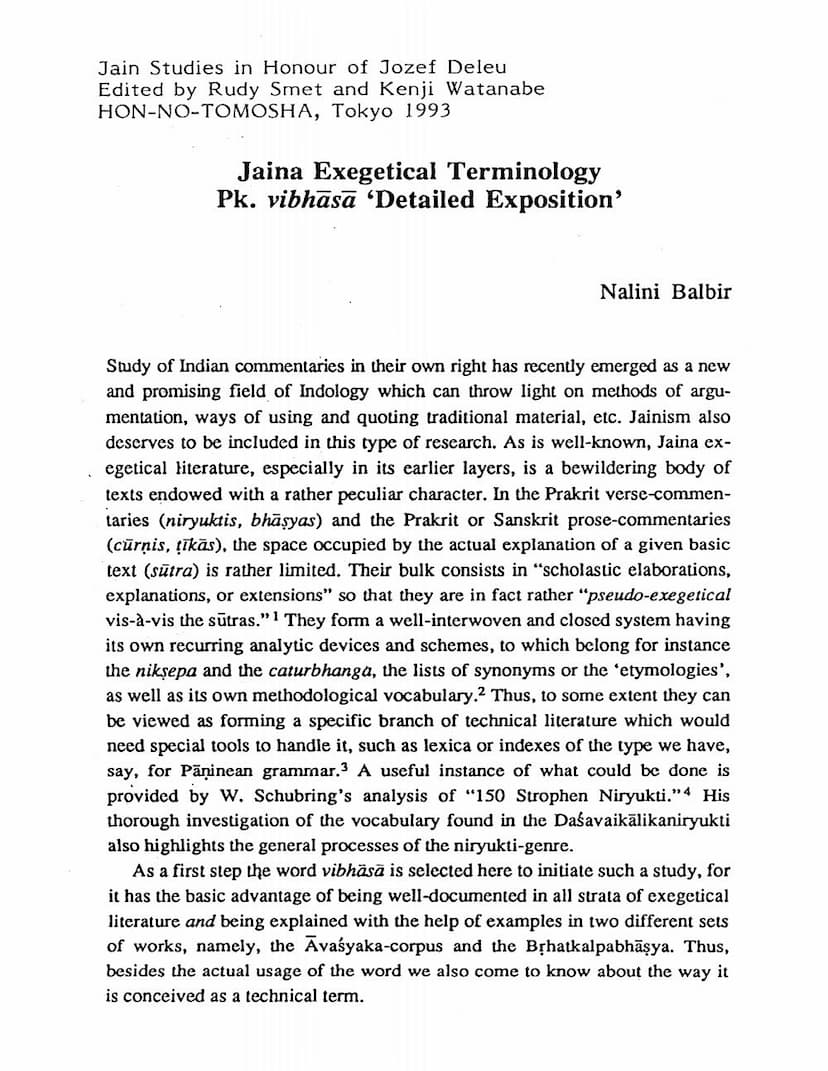
Nalini Balbir's article explores the Jaina exegetical term vibhāsā (Pk. vibhāsā, Sk. vibhāṣā), meaning "detailed exposition." The author positions this study within the emerging field of analyzing Indian commentaries as independent entities, highlighting their unique methods of argumentation and use of traditional material. Jainism, with its complex exegetical literature, is presented as a crucial area for such research. Early Jaina commentaries, particularly the Prakrit verse-commentaries (niryuktis, bhāṣyas) and prose-commentaries (cūrṇis, ṭīkās), are characterized by their "pseudo-exegetical" nature, where the actual explanation of the basic text (sūtra) is often overshadowed by scholastic elaborations. These commentaries form a closed system with recurring analytical devices like the nikṣepa and caturbhanga, and require specialized tools for their study.
The Term vibhāsā and its Semantic Field:
The article focuses on vibhāsā as a starting point for this research due to its well-documented presence across various exegetical strata and its explanation with examples in key works like the Āvaśyaka-corpus and the Bṛhatkalpabhāṣya.
- Classification: Vibhāsā is identified as one of five terms within a chain related to "exposition" (aṇuyoga): aṇuyoga, niyoga, bhāsā, vibhāsā, and vattiyam. These are presented as synonyms or terms within a semantic field, often strengthened by morphological and phonetic similarities.
- Contrast with Bhāsā and Vattiya: Vibhāsā is primarily understood and explained in contrast to bhāsā (a more concise or summary exposition) and vattiya (an exhaustive or fully detailed exposition). The level of explanation and the nature of examples vary across different exegetical layers.
Explanations and Examples:
The article meticulously analyzes how vibhāsā is defined and illustrated in various Jaina texts:
-
Āvaśyakacūrṇi (ĀVC): This text provides a general definition:
- Bhāsaga: Explains only one type of meaning.
- Vibhāsaga: Explains certain types of meaning or explains in detail the words and meanings of a sūtra in two, three, or four different ways.
- Vatukaraga: Explains all types of meaning or provides an explanation with the maximum amount of details. The Āvaśyakacūrṇi uses a series of analogies to illustrate these distinctions, including:
- Woodworking: A simple chiseling of wood is bhāsā, shaping limbs and secondary members is vibhāsā, and producing the full figure with intricate details is vattiya.
- Clay Modelling: Shaping the basic form is bhāsā, forming limbs and secondary members is vibhāsā, and completing the full figure with eyes, etc., is vattiya.
- Painting: Outlining the shape is bhāsā, drawing the limbs and secondary members is vibhāsā, and completing the full figure is vattiya.
- Treasure House: Knowing the presence of jewels is bhāsā, knowing the specific type of jewel is vibhāsā, and knowing everything about their power, value, and usage is vattiya.
- Lotus: A slightly blooming lotus is bhāsā, a more bloomed lotus is vibhāsā, and a fully bloomed lotus is vattiya.
- Guide: Knowing the general direction is bhāsā, knowing the specific road with its turns and length is vibhāsā, and knowing all the details about dangers and how to bypass them is vattiya.
-
Bṛhatkalpabhāṣya (BKBh): This text also differentiates the terms, using different examples:
- A roofer putting on one leaf is bhāṣaka, putting on several leaves is vibhāṣaka, and thatching with various materials is vyaktikara (related to vattiya).
- It defines vibhāsā as explaining one word with two or more meanings, exemplified by the word āsa (horse) which can be interpreted as "it eats" and "it runs fast but does not get tired."
- Those who know the Pūrvas explain sāmāyika in full detail.
-
Viśeṣāvaśyakabhāṣya (ViśAvBh): This commentary offers an analysis of the terms themselves:
- Vibhāsā is defined as a manifold or specific exposition using two or more equivalent terms.
- The example of sāmāyika is used, which can be analyzed in three ways: "correct direction" (path of Emancipation), "gaining peace," and "equanimity."
-
Haribhadra and Malayagiri: These Sanskrit commentators follow a similar approach, using ghata (pot) as an example.
- Bhāsā: Refers to one characteristic of an object.
- Vibhāsā: Explains an object by employing various synonyms (e.g., ghata, kuta, kumbha).
- Vattiya (vārtika): Enumerate all synonyms to bring out all characteristics.
Key Observations and Trends:
- Interrelationship of Texts: The article notes the parallel nature of the Āvaśyakacūrṇi and Viśeṣāvaśyakabhāṣya, though with distinct wording and little sign of reciprocal influence. Sanskrit commentaries by Haribhadra and Malayagiri show the influence of the Viśeṣāvaśyakabhāṣya.
- Core Distinction: Despite variations in examples, the fundamental differentiation between the three terms (based on the extent of explanation) remains consistent.
- Sanskritization: The term vattiya is Sanskritized as vārtika or vyakti(kara), the latter being a pseudo-Sanskritization.
- Illustrative Freedom: The differences in illustrations suggest a degree of freedom allowed among various groups of teachers, while core verses remain consistent. These examples served as a "stock" for teachers to draw from.
- Literary Classification: Bhāsā is used to designate a class of Jaina texts, but vibhāsā and vattiya are not.
- Second Triad: The triad sutta, vitti, vattiya (Sūtra, vrtti, vārtika) is also mentioned, where vattiya is the largest type of exposition, similar to its role in the bhāsā, vibhāsā, vattiya triad.
Usage and Function of Vibhāsā:
- Methodological Technical Term: The commentators aimed to establish vibhāsā as a methodological technical term with a meaning specific to Jainism.
- Abridgment Mark: More frequently, vibhāsā functions as an abridgment mark to avoid repetition, inviting the reader to supply implicit statements based on context or preceding explanations. This is seen in examples involving:
- Caturbhanga-argumentation: Where not all combinations are explicitly stated.
- Nikṣepa-patterns: Indicating that a parallel development should be followed.
- Narrative Sections: Signifying a "full description" to be inferred or elaborated upon, often by referencing existing patterns within the text or other works (Ohaniryukti).
- Context-Dependent Elaboration: The exact content implied by vibhāsā can be determined when it refers to expansions of words in subsequent verses or commentaries, or when it is linked to established scholastic patterns.
- Vague Implication: In some narrative or descriptive passages, the implied content remains vague to the modern reader, suggesting it might have been left to the teacher's discretion to elaborate or even invent details.
- Specific Usage in Āvaśyaka-commentaries: The article highlights a specific usage of vibhāsā in an Āvaśyakaniryukti-stanza, where it announces a "detailed discussion" or "detailed exposition" on a point. The cūrṇi clarifies that it signifies a development to be found in subsequent verses.
- Non-Canonical Origin: Vibhāsā does not appear in the Jaina Canon and is considered a term originating with the exegetical texts.
- Sanskrit vs. Prakrit Usage: The term vibhāsā (Sanskritized) in later Sanskrit contexts sometimes reverts to its more general meaning of "option" or "possibility." The specific Jaina meaning is primarily found in Prakrit commentaries.
Conclusion:
Nalini Balbir concludes that the word vibhāsā as a technical term in Jaina Prakrit commentaries has a twofold meaning:
- Medium Exposition: In theoretical discussions, it denotes a medium-sized exposition, contrasting with bhāsā (summary) and vattiya (exhaustive).
- Contextual Elaboration: In practical usage, it serves as a marker for a detailed exposition to fill in a gap or avoid repetition, a function observed over a long period.
The study demonstrates that vibhāsā is a key term in understanding the sophisticated hermeneutical practices of the Jaina tradition, revealing the methods by which commentators expanded upon, clarified, and contextualized the foundational scriptures.