
Jain Presence In Nepal
Added to library: September 2, 2025
Summary
Here's a comprehensive summary of Ernest Bender's "Jain Presence in Nepal," based on the provided text:
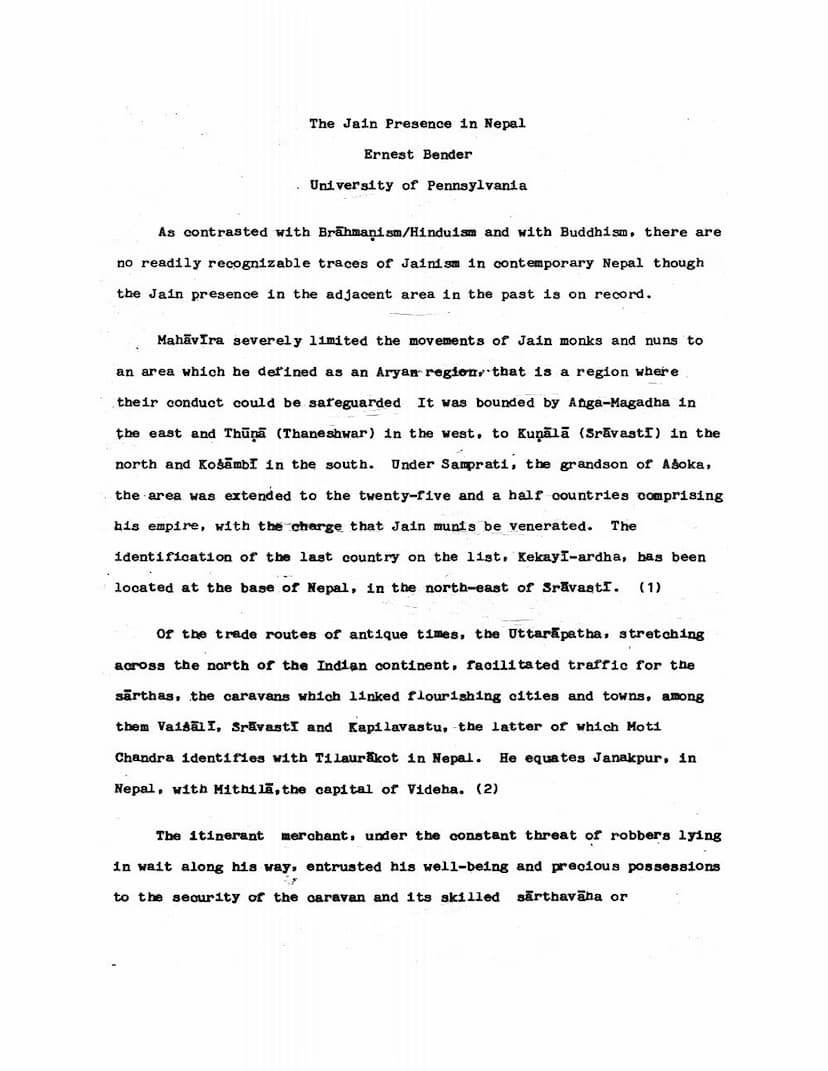
The book "Jain Presence in Nepal" by Ernest Bender explores the historical presence of Jainism in Nepal, acknowledging that while contemporary evidence is scarce, historical records and Jain literature indicate a significant past influence.
Early Jain Influence and Geographic Boundaries:
- Jainism's early movements, particularly those of monks and nuns, were restricted by Mahāvīra to an "Aryan region" bounded by Anga-Magadha in the east, Thūņā (Thaneshwar) in the west, Kuņālā (Śrāvastī) in the north, and Kośāmbī in the south.
- Under Samprati, Ashoka's grandson, this region was expanded to include twenty-five and a half countries within his empire, with an emphasis on venerating Jain ascetics. One of these regions, Kekayī-ardha, is identified as being at the base of Nepal, northeast of Śrāvastī.
Trade Routes and Merchant Networks:
- The ancient Uttarāpatha trade route, traversing the north of the Indian subcontinent, facilitated traffic for sārthas (caravans).
- Key cities linked by these caravans included Vaidālī, Śrāvastī, and Kapilavastu, with the latter being identified with Tilaurakot in Nepal. Janakpur in Nepal is equated with Mithilā, the capital of Videha.
- The sārthavāna (entrepreneur leading the caravan) played a crucial role, managing logistics, routes, schedules, and negotiations with officials. These sārthavānas acted as early forms of multinational organizations.
- The author suggests that these merchants, often serving as financial advisers and tax collectors for rulers, also functioned as heads of intelligence networks, gathering firsthand information from their widespread merchant colleagues. This is supported by references in the Arthashastra to the recruitment of merchants (including Jain and Buddhist ones) for espionage.
Jain Literature as a Source:
- Jain literature, particularly texts like the angas, upangas, gāthās, and cūrṇis, contains unique cultural data not found in Pali or Sanskrit literature. However, the scarcity of these texts makes accessing this information difficult.
- The Paumacariu by Svayambhū (9th century AD) contains stray references to Nepal, including its musk and the women's thighs.
- Jain literature is noted for providing minute details about the lives of merchants, who formed a significant portion of Jain followers. Jain monks, being wanderers, meticulously observed and documented the geographical and social conditions, as well as local languages, of the areas they traversed.
The Great Famine and Bhadrabāhu's Migration:
- Both Digambara and Śvetāmbara traditions agree that a severe twelve-year famine in Magadha during Candragupta Maurya's reign (c. 322-298 BC) led to the migration of Jains southward.
- The Āvaśyakacūrni of Jinadāsagaņi Mahattara (2nd century AD) records the Śvetāmbara tradition of Bhadrabāhu, the head of the Sangha, moving to Nepal.
- Hemacandra (12th century AD), in his Sthavirāvalī or Pariśiṣṭaparvan, provides a more detailed account. During the famine, the Sangha went to the sea, and neglected sacred texts were at risk of being lost. After the famine, they reconvened at Pāţaliputra and compiled eleven Angas.
- To recover the twelfth Amga, the Dṛṣṭivāda, the Sangha learned that Bhadrabāhu, the sole repository of this Amga, was in Nepal. They sent two monks to call him.
- Bhadrabāhu, who had begun a twelve-year Mahāprāṇa-meditation, agreed to teach the Pūrvas (earlier scriptures) and Sūtra meanings after completing his meditation.
- When asked about the punishment for an Ācārya who disobeys the Sangha, Bhadrabāhu suggested that learned students be sent to him, to whom he would impart seven lectures daily during his meditation.
- The Sangha sent five hundred monks, led by Sthūlabhadra, to Bhadrabāhu. Only Sthūlabhadra was able to keep pace and learn the first ten Pūrvas.
- Bhadrabāhu later considered Sthūlabhadra unworthy and stopped teaching him, despite Sthūlabhadra's pleas. He eventually relented, agreeing to teach the remaining Pūrvas on the condition that Sthūlabhadra could not transmit them to others. Sthūlabhadra succeeded Bhadrabāhu as the leader of the Sangha.
Archaeological and Epigraphical Evidence:
- The author cites historian Vincent A. Smith (1915) who noted that Jainism was far more widely diffused in ancient times than in the present, with adherents in areas like Vaiśālī and eastern Bengal, and significant evidence of its presence in Bundelkhand during the medieval period.
- Luciano Petech suggests a connection between the Śulkaṅkī (or Surakī) family of Śikhārapur (Pharping) in Nepal (14th-16th centuries AD) and the Solanki dynasty of Gujarat, known for its Jain rulers or influences. This family is thought to have migrated from Gujarat.
- A "Book of Omens" by Pratipaditya Pal mentions a "Jain mendicant."
- Sylvain Levi describes an inscription in Kathmandu on the pedestal of a now-missing statue. The inscription, from the year 402, states that Guhamitra, the head of a merchant company, erected a holy Divākara under the name of Indra, assigning land for its maintenance. Levi found the syncretic divinity of Divākara-Indra puzzling.
- The author proposes that this inscription can be interpreted through Jain sources. Acārya Raviṣeņa, author of the Padma Purāṇa (c. 678 AD), mentions his lineage: he was the grand-disciple of Arhatmund, the disciple of Divākara, whose preceptor was Indra.
- Therefore, Guhamitra, a Jain and head of a sārtha, erected the image to his Ur-guru, Indra, whose disciple was Divākara. The land donation was for the upkeep of the image and its shrine.
Conclusion and Future Research:
- The author suggests that the traditions of Newar merchant castes, such as the Śreṣṭhas/Śeṣyāś, may hold further evidence of Jain presence in Nepal and encourages further study into these groupings.
In essence, Bender's work argues that despite the lack of overt contemporary Jain presence in Nepal, historical evidence from trade routes, Jain literature detailing migrations, and epigraphical records strongly suggests a past engagement of Jainism with the region, particularly through its merchant communities and monastic movements.