
Jain Kavio
Added to library: September 2, 2025
Summary
Here's a comprehensive summary of the provided Jain text, "Jain Kavio" by Acharya Muni Nyayavijayji, focusing on the key themes and figures discussed:
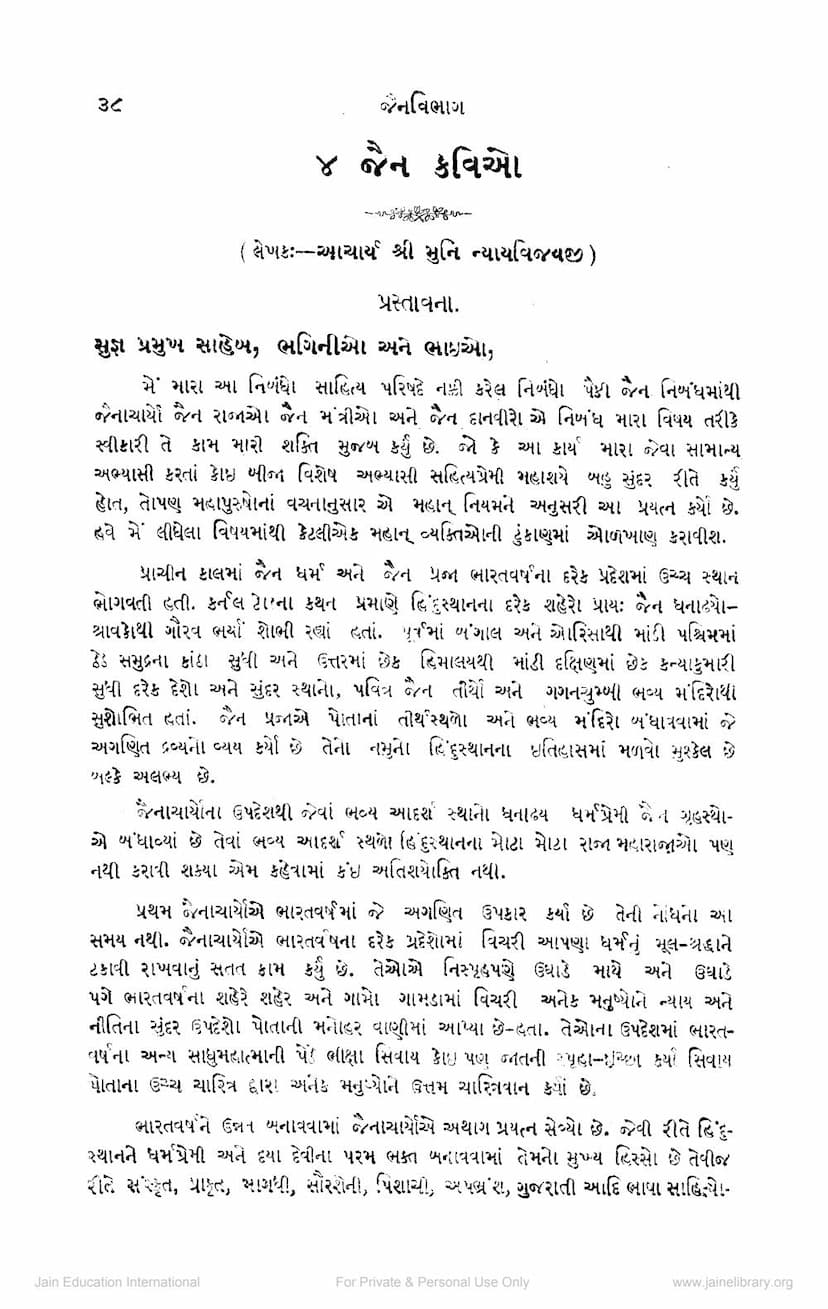
The book, "Jain Kavio" (Jain Poets), authored by Acharya Muni Nyayavijayji, is presented as an exploration of the significant contributions of various individuals within the Jain tradition to Indian culture and literature. The author acknowledges that the work is an effort to fulfill a mandate from a Sahitya Parishad (Literary Council) and expresses hope that a more specialized scholar might have undertaken this task with greater finesse.
The Author's Vision and the Glorious Past of Jainism:
- Pervasive Influence: Nyayavijayji begins by emphasizing the widespread and esteemed position of Jainism and its followers across India in ancient times. He quotes Colonel Todd to illustrate how numerous cities were adorned by Jain patrons (shrāvak). From Bengal and Orissa in the east to the western coast, and from the Himalayas to Kanyakumari in the south, Jain sacred sites and magnificent temples were prevalent.
- Unprecedented Generosity: The text highlights the immense wealth Jain patrons, kings, ministers, and scholars dedicated to building temples and supporting religious establishments. This expenditure, the author claims, is unparalleled in Indian history.
- Spiritual and Intellectual Prowess: Jain acharyas (spiritual leaders) are credited with immense contributions to India's upliftment. Their teachings fostered a spirit of piety and compassion. They tirelessly traversed the country, disseminating messages of justice and ethics with their eloquent discourse. They lived simple lives, seeking only alms, and by their exemplary conduct, inspired many to lead virtuous lives.
- Literary Contributions: Jain acharyas were also instrumental in nurturing various languages, including Sanskrit, Prakrit, Agam, Sauraseni, Paisachi, Apabhramsha, and Gujarati. They enriched these languages through their literary works, often in seclusion, demonstrating immense dedication.
Prominent Jain Acharyas and their Impact:
The text then introduces several highly influential Jain acharyas and their significant achievements:
- Acharya Shri Siddhasen Diwakar: Author of 1844 texts and a brilliant logician, he graced the court of King Vikramaditya.
- Acharya Shri Haribhadra Suri: A renowned philosopher and author of 1444 texts.
- Acharya Shri Hemachandra Surishwar: Referred to as the "Kalkal Sarvajna" (Omniscient of the Age of Kalikala) and a Brahmachari scholar, he was highly influential and adorned the court of Chakravarti Kumarpal.
- Acharya Shri Bappabhatta Suri: Associated with the court of the Maharaja of Gwalior (Gopura).
- Acharya Shri Abhayadev Suri: Author of Navangi Tikakar, he was prominent in the court of Maharaja Bhimdev of Gujarat.
- Acharya Shri Hiravijaya Suri: The "Jagatguru" (World Teacher), he softened the heart of the Mughal emperor Akbar with the pure mantra of non-violence.
The author notes that many other Jain saints contributed to making India a "Nandanvan" (paradise) by spreading the message of non-violence and enriching the literary garden of the land.
The Role of Jain Poets:
The text specifically emphasizes the crucial role of Jain poets in enriching literature. The author asserts that if the contributions of Jains were removed from Sanskrit, Prakrit, and Gujarati literature, very little would remain.
- Haribhadra Suri and Hemachandra Suri: These scholars are highlighted for their immense contributions to Sanskrit and Prakrit literature.
- Lack of Biographical Information: A recurring theme is the difficulty in finding detailed biographies of many Jain poets and saints, even for some renowned ones. The author laments this lack of information, attributing it partly to the custom of Jain scholars not always providing personal details beyond their lineage.
- Notable Poets and their Works:
- Shri Hemachandra Suri: Renowned for his epic poems like "Dvishray," "Trishashti," and the literary treatise "Kavyanushasan."
- Shri Abhayadev Suri (II): Author of "Jayantavijay Kavya."
- Shri Vardhaman Suri: Author of "Vasupujya Charitra," considered a Mahakavya (epic poem) rather than just a biography.
- Shri Samprabha Suri: A renowned scholar, acharya, and poet, known for "Suktāmuktāvali," "Vairāgyatarangini," and the Prakrit Mahakavya "Kumārapāla Prāchibandha."
- Upadhyay Shri Meghavijaya: Author of the Mahakavya "Saptasandhāna."
- Mahakavi Dhanpal: Celebrated for "Tilakamanjari" and "Rishabha Panchashikha." "Tilakamanjari" is praised for its elegant prose, concise sentences, and apt descriptions, contrasting with the verbose style of Bana's "Kadambari." Dhanpal is also noted for his self-comparison to Bana in his preface.
- Shri Shobhanacharya: Dhanpal's younger brother, known for his speed in composition. His "Shobhanastuti" is described as rich in figures of speech and wordplay.
- Shri Udayavanta: Author of "Sakhetri Ras."
- Shri Lavanyasamaya: Known for works like "Vimalaprabhandh."
- Shravak Kavi Shri Rishabhdas: His biography was presented at a literary conference.
- Upadhyay Shri Yashovijaya: Author of significant Gujarati poems like "Dravyagunaparyayane Ras" and "Shripalra Uttarardh."
- Upadhyay Shri Vinayavijaya: Also a notable poet, known for "Shripalra Purvardh" and "Vinaya Vilas."
- Mahagishwar Anandhanji: Another accomplished poet.
- Mahakavi Shri Viravijay and Rupavijayji: The author has provided details for Shri Viravijayji.
Jain Kings and their Patronage:
The text highlights the significant role of Jain kings in promoting Jainism and protecting their kingdoms.
- Contemporary to Mahavira: Kings like Shrenik of Champa and Cheda (Chetak) of Vaishali, contemporaries of Lord Mahavir, are mentioned. Chetak, initially a Buddhist, became a devout follower of Mahavir.
- Other Jain Kings: The text lists numerous kings who were devoted Jains during Mahavir's time, including Ashokchandra (son of Shrenik), kings of Kashi and Kosala, Vijayaraj of Pulashpur, Udayan of Vitabhadrapattan (who took diksha from Mahavir), Nandivardhan (Mahavir's elder brother), Chandrakat of Ujjain, Shal and Mahashal of Uttarpal (Himalayas), Prasannachandra of Patanpur (also known as Rajarshi), Adhinshagu of Hastirsh, Dhanvah of Ishabhpur, Virakrishnamitra of Virpur, Vasavadatta of Vijaypur, Apratihata of Saugandhak, Pradipchandra of Kanpur, Bal of Mahapur, Arjun of Sushapati, and Dutt of Saketpur. The author notes that information about these kings is found in Jain Sutras but couldn't be explored in detail due to time constraints.
- Post-Mahavir Kings: Emperor Samprati (grandson of Ashoka) is described as a staunch Jain king who greatly aided the progress of Jain philosophy. King Vikramaditya became a devout Jain under the guidance of Siddhasen Diwakar. Amaraja of Gwalior also embraced Jainism due to Bappabhatta Suri's teachings. The author expresses a desire to compile biographies of these kings if time permits.
- Maharajadhiraj Parmat Kumarpal: This king became a devout Jain under Hemachandra Suri's guidance and is referred to as a Rajarshi.
Jain Ministers and their Service:
The text also acknowledges the significant contributions of Jain ministers:
- Abhayakumar Mantri: A devoted follower of Lord Mahavir and chief minister to King Shrenik, his life story is celebrated in the Jain community.
- Shakatala (Shakadal) and his son Siddhiyaka (Shriyak): Ministers during the time of the Nandas.
- Gujarat's Ministers: From Vanraj to Varthaval, Jains held ministerial positions with varying degrees of influence. Key figures include Cha, minister to Vanraj; Vimal Mantri, who rivaled Bhoj of Malwa and built the famous Jain temples of Mount Abu; Munjaal, chief minister to Siddharaj Dev, who was a shrewd strategist and a devout Jain; Udayan Mantri; Sajjan, lord of Saurashtra, and his son Parshuram; and Chahad, the adopted son of Siddharaj (son of Udayan Mantri). These ministers, despite their commitment to non-violence, fought valiantly on the battlefield to protect Gujarat's honor.
- Ministers of Kumarpal: Valmat, Bahad, and Adambhat were devout Jains who oversaw the renovation of the Shatrunjay Tirth temples.
- Vastupal and Tejpal: Ministers of Varthaval, they are credited with revitalizing Gujarat. These brothers were devout Jains and skilled warriors, spending vast sums on the Jain temples of Mount Abu, which are architectural marvels.
- Akbar's Ministers: Todarmal and Karmashah are mentioned, with Todarmal being a skilled administrator and warrior, responsible for land revenue assessment that is still partially in use. The author apologizes for not being able to detail all ministers due to length.
Jain Philanthropists and their Generosity:
The text concludes by highlighting the renowned philanthropy of Jains.
- Inherent Generosity: Jainism instills a spirit of generosity, encouraging daily acts of charity according to one's means.
- Historical Philanthropists:
- Seth Emāholiyā: During the severe famine of 1315 in Muhammad Begada's reign, he transformed Gujarat into a land of plenty through his generosity, living up to his title.
- Seth Jagadushah of Kutch-Bhadreshwar: Known as the "Kuber Bhandari of Gujarat," he aided all of India during severe famines, saving countless lives and providing sustenance to kings and emperors. His death was mourned deeply across India, signifying the end of a prosperous era.
- Later Philanthropists: Seth Shantidas, Seth Premchand Raichand, and Seth Motisha are mentioned for their significant philanthropic contributions.
- Service in Times of Crisis: Jain generosity was also evident during the famine of 1856 and the influenza outbreak of 1974-75. A recent example includes a householder from Kutch donating ₹50,000 during a drought. The author extends his heartfelt congratulations to all known and unknown philanthropists.
The author concludes by listing the sources that aided him in compiling this work, including the Kalpa Sutra, Chaturvinsati Prabandh, Vimalaprabhandh, Prabandh Chintamani, Jain Aitihasik Rasamala, Viravanshvali, History of Jainism, Tappagachh Pattavali, Jain Conference Herald, Puratatva, and Atmānand Prakash.
Mahakavi Dhanpal (Detailed Section):
This section provides a more in-depth look at the life and works of the renowned poet Dhanpal.
- Context: Dhanpal flourished in the 13th century Vikrama, a golden age for Jain literature, during the reign of the liberal King Bhoj.
- Literary Prowess: Dhanpal's poetry is described as exceptionally brilliant, showcasing his intelligence and wit. His works are said to captivate readers with their unique charm.
- Relationship with King Bhoj: Bhoj, a great patron of Sanskrit literature and a poet himself, held a court attended by scholars from across India. Dhanpal and Bhoj were friends from childhood. Impressed by Dhanpal's profound scholarship, King Munja (likely referring to Bhoj) bestowed upon him the title "Pride of Saraswati."
- Conversion to Jainism: Dhanpal was initially a Vedic follower but later converted to Jainism. His birthplace was Dharanagari, and his father was a devout Brahmin. His brother, Shobhan, was initiated into Jainism under the guidance of Shri Mahendra Suri.
- Dhanpal's initial resistance: Dhanpal was initially displeased with his brother's conversion and influenced King Bhoj to restrict the entry of ascetics into Dharanagari.
- Brother's Influence: Shobhan, after his initiation, became a learned scholar and was given the title of Acharya, becoming known as Shobhanacharya. His eloquence spread throughout the land. The Jain community of Dharanagari invited him, and his powerful discourse revitalized the city's populace.
- Dhanpal's encounter with Shobhanacharya: When Shobhanacharya's disciples visited Dhanpal, Dhanpal witnessed a demonstration of Jain principles regarding the sanctity of life in even simple acts like consuming curd. This experience deeply impressed him, leading him to question his own beliefs.
- Reunion and Spiritual Journey: Dhanpal reunited with his brother, Shobhanacharya, and was moved by his brother's spiritual path. He began studying Jain principles under Shobhanacharya and eventually took Jain diksha from Shri Mahendra Suri.
- Debates with King Bhoj: Dhanpal's conversion led to frequent debates with King Bhoj, who was a staunch follower of the Vedic tradition. However, Dhanpal's deep understanding of Jain philosophy and his logical arguments often impressed the king.
- "Tilakamanjari": Inspired by King Bhoj's curiosity about Jain philosophy, Dhanpal composed the extraordinary story of "Tilakamanjari." This prose epic is highly praised for its elegant prose, concise sentences, and apt descriptions, distinguishing it from the verbosity of Bana's "Kadambari." It is considered a masterpiece of Sanskrit literature.
- Other Works: Dhanpal also authored "Rishabha Panchashikha" and "Pāyachl-chhamamālā" (some of which are extant). He also wrote a commentary on "Shobhanastuti."
- Praise from Hemachandra: Even the great scholar Hemachandra Suri praised Dhanpal's work extensively.
- Legacy: "Tilakamanjari" is considered a rare gem in Jain literature, acknowledged even by scholars of other sects. A legend is recounted about the origin of "Tilakamanjari," where King Bhoj, delighted by the story, wished to have his name incorporated into it, a request Dhanpal politely declined, leading to the king burning the manuscript. However, Dhanpal's daughter, who had memorized the story, recited it to him, and he renamed it "Tilakamanjari" in her honor.
Mahakavi Shobhanacharya (Brother of Dhanpal):
- Exceptional Poet: Shobhanacharya, Dhanpal's younger brother, was also an extraordinary poet.
- "Shobhanastuti": His "Shobhanastuti" is considered a complex work, requiring scholarly interpretation. It features a unique poetic structure where the second and fourth lines of each stanza share the same wording but convey different meanings.
- Example Stanza: An example stanza praising Lord Adinath is provided, illustrating his poetic skill in comparing the Tirthankara to the sun that awakens lotuses and his ability to overcome obstacles.
- Praise for Jain Agamas: Another stanza describes the Jain Agamas as a beautiful garden for ascetics, a dwelling for great teachings, and a bridge to cross the ocean of existence, free from desires, diseases, ego, sins, and ignorance.
- Description of a Goddess: A stanza beautifully describes a goddess, armed with a sword brighter than the sun, riding a lion, and destroying enemy ranks.
- Praise for Lord Rishabhadeva: He composed 86 verses in praise of Lord Rishabhadeva, each filled with new meanings, ornamentation, and rasa. It is said that he composed this hymn while on his begging rounds, showcasing his innate poetic talent.
Gujarati Mahakavi Shri Viravijayji:
This section focuses on the prominent Gujarati poet Viravijayji.
- Renowned Poet: Shri Viravijayji is a highly acclaimed poet in the Jain community, whose works are known to all. He immortalized himself by composing numerous "pooja" (devotional songs), "stavana" (hymns), "chekhaliya" (short devotional pieces), and "rasa" (narrative poems) in Gujarati.
- Simplicity and Depth: His devotional songs are praised for their unique charm, emotional depth, and varied rasa, making them accessible even to children. He is considered the last great poet in the Jain tradition.
- Life Details: Born in Ahmedabad in 1829, he was originally Keshavram, an Audichya Brahmin. His parents were Jagneshwar and Vijakerbai. He had a sister named Ganga. After his marriage at 18, his father passed away. A dispute with his mother led him to leave home. His mother and sister later died due to grief.
- Spiritual Transformation: Keshavram embarked on a pilgrimage to Shatrunjay, where he encountered Jain muni Shri Shubhayvijayji. His health deteriorated in Palitana, but with the guru's grace, he recovered, developing deep faith in his guru.
- Diksha and Education: He took diksha in 1848 near Khambhat. Shri Shubhayvijayji showed great care in his disciple's education, staying with him for five years in Khambhat to impart his knowledge. He was later appointed "Panyasapad" (a scholarly position) in Ahmedabad.
- Grief and Devotion: His guru, Shri Shubhayvijayji, passed away in 1867, a loss that deeply affected Viravijayji, who expressed his devotion and gratitude to his guru in his work "Shubhabeli."
- Literary Career: After taking diksha, he began developing his poetic skills, starting with the "Khaliya" of Gandi Parshvanath in 1853, followed by "Sursundari Ras" and a work describing the virtues of Lord Mahavir's speech.
- Orator and Reformer: He was a captivating orator, drawing large crowds. He was also fearless, confronting and criticizing the lax practices of the Dhundhakia and Shithilyati sects. Despite facing opposition and harassment from these groups, he remained steadfast, his truth prevailing.
- Knowledge of Jain Sutras: He had a profound understanding of Jain Sutras, incorporating their teachings into his "pooja," "stavana," and "rasa." The text provides examples of his verses quoting from the "Uttaradhyayana" and "Pannavana" Sutras.
- Impact and Legacy: Viravijayji's works showcase his extraordinary scholarship and poetic talent. His "pooja" are highly valued and often performed first in Jain temples. While his poems are simple and easy to understand, they also contain profound meanings that challenge even learned scholars. He enriched the Jain literary tradition with his pure spirit, likening his contribution to watering a garden with nectar. His legacy shines brightly in Jain history, like the star Dhruv.
- Examples of His Poetry: Several verses are provided as examples of his poetic prowess, covering themes of nature, ethical conduct, devotion, and philosophical insights. These verses demonstrate his ability to evoke imagery and convey deep spiritual messages.
- Philanthropic Endeavors: The text mentions his participation in the consecration ceremonies of significant temples built by Seth Motisha and Seth Hathisingh in Ahmedabad, highlighting his involvement in important Jain religious activities. He also composed a "rasa" describing a grand pilgrimage organized by Sheth Premabhai Hemabhai of Ahmedabad.
- Integrity and Devotion: The author emphasizes that Viravijayji never indulged in flattery or made empty claims. His work consistently reflected devotion to God, religious activities, and the righteous lives of past Jain kings and sages. Devotional rasa is the primary element in his writings.