
Jain Ekta
Added to library: September 2, 2025
Summary
Here's a comprehensive summary of the provided Jain text, "Jain Ekta" (Jain Unity), based on the pages provided:
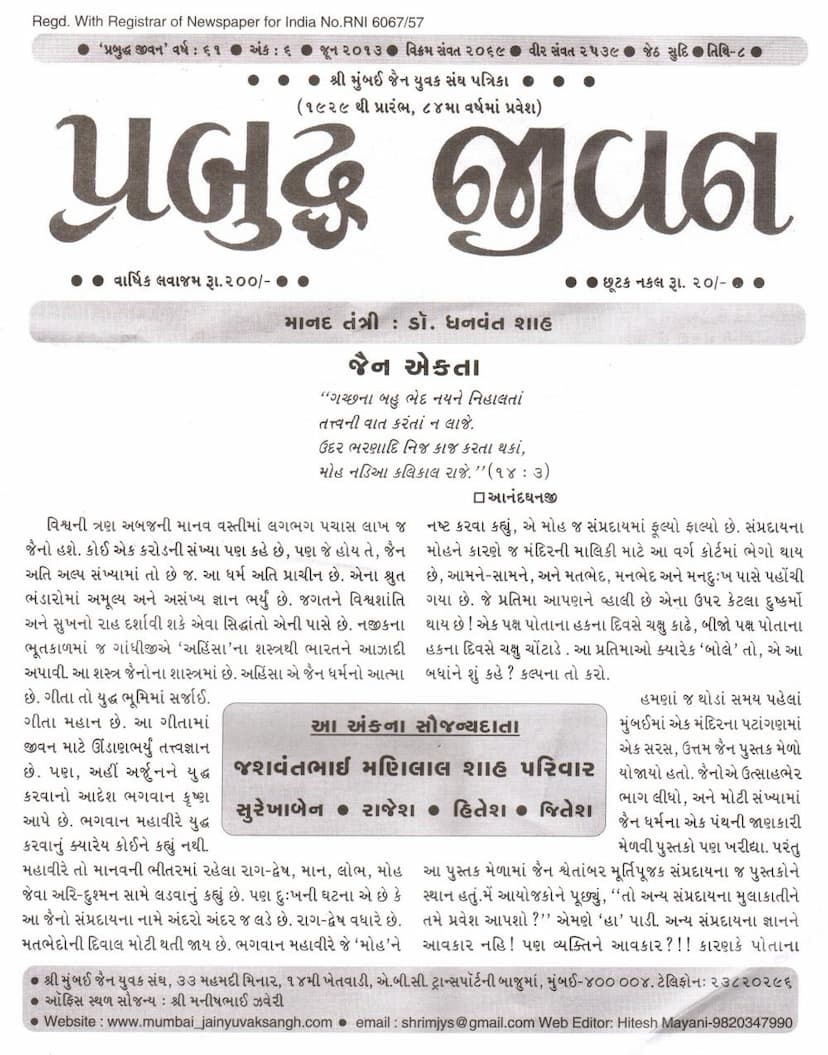
The article, published in "Prabuddh Jivan" (Enlightened Life) in June and July 2013, edited by Dr. Dhanvant Shah and published by Shri Mumbai Jain Yuvak Sangh, is a passionate call for unity within the Jain community, as articulated by the revered poet-saint Anandghanji. The author laments the deep divisions and internal conflicts plaguing Jainism, which he believes are a result of moha (attachment and delusion) and the proliferation of numerous sub-sects (gaccha and panth).
The Core Problem: Division and Attachment
- Internal Strife: The article begins by highlighting the paradox of Jainism, an ancient religion with profound principles of peace and non-violence, being embroiled in internal disputes. Anandghanji is quoted, stating that "Jain Ekta" cannot shy away from discussing the essence of the Jain principles when viewed through the many divisions of the gaccha (sects). He criticizes the pursuit of personal gain and the influence of moha in the current era.
- Temple Disputes: A stark example is given of Jains fighting in court over temple ownership, even to the point of symbolic violence against religious images. This is seen as a manifestation of moha.
- The Spirit of Mahavir vs. The Reality: While Lord Mahavir preached fighting internal enemies like raag-dvesh (attachment-aversion), pride, greed, and delusion, Jains are instead fighting amongst themselves due to sectarian differences. The walls of disagreement are growing taller.
- Historical Roots of Division: The text traces the origins of schisms back to Lord Rishabhdev's time, with Marichi establishing a new sect. Later, after Mahavir Swami, divisions arose between the Shvetambara and Digambara traditions, and further splintering occurred over centuries, leading to a multitude of gaccha and panth. The author mentions over 84 gaccha existing during Anandghanji's time and notes that even today, there are around 25 Shvetambara, 23 Sthanakavasi, and 20 Digambara sects, each with their own interpretations and practices.
- Attachment to Symbols and Practices: The article criticizes the focus on external practices and differences in celebrating festivals (like Samvatsari), adherence to different canons (Agam), and even the interpretation of religious texts. This attachment to specific interpretations and traditions, rather than the core principles, is seen as detrimental.
Anandghanji's Critique and Vision:
- Critique of Sectarianism: Anandghanji's words strongly condemn the narrow-mindedness of those who cling to their gaccha and seek personal prestige or to belittle others. He states that such individuals, engrossed in confined boundaries, have no right to speak of the profound truths of Jainism.
- The True Path: The author emphasizes that ahimsa (non-violence) is the soul of Jainism, as evidenced by its scriptures. He draws a parallel to the Bhagavad Gita, which originated in a battlefield, but highlights that Mahavir Swami never advocated for physical warfare. Instead, Mahavir's battle was against internal vices.
- The Importance of Non-Jain Contributions: The article emphasizes that genuine efforts towards Jain unity have also come from non-Jains. It highlights the profound impact of Lord Mahavir's teachings on Vinoba Bhave, who saw him as a significant influence after the Bhagavad Gita. Vinoba Bhave's vision was one of accepting the truth in all religions and individuals.
- The "Shraman Sutram" Initiative: A significant portion of the article is dedicated to the effort of Vinoba Bhave and Tapasvi Jinendra Varniji to create a comprehensive and representative Jain text, "Shraman Sutram" (later known as "Jinadhamma"). This was an attempt to encapsulate the essence of all Jain traditions. The initiative aimed to avoid sectarian bias by drawing from various scriptures without explicitly stating their origin, fearing inter-sectarian disputes.
- Lack of Recognition: Despite this monumental effort, the author expresses disappointment that the Jain community has not widely embraced or promoted "Shraman Sutram." He notes that while non-Jains like the Somaiya family have organized seminars on it, the Jain institutions have largely remained indifferent.
The Call to Action:
- Beyond Discussion to Action: The author urges the community to move beyond mere discussion and engage in concrete action for Jain unity. He calls for prayers for prosperity and unity.
- Individual Responsibility: The article suggests that each Jain should pledge to raise their children as "Jains" without specific sectarian labels, allowing them to discover their own identity and connect with the broader Jain heritage.
- Unity in Diversity: The article concludes by stating that while complete assimilation of all sects into one might be impossible due to deeply entrenched differences, a form of unity is achievable. This unity would involve merging the various sub-sects into the main traditions (Shvetambara Murtipujak, Digambara, Sthanakavasi, and Terapanth). This, the author believes, would at least reduce the current levels of sectarian discord and bring the focus back to the core principles of apeksha (relativity) and anekantavada (non-absolutism), which are the soul of Jainism.
- The True Ocean: The article uses the metaphor of the gaccha being rivers and Jainism being the ocean, urging all rivers to merge into the ocean, dissolving the ego and achieving unity.
In essence, "Jain Ekta" is a critical and hopeful examination of the internal state of Jainism. It laments the divisive forces at play while championing the universal principles of non-violence and truth taught by Lord Mahavir, and it looks towards a future where unity and understanding prevail.