
Jain Declaration Of Nature
Added to library: September 1, 2025
Summary
Here is a comprehensive summary of "The Jain Declaration on Nature" by Dr. L. M. Singhvi, based on the provided text:
Overview:
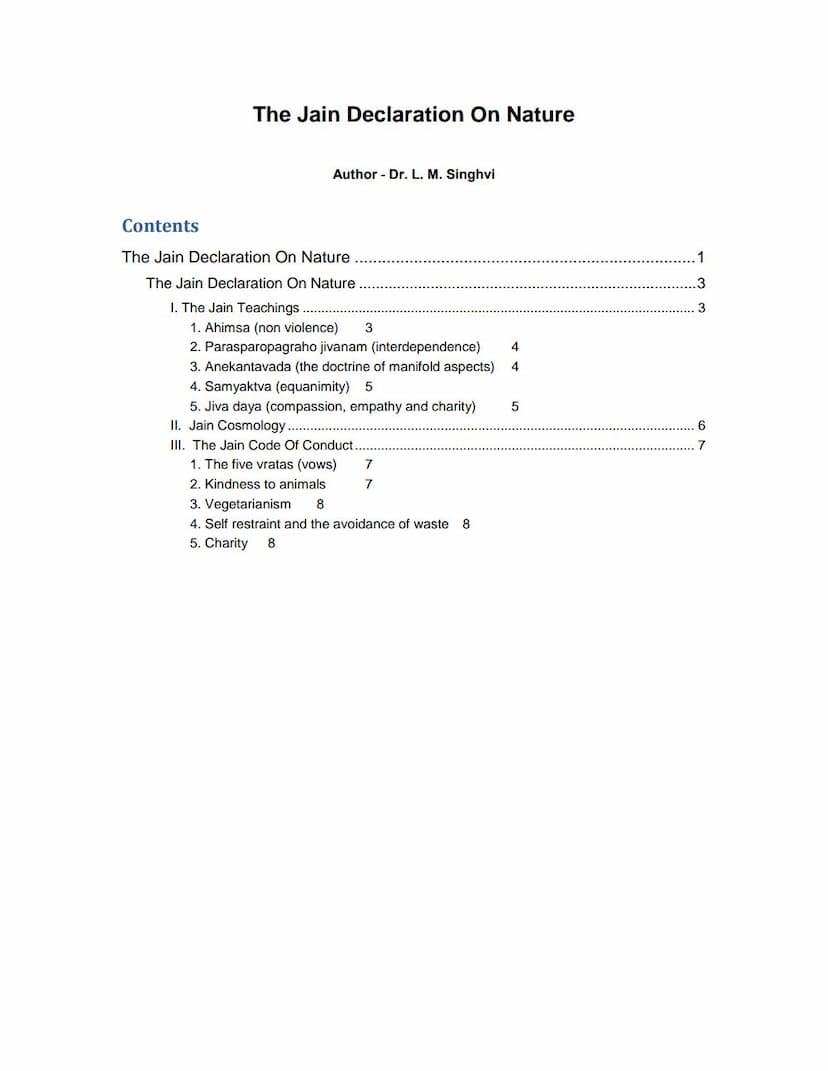
"The Jain Declaration on Nature" by Dr. L. M. Singhvi presents Jainism's profound and enduring philosophy of ecological harmony and non-violence. It argues that this spiritual quest has historically shaped Jain ethics, aesthetics, art, literature, economics, and politics, contributing significantly to ancient Indian life and thought. Despite their small numbers today, the Jain perspective on reverence for all life and environmental preservation continues to influence Indian society. The declaration highlights Mahatma Gandhi, a proponent of Jain teachings, as a testament to this influence, particularly his embrace of "ahimsa" (non-violence).
Key Jain Teachings for Ecological Harmony:
The document elaborates on five core Jain principles that underpin its ecological outlook:
-
Ahimsa (Non-violence): This is the paramount teaching of Jainism, considered the supreme religion ("Ahimsa parmo dharmah"). It extends beyond human interactions to encompass all of nature. Jainism emphasizes that violence is not just physical harm but also the intention and lack of compassion behind actions. Even thoughts of harming others are considered violent. The core message is to "do not injure, abuse, oppress, enslave, insult, torment, torture or kill any creature or living being."
-
Parasparopagraho Jivanam (Interdependence): This principle, translated as "All life is bound together by mutual support and interdependence," is presented as a precursor to the modern science of ecology. It posits that all aspects of nature are interconnected and bound by physical and metaphysical relationships. Life is viewed as a collective endeavor of togetherness, accommodation, and assistance in a universe of interdependent constituents. Neglecting any part of nature is seen as neglecting oneself.
-
Anekantavada (The Doctrine of Manifold Aspects): This epistemological doctrine states that reality is multifaceted, with an infinite number of viewpoints. Truth is relative to these perspectives. Absolute truth can only be grasped by considering all these diverse viewpoints, not just one. Jainism, rooted in Anekantavada and its corollary syadvada (relativity), therefore, avoids anthropocentric, ethnocentric, or egocentric viewpoints, actively considering the perspectives of other species, communities, and individuals.
-
Samyaktva (Equanimity): The combined principles of non-violence, interdependence, and manifold aspects lead to the pursuit of equanimity. This involves avoiding dogmatic, intolerant, aggressive, or harmful attitudes towards the world. It promotes a balanced approach of "give and take" and "live and let live," offering a peace plan based on mental equilibrium for preserving the universe's balance rather than domination.
-
Jiva Daya (Compassion, Empathy, and Charity): While "ahimsa" is a negative term (non-violence), it is deeply rooted in positive actions like compassion, empathy, and charity. "Jiva daya" means caring for, sharing with, tending, protecting, and serving all living beings. This encompasses universal friendliness, forgiveness, and fearlessness. Jains strive for a heart filled with forgiveness and friendship for all beings, praying for peace and mutual cherishing throughout the world.
Jain Cosmology:
The Jain tradition does not believe in a creator god. The universe is seen as eternal, without beginning or end, composed of two fundamental, coexisting categories: jiva (consciousness/soul) and ajiva (non-conscious matter). Ajiva is further categorized into five substances: dharma (medium of motion), adharma (medium of rest), akasha (space), pudgala (matter), and kala (time). Matter (pudgala) is composed of atoms. Souls, though formless, are influenced by karmic particles (asravas) attached due to worldly activities, leading to cycles of rebirth. Souls are in bondage until they achieve liberation (moksha).
The Jain evolutionary theory is based on the degree of sensory perception in bodies. All souls are equal, but their karmic attachment dictates their physical form, ranging from plants (one sense) to humans and celestial beings (five senses plus rationality). This conception of life's eternal coherence instills a profound ethical responsibility in humans towards the universe, making Jainism a historical cradle for environmental protection.
Jain Code of Conduct:
The Jain ethical framework is built upon the five vratas (vows):
- Non-violence in thought, word, and deed.
- Speaking the truth.
- Honesty and not taking anything by force or theft.
- Restraint and chastity in thought, word, and deed.
- Non-acquisitiveness.
These vows, undertaken at higher levels by monks and nuns (maha vratas) and at a more moderate level by householders (anu vratas), emphasize individual responsibility and have profound ecological implications.
Specific manifestations of this code include:
- Kindness to Animals: Condemnation of animal sacrifice, prohibition of cruelty, captivity, and deprivation of animals. Mercy is allowed even in animal training, but without anger.
- Vegetarianism: Jains are strict vegetarians, consuming no meat, fish, or eggs, and using vegetables judiciously, avoiding harm to plants wherever possible.
- Self-Restraint and Avoidance of Waste: Jains practice moderation, austerity, and abstinence. They are encouraged to limit desires and consumption, recognizing that using resources beyond one's needs is a form of theft. Waste and pollution are considered acts of violence.
- Charity: Minimizing personal accumulation and generously contributing to social welfare is an obligation. Jains have established numerous institutions like schools, hospitals, and animal shelters, reflecting a sense of social responsibility and stewardship over wealth for the benefit of all.
Conclusion:
The declaration concludes by asserting that the fundamental Jain teachings and code of conduct are deeply rooted in its living ethos and have remained unbroken for centuries. They offer a timeless ethical framework and a practical guide for humanity's pursuit of holistic environmental protection, peace, and universal harmony.