
Jain Danviro
Added to library: September 1, 2025
Summary
Here's a comprehensive summary of the provided Jain text "Jain Danviro" by Acharya Muni Nyayavijayji, focusing on the lives and contributions of the Jain benefactors discussed:
The book "Jain Danviro" (Jain Benefactors) by Acharya Muni Nyayavijayji highlights the lives and philanthropic deeds of prominent Jain laymen who significantly contributed to society and their faith. The text details the lives of three such individuals: Bhavadshah, Khemāderāṇī, and Jagadushah.
1. Bhavadshah:
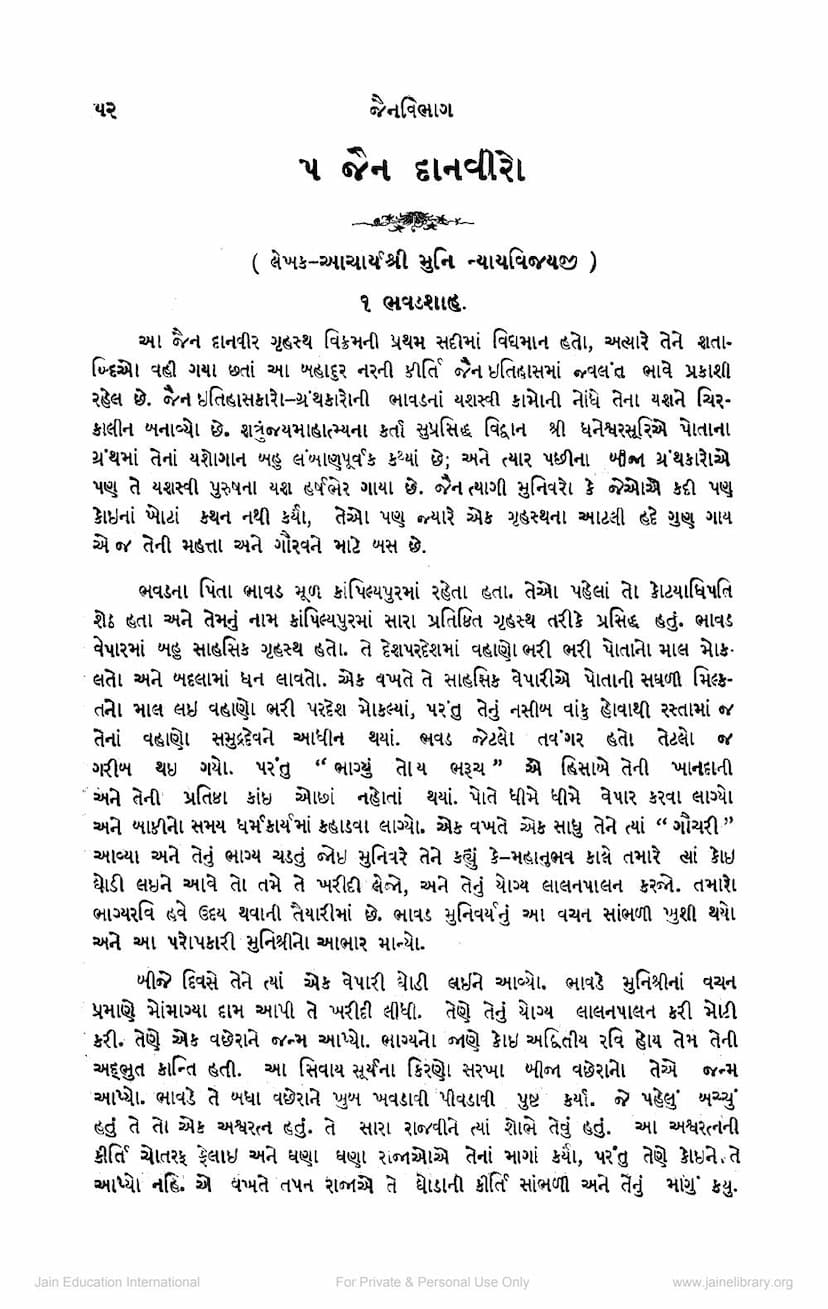
- Early Life and Misfortune: Bhavadshah lived in the first century of Vikram era. He was the son of Bhavad, a prosperous merchant in Kapilipura, known for his adventurous trade across countries. Bhavad's fortunes took a turn when all his ships carrying goods were lost at sea, rendering him bankrupt. Despite his financial ruin, his nobility and reputation remained intact. He began to trade on a smaller scale and dedicated his remaining time to religious activities.
- Divine Intervention and Rise to Prosperity: A Jain monk visited Bhavad and predicted a turn in his fortune, advising him to buy a particular mare. Following the monk's advice, Bhavad bought the mare, which gave birth to exceptional colts, resembling the sun's rays. One of these colts was an exceptional horse. King Tapan purchased this horse for three lakh rupees, marking the beginning of Bhavad's resurgence.
- Royal Recognition and Service: Bhavad gifted other offspring of the mare to King Vikram. In return, King Vikram appointed him as the ruler of twelve villages, including Madhumati (Mahuva). Bhavad, demonstrating great intelligence and skill, managed the kingdom like a seasoned ruler, surpassing his father's administrative capabilities.
- Bhavad's Legacy and the Great Bhavad: Bhavad had a son named Bhavad (the main protagonist of this section), born to his wife Bhavala. Bhavad married Sushila. After Bhavad's passing, his son Bhavad took over the administration, ruling with justice and integrity. He improved the lives of his subjects by constructing wells, step-wells, and ponds.
- Conquest and Devotion: Bhavad was captured by the Mughal army. However, he was treated with generosity by the Mughal emperor and was allowed to practice his religious duties. Jain monks visited him, and upon hearing about the glory of Shatrunjay Tirth, he became eager to undertake its restoration.
- Restoration of Shatrunjay: Through intense fasting and divine aid from Chakreshwari Devi, Bhavad obtained a beautiful idol of Lord Adinath from Takshashila. He brought it to Madhumati by sea. Upon arriving at Shatrunjay with Acharya Vrajswami and a large congregation, Bhavad purified the mountain with milk. However, a hostile deity initially prevented the installation of the new idol. Acharya Vrajswami intervened, pacified the deity, and with the help of the new divine presence, established the idol in a grand new temple.
- Martyrdom and Legacy: During the flag-hoisting ceremony after the idol's installation, Bhavad and his wife Sushila, overwhelmed with joy and devotion, were so filled with spiritual ecstasy that their hearts burst, and they ascended to heaven. Bhavad's generosity mirrored his father's, as he liberally spent wealth on poets, bards, beggars, and the poor, demonstrating immense charitable spirit.
2. Khemāderāṇī:
- The Great Famine and Khemā's Role: During the reign of Muhammad Begada, Gujarat faced a severe famine. Khemā Derāṇī, a resident of Hadala, played a crucial role in sustaining the people by providing free food for an entire year, thus upholding the prestigious title of "Shah" for the Vaniyas (merchants).
- The Tale of Jagadu Shah and the Bard: The narrative recounts an incident involving a bard named Bambha. While praising the merchant community, the bard attributed their noble qualities to their ancestors, particularly Jagadushah, who had provided relief during a devastating famine in Samvat 1315 (the "Pandherottara" famine). This praise angered the king, who summoned the bard.
- The Challenge and the Merchants' Pledge: The bard explained that he was merely reciting the historical deeds of Jagadushah, who was known for his immense generosity and acts of salvation during the famine. This explanation further incensed the king. The merchants, led by Nagarseth Champashi Mehta, realized the gravity of the situation. They pledged to prove their lineage's generosity by providing food to the populace for a year.
- The Collective Effort and Khemā's Intervention: To fulfill the pledge, the merchants pooled their resources, dividing the responsibility for each day of the year. For the remaining days, they sought help from the affluent merchants of Patan and Veraval. While traveling, they encountered Khemā Derāṇī in Hadala.
- Khemā's Humility and Generosity: Khemā, clad in simple clothes, humbly requested the merchants to accept his hospitality. Impressed by his sincerity and the significance of their mission, the merchants agreed to dine at his home. Khemā hosted them with extraordinary hospitality, serving elaborate meals.
- Khemā's Pledge and Royal Recognition: Khemā, upon learning about their mission and seeing his name on their list, offered to bear the expenses for 360 days, exceeding the merchants' expectations. His father, a man of immense generosity, encouraged him to seize this opportunity to uphold their lineage's honor. Khemā's selfless act and humility deeply impressed everyone, including Nagarseth Champashi Mehta, who acknowledged Khemā as the true benefactor.
- Fulfilling the Pledge and Royal Decree: The merchants, accompanied by Khemā, presented themselves to the king. Khemā pledged to provide food for the entire year. The king, surprised by Khemā's simple attire and humble demeanor, inquired about his wealth. Khemā explained his two villages, "Pali" and "Pali," signifying giving and receiving. This witty response pleased the king immensely. Consequently, the king not only accepted Khemā's pledge but also honored the entire merchant community. This event solidified the saying, "One Shah the Vaniya, another Shah the Emperor." Khemā's generosity, humility, and service during the famine saved Gujarat and preserved the reputation of the merchant community. He passed away after undertaking a pilgrimage to Shatrunjay.
3. Jagadushah:
- The Great Famine of Samvat 1315: Jagadushah was a prominent figure in the 14th century. During the severe famine of Samvat 1315, which affected numerous regions across India, Jagadushah exemplified immense generosity.
- Philanthropic Efforts: Born in Bhadreshwar, Kutch, to Saha and Keti, Jagadushah discovered hidden wealth, which he used to alleviate poverty. He generously distributed food from his granaries to kings of various regions, including Sindh, Ujjain, Delhi, Kandahar, and Patan. He is credited with distributing an astonishing 999,000 "muda" (measures) of grain.
- Public Welfare Institutions: Jagadushah established 112 public charity kitchens, where daily, an estimated one lakh people received sustenance. He also gifted 18 crore "dramma" (coins) to the needy. His unparalleled generosity earned him the title of "Kubera of Gujarat."
- Religious Contributions: Beyond his social welfare, Jagadushah was deeply devoted to Jainism. He commissioned the construction of 108 Jain temples and undertook grand pilgrimages to Shatrunjay three times. He also built the magnificent temple at Bhadreshwar, though remnants of it are no longer visible.
- The Legend of Khelā Dungri: The text also includes a legend about Jagadushah from the "Kathiawar Sarvasangrah." It describes how, after his ships were wrecked near Khelā Dungri, he performed severe penance to appease the deity Harshad Mata (Mahakali). The deity agreed to relocate from the hill to the foothills upon the sacrifice of a buffalo at each step. Jagadushah, in his devotion, sacrificed his wife, children, and finally himself to fulfill the deity's demand. Impressed by his ultimate sacrifice, the goddess revived them and blessed his lineage to remain eternal. This story highlights Jagadushah's profound love and selfless dedication to humanity and his faith.
In essence, "Jain Danviro" celebrates these extraordinary individuals who, through their immense wealth, unwavering faith, and profound compassion, made lasting contributions to society, embodying the Jain principles of generosity, charity, and spiritual devotion.