
Is There Room For God In Jainism
Added to library: September 1, 2025
Summary
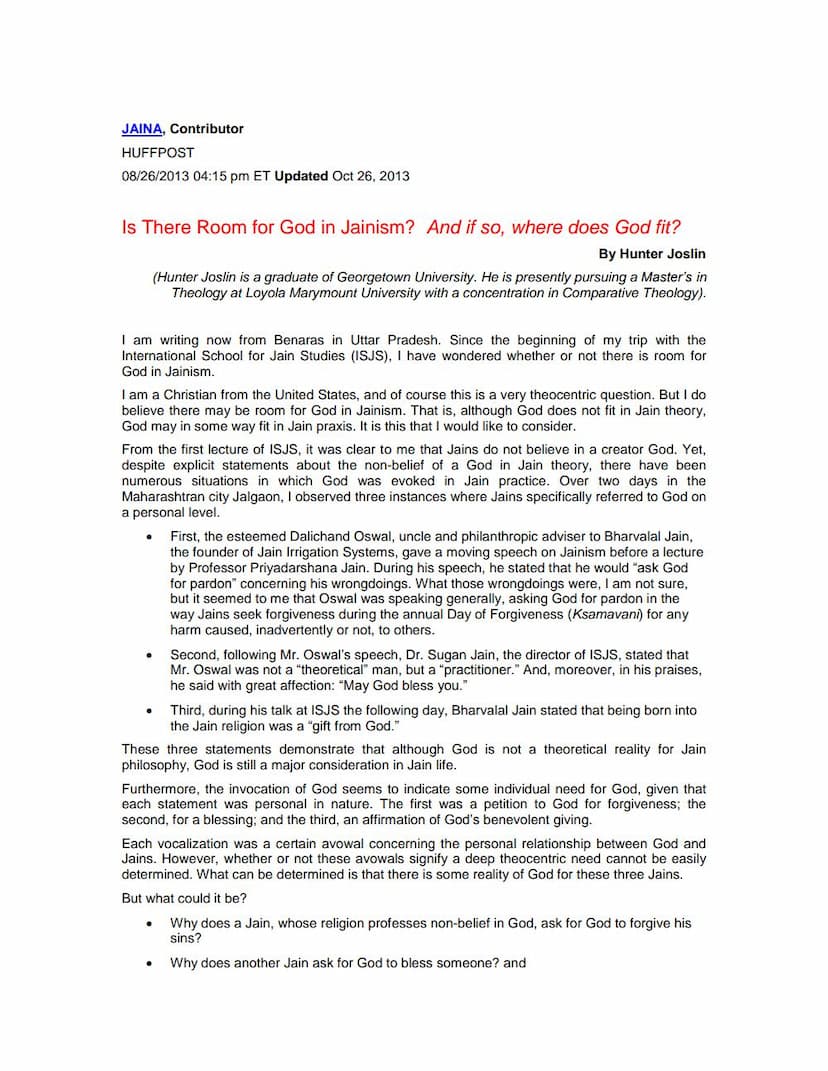
Here's a comprehensive summary of Hunter Joslin's article, "Is There Room for God in Jainism? And if so, where does God fit?":
Hunter Joslin, a Christian pursuing a Master's in Theology, explores the apparent paradox of God's presence in Jainism, a religion that, in theory, does not believe in a creator God. While studying with the International School for Jain Studies (ISS) in India, Joslin observed several instances where prominent Jains invoked God in personal and meaningful ways, leading him to question whether God, though absent in Jain theology, might find a place in Jain practice.
Joslin recounts three specific examples:
- Dalichand Oswal asked "God for pardon" for his wrongdoings, which Joslin interprets as a parallel to the Jain practice of seeking forgiveness during Ksamavani.
- Dr. Sugan Jain, Director of ISJS, praised Oswal by stating, "May God bless you," implying a belief in God's ability to bestow blessings.
- Bharvalal Jain, founder of Jain Irrigation Systems, referred to his birth into the Jain religion as a "gift from God," suggesting divine benevolence.
These instances, Joslin argues, suggest that for these individuals, God is a reality capable of forgiveness, blessing, and gifting, indicating a personal relationship and a need for God, even if this contradicts theoretical Jain doctrine.
Joslin proposes several explanations for this phenomenon:
- Linguistic Idiom: The references to God might simply be common, idiomatic expressions without a deep theological implication.
- Personal Belief in a Non-Creator God: These Jains might personally believe in a supreme being, but not one who actively intervenes in human affairs as a creator. However, Joslin counters that the specific acts mentioned (forgiveness, blessing, gifting) imply active involvement.
- Subconscious Need for God: Joslin, from his Christian perspective, leans towards this explanation, suggesting a basic human need for a divine presence that transcends purely philosophical reasoning. He draws a parallel to the Christian emphasis on moving from "head to heart" and from logic to faith.
Joslin then delves into the theoretical underpinnings of Jainism to understand its stance on God. He acknowledges that Jainism is generally considered atheistic because it rejects the concept of a creator God. However, he distinguishes Jainism from purely materialistic traditions like Charvaka. Jainism's core tenets, according to Joslin, include:
- The Soul (Ātma): Every living being possesses a soul.
- Liberation (Moksa): The goal is to liberate the soul from karmic bondage through right belief, right knowledge, and right conduct (the "three jewels").
- Karma: A fundamental law that governs actions, leading to meritorious or demeritorious outcomes and influencing rebirth in heavenly or hellish realms.
While the karmic law is described as impartial and without divine grace or supernatural intervention, Joslin argues that it is fundamentally evaluative. This inherent morality, which directs individuals towards a "higher good" and a state of liberation, can be interpreted as a form of "Jain theism" in practice, even if not in theory. This ethical framework, which distinguishes good from bad actions, suggests an underlying ideal or ultimate reality that governs moral order.
Ultimately, Joslin concludes that while Jainism may reject a creator God in its theoretical framework, there appears to be room for God in Jain practice, particularly in the personal lives and experiences of its adherents. He suggests that the question might not be if there is room for God, but rather if there is room for a personal God in the hearts of Jains. The examples he provides suggest a desire or value placed on God that transcends purely rational understanding, hinting at a deeply felt, albeit unconventionally expressed, connection to the divine.