
Is There An Inner Conflict Of Tradition
Added to library: September 1, 2025
Summary
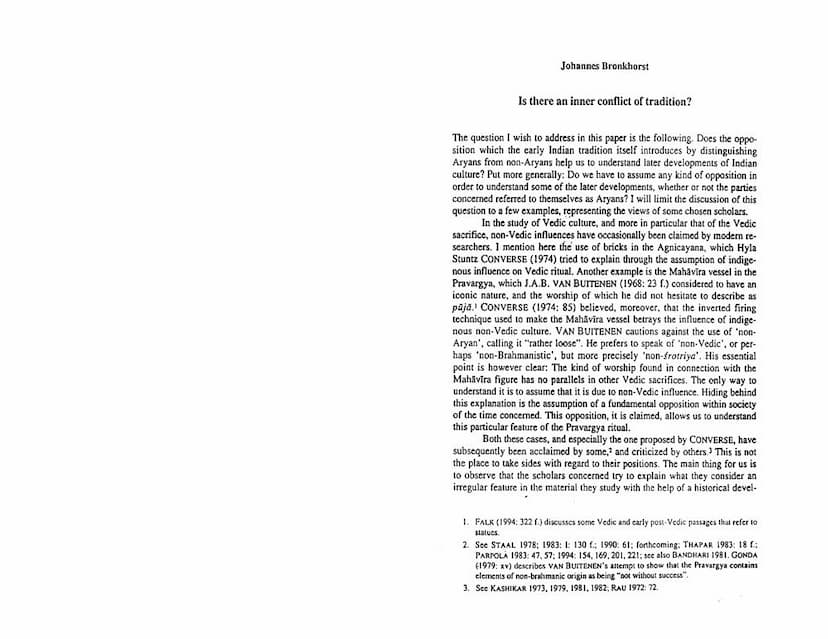
This paper, "Is There An Inner Conflict Of Tradition?" by Johannes Bronkhorst, explores whether inherent oppositions within early Indian traditions, particularly between "Aryans" and "non-Aryans," are essential for understanding later Indian cultural developments. Bronkhorst examines scholarly attempts to explain perceived "irregular features" in Vedic culture by positing external, non-Vedic influences.
The paper first discusses the use of bricks in the Agnicayana ritual and the Mahāvīra vessel in the Pravargya, where scholars like Hyla Converse and J.A.B. Van Buitenen suggested indigenous, non-Vedic influences due to the unique nature of these elements compared to other Vedic sacrifices. Bronkhorst notes that these historical reconstructions are speculative but highlights the general principle of explaining anomalies through borrowings from different contexts. He also touches upon the idea that the Asuras, enemies of the gods in Vedic lore, might be linked to the non-Vedic population, citing the Satapatha Brāhmana passage and scholarly interpretations suggesting a hybrid Vedic culture.
The core of the paper then shifts to the emergence of new religious and philosophical ideas in late Vedic literature, specifically the doctrines of karma and reincarnation. Bronkhorst questions whether an opposition between different communities explains these innovations, or if no such assumption is needed. He discusses the influential thesis of Louis Dumont, who posits a fundamental opposition between the "renouncer" and the "man in the world" as the driving force behind Indian innovations, particularly in the transition from the late Vedic period to Buddhism and Jainism. Dumont argues that renouncers, detached from societal constraints, were responsible for religious advancements. Bronkhorst, however, scrutinizes Dumont's theory, pointing out that it primarily concerns the remote past and is based on philological analysis rather than contemporary observation. He also questions whether renouncers were truly free from constraints, referencing the elaborate rules of Buddhist monks.
Bronkhorst then introduces the perspective of J.C. Heesterman, who also believes in conflict as an explanatory factor but defines it as an "inner conflict" inherent within traditions, rather than between distinct groups. Heesterman sees the karma doctrine as a development of Vedic sacrifice and renunciation as an internal evolution of Vedic thought, not necessarily an import from outside. Bronkhorst contrasts this with the possibility that the conflict might indeed be embodied in physically distinct groups, specifically mentioning the non-Vedic population.
The paper further explores the distinct spiritual aims of ascetics in early post-Vedic literature. Bronkhorst notes that some ascetics sought heaven (svarga) and were linked to the Vedic tradition, while others sought liberation from rebirth (moksha) and, in the earliest texts, seemed less connected to Vedic sacrificial traditions. This distinction, he suggests, could point to different origins and traditions.
Bronkhorst then delves into the work of Kenneth G. Zysk on early Indian medicine, arguing that Ayurveda's roots are not in Vedic medical practices but in the Sramana tradition. Zysk suggests that medical specialists, shunned by Vedic society, gravitated towards Sramanas, leading to a paradigm shift in medicine. Bronkhorst aligns this with Dumont's idea of ascetics driving intellectual revolutions but raises the crucial question of whether these ascetics were renouncers because of their new ideas or if they came from social backgrounds where such ideas already existed. He uses evidence from Strabo's Geography, as analyzed by Zysk, to suggest that both Vedic and non-Vedic ascetics existed, practicing different forms of healing. Vedic ascetics practiced "magico-religious" healing, while non-Vedic ascetics were associated with an "empirico-rational" approach, akin to classical Ayurveda. This distinction, Bronkhorst argues, supports the idea that social background determined the type of healing practiced and that two traditions of healing co-existed in different segments of society.
The paper concludes by considering Erich Frauwallner's theories on the development of Indian philosophy, which also posited explanatory oppositions. While acknowledging criticisms of Frauwallner's specific claims, Bronkhorst finds merit in the idea that the origins of key Indian philosophical schools (Samkhya, Buddhism, and Vaiseșika) can be traced to the non-Vedic population where the concepts of karma and rebirth were prevalent. He emphasizes that while ideas began to cross over and influence each other in later periods, a division between Vedic and non-Vedic segments of society likely existed in the late Vedic period, underpinning these fundamental differences.
Ultimately, Bronkhorst concludes that while the exact relationship between "Aryan" and "non-Aryan" oppositions and later Indian cultural developments remains uncertain, it is clear that fundamental differences existed between at least two segments of the late Vedic population. He suggests that the "magico-religious" nature of Vedic thought might have been a consciously cultivated approach, differentiating the Vedic segments from others who thought differently. The paper thus leans towards the idea that distinct societal groups with differing worldviews played a significant role in shaping Indian traditions.