
Interpreting Vakyapadiya Historically
Added to library: September 1, 2025
Summary
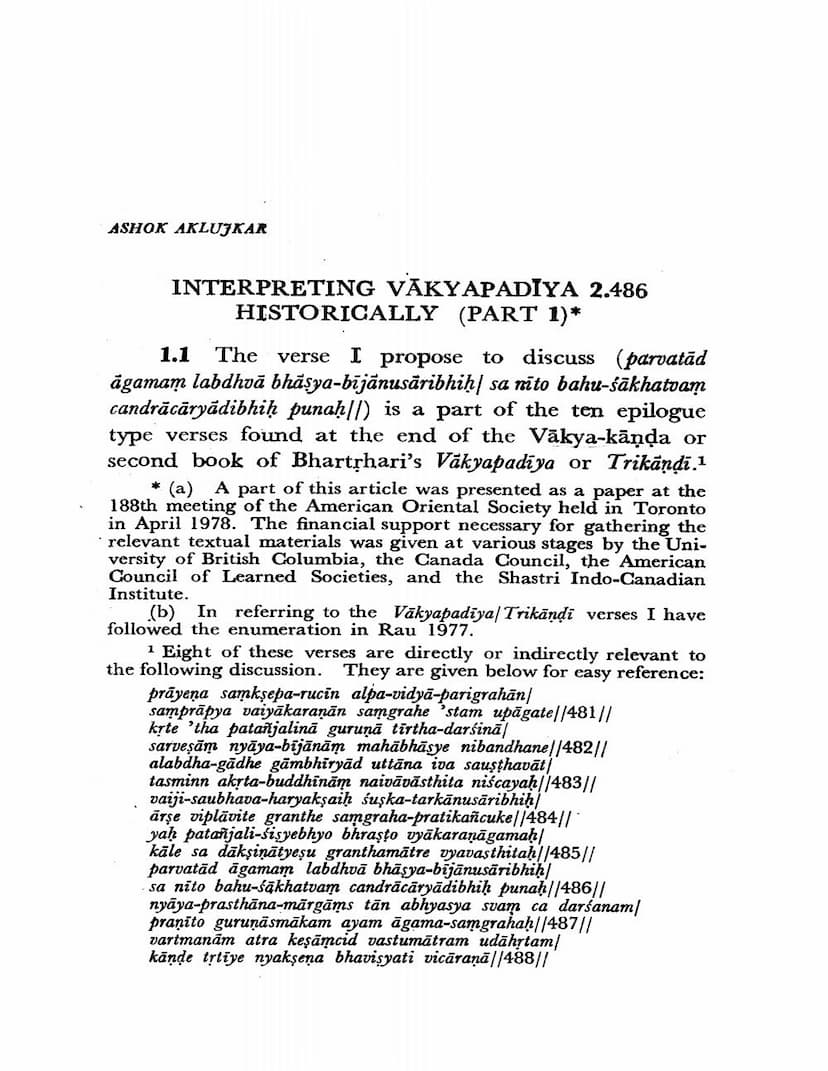
Here's a comprehensive summary of the provided text, "Interpreting Vākyapadīya Historically (Part 1)" by Ashok Aklujkar, focusing on the analysis of verse 2.486 of Bhartṛhari's Vākyapadīya:
The article aims to provide a historical interpretation of verse 2.486 of Bhartṛhari's Vākyapadīya, which is part of a group of ten epilogue-type verses. The author, Ashok Aklujkar, begins by clarifying his approach:
- Authorship: While Aklujkar has previously argued that these ten verses were not written by Bhartṛhari but by a student, this conclusion is not a prerequisite for the current analysis. The historical importance of the verses remains regardless of their direct authorship.
- Historical Interpretation: A historical interpretation, for Aklujkar, means attempting to detach the verse from mythological or superstitious interpretations found in commentaries (like the Ṭikā) and elsewhere. The goal is to find a common-sense, contextually defensible meaning, acknowledging that this meaning might not reflect precisely what historically occurred. The value lies in understanding what learned individuals viewed as history at the time.
The core of the article is an attempt to answer specific questions regarding verse 2.486:
"pratād āgamam labdhvā bhāsya-bījānusāribhiḥ| sa nīto bahu-sākhatvam candrācāryādibhiḥ punaḥ||"
The author focuses on answering question (a): What was the nature of the activity referred to by āgamam labdhvā (acquiring āgama)?
Key Issues and Analysis:
-
Grammatical Problem in 2.486: Aklujkar highlights a perceived strangeness in the phrasing "āgamam labdhvā sa bahu-śākhatvam nītaḥ." He compares it to other constructions where a pronoun ("saḥ") seems unnecessary. While he considers emending the text, he ultimately decides against it due to the consistent manuscript evidence and the possibility that the "saḥ" is used for stylistic emphasis or to refer back to the vyākaraṇāgama (grammatical tradition) mentioned in the previous verse (485). He explores two syntactic solutions for the construction:
- (a) Intervening Expressions: The "saḥ" refers back to the vyākaraṇāgama mentioned earlier, with the phrase "bhāsya-bījānusāribhiḥ" (following the seeds of the commentary) acting as an intervening element. This is seen as a plausible, if slightly loose, grammatical construction.
- (b) Different Entities: The āgama and saḥ refer to different entities. This interpretation is favored by the Ṭikā (commentary).
-
The Ṭikā's Interpretation: The Ṭikā (attributed to Punya-rāja or Helārāja) interprets āgamam as referring to a "mūla-bhūta vyākaraṇāgama" (fundamental grammatical tradition) and saḥ as the vyākaraṇāgama lost by the successors of Patañjali. According to this view, Candrācārya and others rediscovered this fundamental tradition, studied the intimations (nyāya-bijāni) in the Mahābhāṣya, and thereby revived a multifaceted grammatical tradition.
-
Critique of the Ṭikā's Interpretation: Aklujkar finds several problems with the Ṭikā's view:
- Unqualified Use of Āgama: It's unlikely the author would use the general term āgama for a specific "mūla-bhūta vyākaraṇāgama" without further qualification, especially when āgama in the preceding verse refers to the vyākaraṇāgama in general.
- Sequence and Transition: The Ṭikā's interpretation implies a sudden shift in reference from the vyākaraṇāgama in verse 485 to a "mūla-bhūta" āgama, which would ideally require a transitional verse.
- Lack of Corroboration: The concept of an eternal but inaccessible fundamental grammatical tradition isn't corroborated elsewhere in Sanskrit literature.
- Ambiguity and Contradiction: The Ṭikā's explanation doesn't clarify how Candrācārya's acquisition of the mūla-bhūta āgama relates to the vyākaraṇāgama grantha (manuscript) mentioned in verse 485, which was preserved only in the South. If they acquired the latter, it makes the "mūla-bhūta" distinction problematic.
-
Aklujkar's Preferred Interpretation of Āgamam Labdhvā: Aklujkar leans towards the syntactic solution (a), suggesting that "acquiring āgama" refers to a process of intellectual recovery and interpretation. This involves:
- Culling: Collecting the relevant vyākaraṇāgama bearing on the Mahābhāṣya from various works preserved in the South.
- Interpretation/Exegesis: Making sense of these collected texts, which had ceased to be properly studied.
- This activity is described as collation and exegesis, involving both gathering scattered written records and interpreting them based on the principles found in the Mahābhāṣya. The goal was to revive a robust tradition of grammatical thought.
-
The Role of Parvatāt: The word parvatāt (from the mountain) in the verse is interpreted not as a literal mountain, but as indicating a region in the South where the written sources for the āgama had become scarce. This implies Candrācārya and his associates visited this region and made a thorough search, not necessarily that the acquisition happened at multiple distinct places.
-
Comparison with the Rāja-tarangiṇī: Aklujkar notes that a similar passage in the Rāja-tarangiṇī suggests Candrācārya's work made the Mahābhāṣya academically current and attractive to students, supporting his interpretation of the āgama being instrumental in revitalizing the study of the Mahābhāṣya.
-
Reasons for Preferring His Interpretation: Aklujkar lists several reasons why his interpretation is superior to the Ṭikā's:
- It aligns with the context of verses 481-485.
- It avoids supernatural events or persons.
- It doesn't assume an unsubstantiated, hidden, permanent āgama.
- It avoids a sudden shift in the meaning of āgama.
- It is consistent with the Rāja-tarangiṇī passage.
- It reflects the Mahābhāṣya-centric nature of Bhartṛhari's own work, as the recovered āgama was valuable for understanding the Mahābhāṣya.
- It is historically plausible, as the South was known to preserve older works lost in the North.
-
Conclusion on Āgamam Labdhvā: The activity of "acquiring āgama" refers to the recovery and intellectual resuscitation of nearly-lost grammatical works and fragments thereof, particularly those relevant to the Mahābhāṣya. This involved diligent search and understanding of pre-Patañjali scholarship and its influence. The story of Candrācārya, in this view, was originally a tale of intelligent effort against great odds, which likely became mythologized over time.
In essence, Aklujkar seeks to demythologize the process described in verse 2.486, presenting it as a significant intellectual endeavor of collecting and interpreting lost grammatical knowledge, crucial for the preservation and continuation of the Pāṇinian tradition. He emphasizes separating the author's perspective from later commentary.