
Interpreting Vakyapadiya 2486 Historically
Added to library: September 1, 2025
Summary
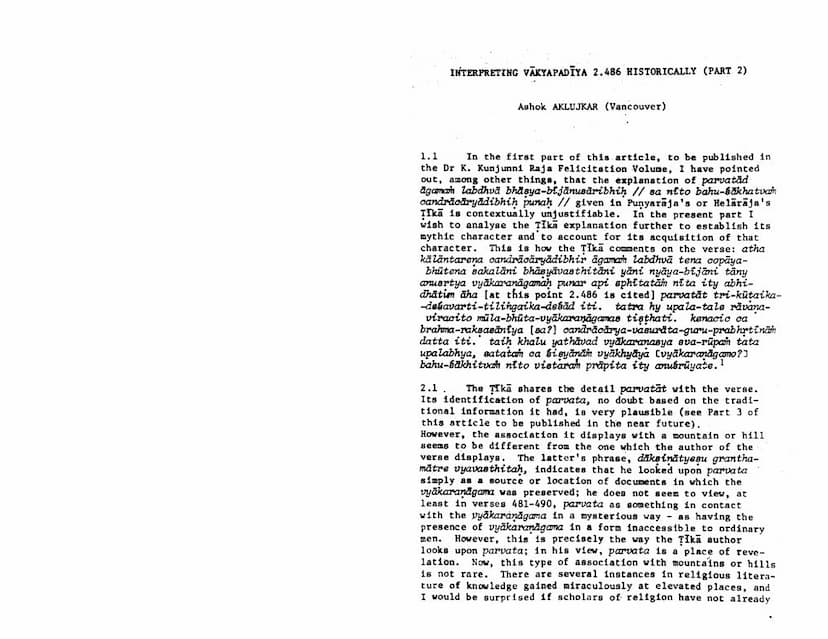
This article by Ashok Aklujkar, "Interpreting Vakyapadiya 2.486 Historically (Part 2)," delves into the commentary (Tika) on verse 2.486 of the Vakyapadiya and argues that the explanation provided in the Tika has acquired a "mythic character" due to various historical and cultural influences.
Here's a breakdown of the key points:
1. Critique of the Tika's Explanation:
- Aklujkar begins by stating that the explanation of the verse in the Tika (attributed to Punyaraja or Helaraja) is "contextually unjustifiable." He aims to further analyze this explanation to demonstrate its mythical nature.
- The Tika associates the verse's mention of "parvata" (mountain) with the preservation and revelation of the vyakaranagama (grammar tradition) on a rock surface, attributing its composition to Ravana and its transmission to a brahma-raksasa.
2. The Mythic Character of the Tika's Explanation:
Aklujkar identifies several factors contributing to the mythicization of the Tika's interpretation:
- Mountain as a Place of Revelation: The Tika views the mountain not just as a location for documents, but as a sacred place of divine revelation, similar to how knowledge is miraculously acquired in elevated places in other religious literature. This is compared to the story of Joseph Smith, the founder of Mormonism, who received revelations on a hill.
- Influence of Contemporary Factors (10th-12th Centuries):
- Interest in Rock Inscriptions: This era saw significant interest in rock and stone inscriptions. Aklujkar suggests that in an environment where literature was being inscribed on stone to prevent loss, the Tika author (or his predecessors) might have believed that ancient texts, if preserved for a long time, must have been inscribed on rock.
- Loss of Script Knowledge: The decline in the knowledge of ancient scripts by the end of the first millennium AD could have led people to view old inscriptions as containing secret, mysterious messages decipherable only through extraordinary experiences. This tendency might have been amplified if the "parvata" was identified with Sri-parvata, known for miracles and extraordinary beings.
- Kashmir Saivism Influence: The Tika's account shares structural similarities with the revelation story of the Siva-sutras to Vasugupta on Maha-deva-giri. This story, prevalent in Kashmir Saivism (a tradition likely familiar to the Tika author), features a revelation received from a divine being after being advised in a dream to acquire secret doctrine written on a great rock. The similarity is further highlighted by the word "upala" (stone/rock) appearing in both narratives.
- Ravana as Author and Transmission: The Tika attributes the mula-bhata vyakaranagama to Ravana and its transmission to a brahma-raksasa. Aklujkar argues this aligns with the broader literary tendency to attribute many works to Ravana, often conflating the historical Ravana with the mythical figure. Ravana's description as a learned but morally fallen Brahmin (a brahma-raksasa) is consistent with this attribution. This is also paralleled by traditions where grammarians like Bhattoji Dikshita become brahma-sanandhas (a Marathi equivalent of brahma-raksasa) to instruct others.
- Cyclical View of Knowledge: The Tika's characterization of the agama as mula-bhuta (fundamental) reflects an Indian cultural tendency to view knowledge and the universe as evolving and dissolving cyclically, originating from and returning to a subtle source. Grammar is thus seen as a body of knowledge that can be reorganized by referencing this original source.
3. The Tika Author's Role:
Aklujkar emphasizes that the author of the Tika is not the originator of this mythologized narrative. Instead, they are connecting pre-existing traditional information with the verse, as indicated by the word "anubruyate" (it is said/heard) in the Tika's explanation.
In essence, Aklujkar argues that the Tika's explanation of Vakyapadiya 2.486 is not a straightforward historical account but a complex interpretation shaped by:
- Religious and Mythological Traditions: The concept of mountains as sites of divine revelation.
- Socio-Historical Context: The practice of inscribing texts on stone and the potential for misunderstanding ancient scripts.
- Inter-Religious Influence: Parallels with revelation narratives in other traditions like Kashmir Saivism and Mormonism.
- Literary Tendencies: The widespread attribution of works to figures like Ravana.
- Philosophical Frameworks: The cyclical view of creation and knowledge.
The article highlights how historical texts can be interpreted and reinterpreted, leading to the accretion of new meanings and the development of mythic layers over time.